

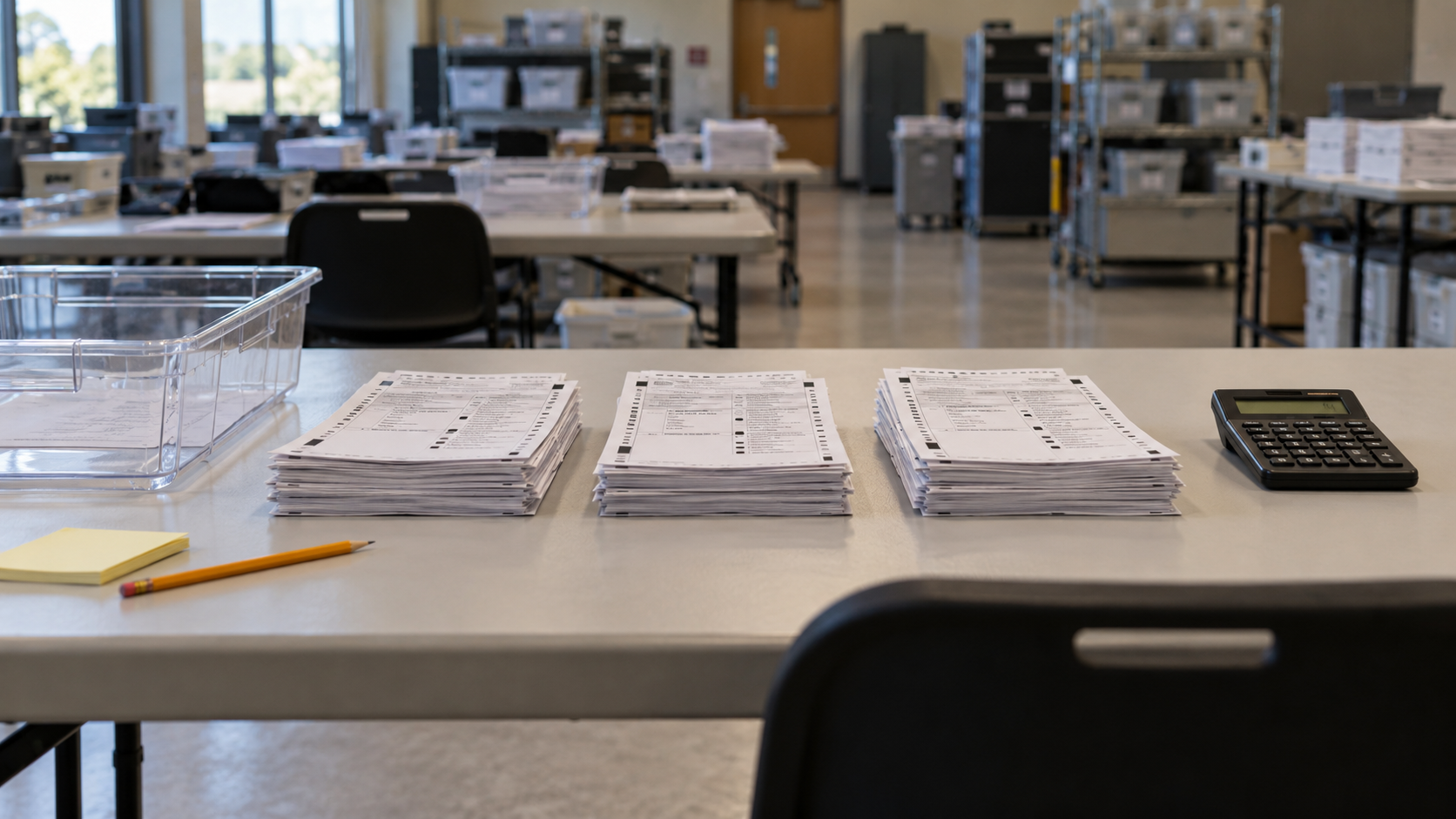
Election Audits Explainer
An election audit is a structured check of election records, procedures, or results. Post-election audits often compare paper ballots or other reliable records with reported counts to assess whether the counting system performed correctly. Their precise purpose and design vary by state and by the type of review. An audit is different from a recount of an entire contest: it may begin with a sample and address a defined question. Explaining that question is essential to understanding what the audit’s findings actually establish.
A traditional manual tally can check randomly selected precincts or batches against the original tabulation. A risk-limiting audit uses a statistical method designed to limit the chance that an incorrect reported outcome escapes correction. It examines a randomly selected sample and can expand the review when the evidence is insufficient. A close contest generally requires more evidence than a wide margin to establish the same confidence in the outcome. The important issue is the method’s ability to detect a wrong winner, rather than an arbitrary number of ballots.
Officials must preserve and organize the records that make a meaningful audit possible. Documented custody, accurate ballot inventories, public procedures, and clear standards for reading voter marks all contribute to a reliable review. Observers can help make the process understandable while respecting security and voter privacy. Different laws place audits at different points in the election timeline. For example, California provides a manual-tally requirement and a risk-limiting audit pilot, illustrating why a procedure used in one state should not be described as the national rule.
An audit’s conclusion is limited by its scope and the quality of its evidence. Checking tabulation does not automatically settle every claim about voter eligibility, campaigning, or unrelated administrative conduct. If discrepancies appear, officials need procedures for investigating and, when required, expanding the count or correcting results. A review called an audit should therefore be evaluated by its standards, independence, records, and stated objective. Understanding those features helps readers distinguish a reproducible check of election evidence from a broad allegation or a political assertion that does not explain how it was tested.
Audits can examine different parts of an election. A result-checking audit should state the contest and records it evaluates.
A sample is meaningful when chosen and analyzed under a sound method. A convenient selection is not equivalent to a random sample.
Risk-limiting audits can expand toward a full hand count when the available evidence does not support the reported outcome.
Reliable paper records and documented custody matter because the review must compare evidence with the original tabulation.
A tabulation audit does not necessarily address all eligibility or campaign-law allegations. Scope limits the conclusions that can be drawn.
Debate concerns audit design, timing, public access, and whether the method provides a transparent route to correcting an incorrect result.
Explore more "Explainers"
Discover additional explainers across politics, science, business, technology, and other fields. Each explainer breaks down a complex idea into clear, everyday language—helping you better understand how major concepts, systems, and debates shape the world around us.