

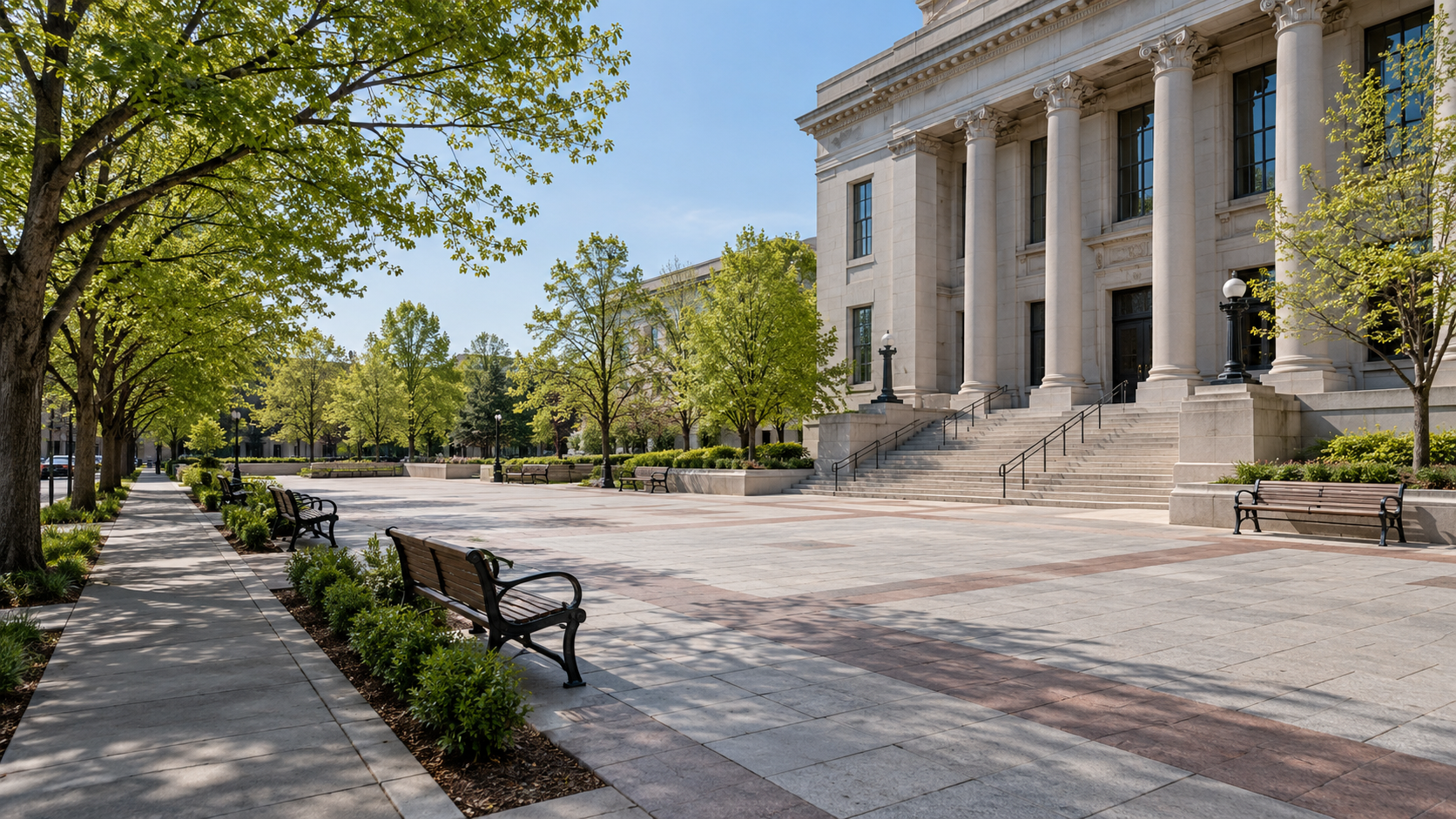
Public Forum Doctrine Explainer
Public forum doctrine is a framework courts use to assess restrictions on private expression in spaces or channels controlled by government. It connects the permitted restriction with the forum’s character and purpose. A public park, a government workplace, and a channel opened for a defined discussion do not necessarily receive identical treatment. The central idea is that government ownership alone does not make every location freely available for every kind of speech. At the same time, public officials cannot avoid constitutional scrutiny simply by describing a restriction as property management.
Traditional public forums include places, such as streets and parks, historically associated with public discussion. Government can also intentionally open a forum for broader expression, creating a designated public forum. Other arrangements are limited to defined subjects or speakers, while nonpublic forums are reserved for particular operational purposes. Courts examine policies, practices, and the nature of the space to identify the relevant category. Terminology and classification can generate difficult disputes, especially when a forum has features of more than one familiar setting.
The classification affects the standard applied to a restriction. Traditional and designated public forums receive strong speech protection, including scrutiny of content-based limits and requirements for permissible time, place, and manner rules. In limited or nonpublic settings, restrictions generally must fit the applicable reasonableness and viewpoint-neutrality requirements. The government’s decision not to create an open public forum does not give it unlimited power to discriminate among viewpoints. Identifying the precise forum and restriction is essential before deciding which legal test applies.
Consider a government facility that permits meetings only for a specified purpose. The question is not merely whether taxpayers own the building, but what access the government has created and whether its restrictions meet constitutional requirements. Debate often concerns exclusion, inconsistent rules, and how emerging communication channels should be classified. Court decisions distinguish private expression in a forum from the government’s own speech, which raises different issues. A clear explanation therefore identifies the speaker, the channel, its established use, and the particular basis for limiting access.
Forum doctrine links private speech rights with the character of government-controlled space or communication channels. Ownership is relevant but does not answer the entire question.
Traditional forums and intentionally designated forums differ from settings reserved for narrower or operational purposes. The classification determines the analysis.
Courts examine the government’s policies and practices as well as the forum’s nature. Opening access selectively does not always create a fully open public forum.
A restriction’s constitutional treatment depends on both the forum and its basis. Viewpoint discrimination can remain impermissible even where broader access is limited.
Debate concerns unclear categories and inconsistent access decisions. New communication settings can make the relationship between public ownership and expression harder to assess.
Government speech and private speech in a government forum are distinct issues. Identifying who is speaking helps avoid applying the wrong framework.
Explore more "Explainers"
Discover additional explainers across politics, science, business, technology, and other fields. Each explainer breaks down a complex idea into clear, everyday language—helping you better understand how major concepts, systems, and debates shape the world around us.