

Exclusionary Rule Explainer
The exclusionary rule is a court-developed remedy that can prevent government from using unlawfully obtained evidence in a criminal prosecution. It is closely associated with the Fourth Amendment’s protection against unreasonable searches and seizures. The rule gives constitutional limits practical consequences in the courtroom: evidence gathered through certain violations may be suppressed rather than presented to establish guilt. It does not mean every official mistake automatically defeats a prosecution, and it should be distinguished from a separate lawsuit or disciplinary action against an officer.
In Mapp v. Ohio, the Supreme Court applied exclusion for unconstitutional searches to state criminal proceedings. The rule’s development reflects concern that constitutional protections would be weakened if government could freely benefit from unlawful searches. Later decisions have emphasized deterrence and examined whether exclusion would discourage improper official conduct. This makes the remedy a separate question from whether a constitutional violation occurred. A court can identify a search problem and still need to determine whether suppression is the appropriate consequence in that particular case.
United States v. Leon recognized an exception involving objectively reasonable reliance on a warrant later found invalid. That does not give officials unlimited permission to disregard defects or mislead a judge. Davis v. United States addressed reliance on binding appellate precedent at the time of a search. Other doctrines can also affect whether evidence remains admissible. The legal inquiry therefore requires attention to the conduct, the source of the evidence, and the particular reason offered for suppression or for an exception.
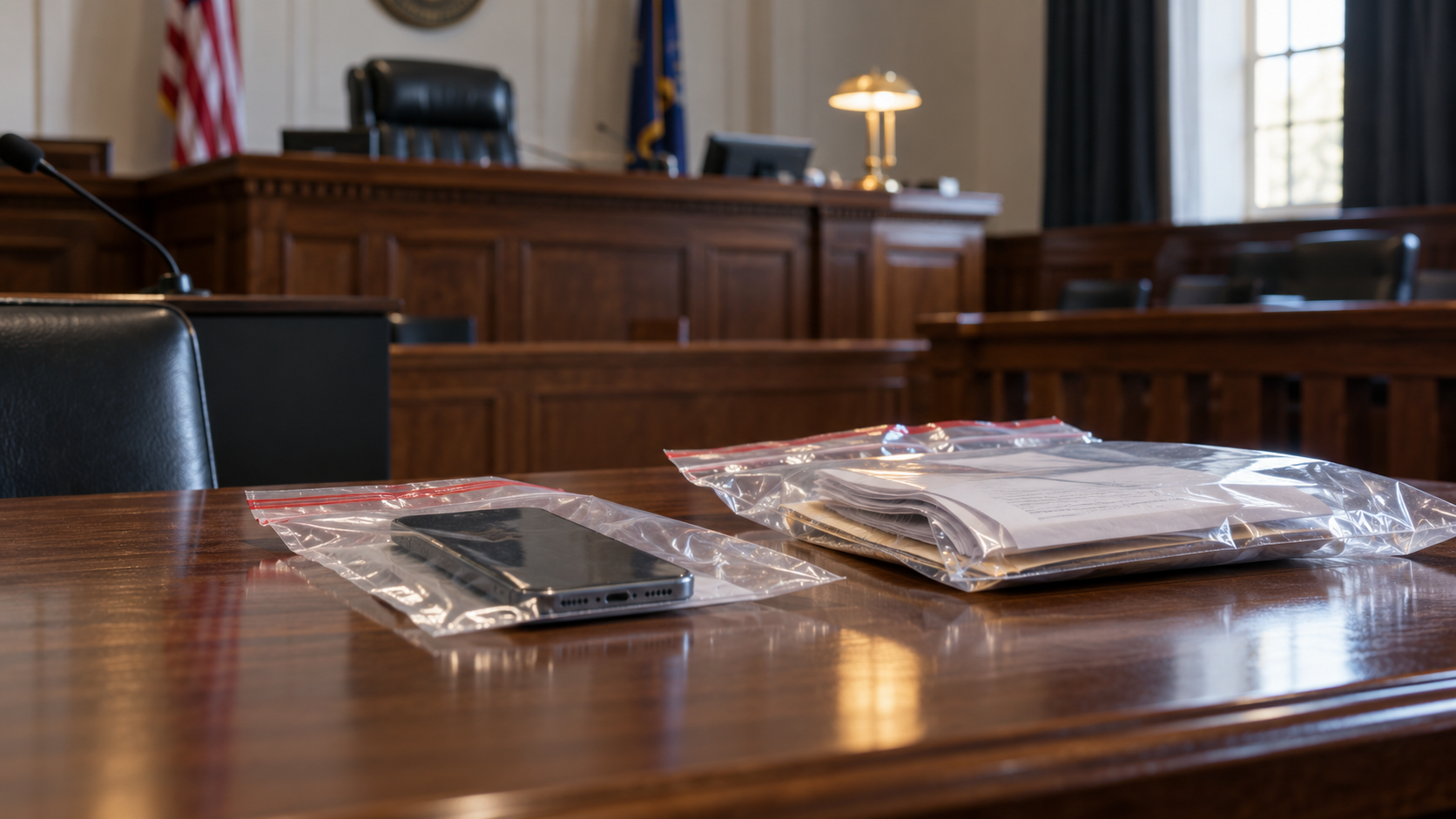
The political debate concerns the relationship between enforcing rights and deciding criminal cases using relevant evidence. Excluding important evidence can affect a prosecution, while allowing it may weaken incentives to respect constitutional boundaries. Imagine a disputed search producing a phone: the question of how officers obtained it must be considered separately from what its contents might prove. Readers should ask what right was violated, whose rights are involved, and what doctrine governs the remedy. The exclusionary rule becomes clearer when those questions are kept distinct.
The rule can suppress evidence obtained through constitutional violations. It is a remedy, rather than a finding that a defendant is innocent.
Mapp applied Fourth Amendment exclusion to state criminal proceedings. Later cases have examined the remedy’s deterrent purpose and limits.
Courts consider the violation and the suppression question separately. Identifying unlawful conduct does not automatically settle admissibility.
Leon recognized objectively reasonable reliance on certain defective warrants. The exception has limits and does not excuse every problem with an application.
Debate weighs deterrence of unlawful searches against the consequences of excluding relevant evidence. Both concerns affect discussion of the remedy.
Davis concerned reliance on binding appellate precedent. Accurate explanations should identify the particular exception instead of treating good faith as a universal answer.
Explore more "Explainers"
Discover additional explainers across politics, science, business, technology, and other fields. Each explainer breaks down a complex idea into clear, everyday language—helping you better understand how major concepts, systems, and debates shape the world around us.