

Animation Storyboarding Explainer
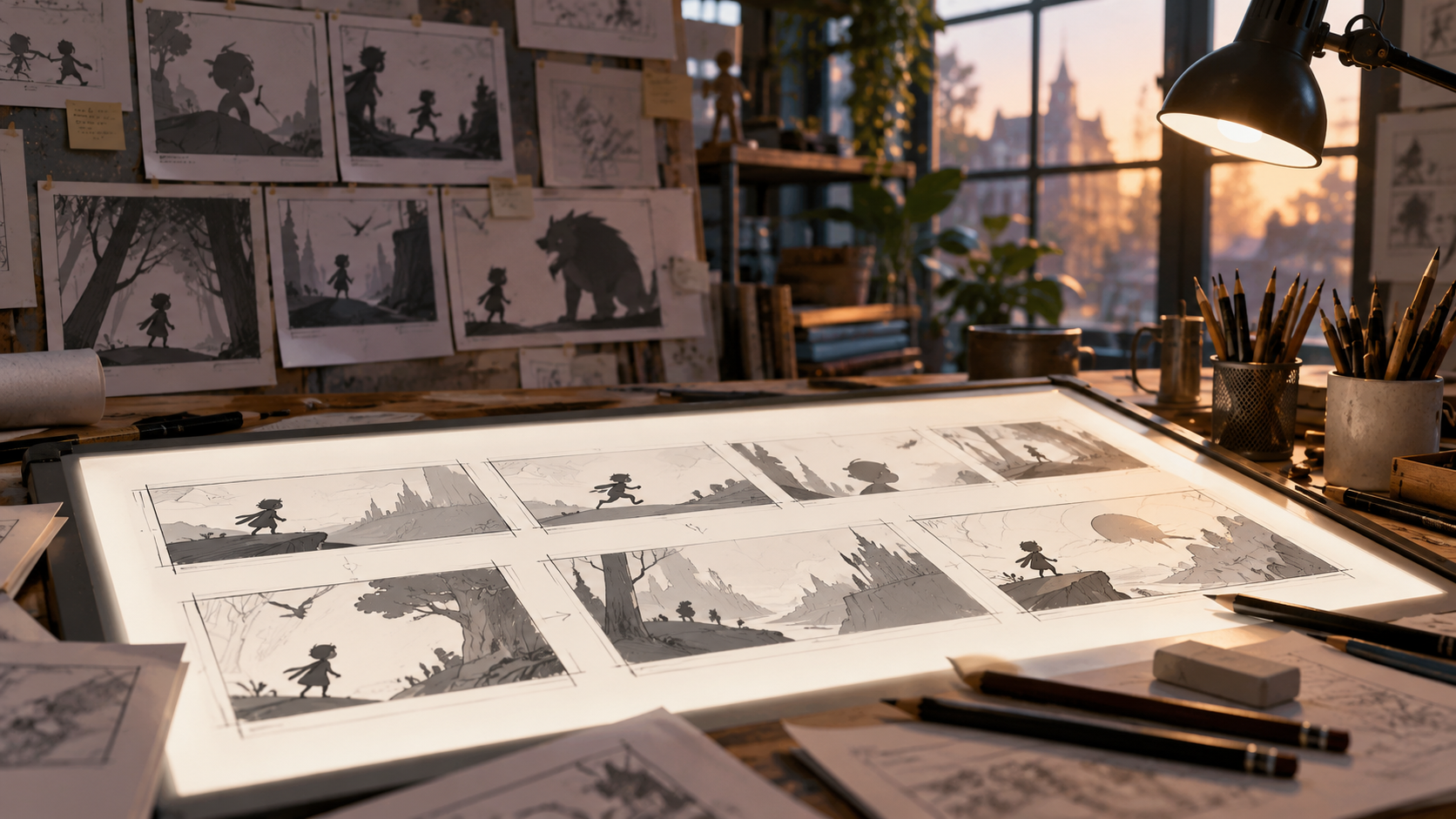
Animation storyboarding is the process of turning a script, outline, or story idea into sequential images that show how a film will unfold on screen. The Academy's educational materials describe a storyboard as small drawings and captions arranged chronologically to show action step by step and help plan structure. In professional animation, boards can also explore acting, comedy, staging, camera position, screen direction, and transitions. The drawings do not need polished illustration. Their purpose is communication: a clear pose, expression, arrow, or composition can solve a narrative problem before teams commit to expensive design, layout, animation, lighting, and rendering.
A storyboard artist breaks a scene into shots and key beats. Wide views establish geography, closer views direct attention, and changes in angle or size create emphasis. The artist tracks where characters enter, look, and move so the audience can understand spatial relationships. In some productions, artists work from a detailed screenplay; in others, especially board-driven television, storyboard teams contribute substantial dialogue and visual storytelling. Directors and story leads review sequences in pitches, ask questions, and revise. Pages or digital panels may pass through many versions as the team improves clarity, emotion, humor, and pace.
Panels become more informative when assembled into an animatic or story reel. Editors place the drawings on a timeline with temporary voices, sound effects, and music, then adjust how long each image remains. This rough movie reveals problems that individual panels cannot: a joke may need another beat, an action may be confusing, or a sequence may run longer than the production can afford. Because animation is constructed rather than captured from continuous live action, story reels can serve as an early version of the film itself. Major structural changes are far cheaper at this stage than after finished animation has begun.
Storyboards guide later departments without dictating every pixel. Layout artists refine perspective, camera movement, and scale. Character animators develop motion and performance between the selected poses. Background, effects, lighting, and compositing teams add their specialized work. Three-dimensional productions may translate boards into virtual cameras and rough blocking, while stop-motion teams use them to plan sets and frame-by-frame action. Continuity information, lens ideas, and dialogue notes may accompany panels, but the exact handoff depends on the pipeline. A storyboard is therefore both a storytelling document and a production map whose level of detail matches the team's needs. The common comparison to a comic book is useful but incomplete. Comics are finished works whose page layout and reader-controlled timing are part of the experience. Storyboards are temporary production tools intended to be revised and replaced by moving images with fixed timing. They may be rough, repetitive, and covered with notes because beauty is secondary to problem solving. Strong boards make the viewer feel what the scene should become while exposing weak logic early enough to change it. Their value lies in reducing uncertainty: a relatively small group can test an entire sequence before hundreds of later decisions make revision slower and more costly. A practical way to read or discuss Animation Storyboarding is to separate the basic definition from the choices made in a particular example. Storyboards arrange drawings in sequence to show action, structure, staging, and shot relationships before full animation. Then identify who sets the relevant rules, which parts are creative decisions, and which parts follow from law, contracts, technology, or production limits. Examples that look similar on the surface can operate differently because their purpose, audience, timing, and surrounding agreements are different. An animatic places panels on a timeline with temporary sound so the team can judge timing, clarity, emotion, and total length. It is also useful to check whether a source is describing a formal industry category, an informal critical label, or one organization's current practice. Those distinctions prevent a memorable anecdote from becoming a false universal rule. Finally, compare the visible result with the less visible work that produced it. Unlike a finished comic, a storyboard is a revisable production document designed to be replaced by the completed moving image. That approach keeps the explanation grounded while leaving room for reasonable disagreement about borderline cases.
Storyboards arrange drawings in sequence to show action, structure, staging, and shot relationships before full animation.
Artists use composition, pose, expression, arrows, and screen direction to communicate clearly without polished final art.
Storyboarding may follow a screenplay or contribute substantially to dialogue and visual storytelling in a board-driven production.
An animatic places panels on a timeline with temporary sound so the team can judge timing, clarity, emotion, and total length.
Layout, animation, backgrounds, effects, lighting, and compositing refine the work after the storyboard has established the sequence.
Unlike a finished comic, a storyboard is a revisable production document designed to be replaced by the completed moving image.
Explore more "Explainers"
Discover additional explainers across politics, science, business, technology, and other fields. Each explainer breaks down a complex idea into clear, everyday language—helping you better understand how major concepts, systems, and debates shape the world around us.