

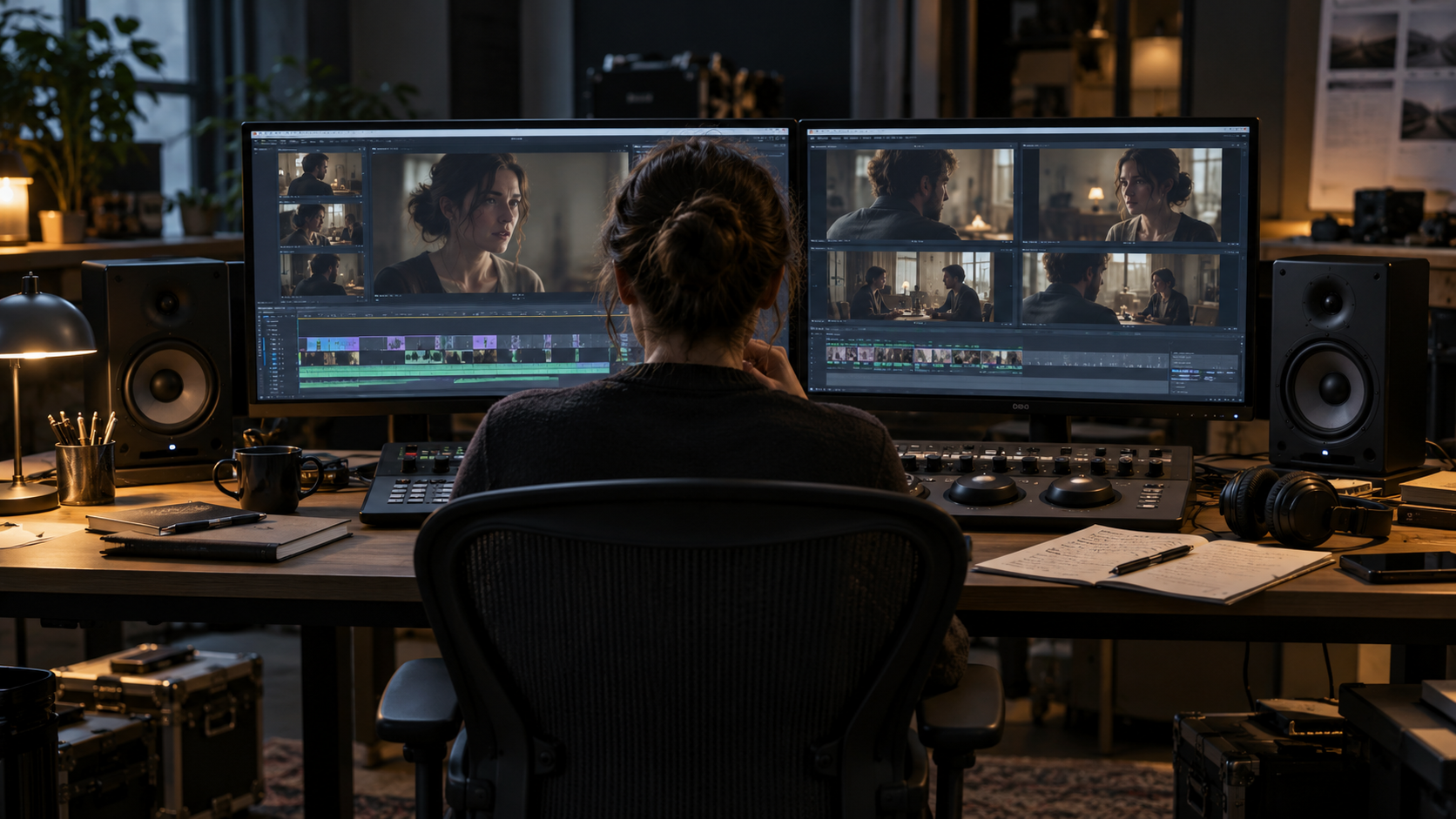
Film Editing Explainer
Film editing is the process of selecting and arranging recorded images and sounds to create the finished progression of a screen story. Productions usually shoot scenes out of narrative order and record several performances, framings, and camera angles. The editor organizes that material, chooses moments, and determines when the audience receives information. A cut can connect separate spaces, compress time, redirect attention, preserve a performance, or create an idea that was never present in any single shot.
Work often begins during production. Camera and sound files are copied, synchronized, labeled, and linked to reports from the set. Editors review daily footage, assemble scenes, and identify missing coverage or technical problems while reshoots may still be possible. Assistants manage media, metadata, versions, and communication with other departments. As scenes accumulate, an assembly becomes a rough cut. The director and editor then refine structure, performance, pace, transitions, and clarity through many versions before the picture is locked for final sound, color, and visual effects.
Continuity editing is one widely used approach, designed to make space and action easy to follow. Matching eyelines, screen direction, movement, and position can allow several shots to feel like one continuous event. But editors can break continuity deliberately to create surprise, discomfort, comedy, or abstraction. Montage can compress a process or place contrasting images in conversation. Parallel editing can make events seem simultaneous. The grammar depends on context; a visible cut is not automatically a mistake, and an invisible cut is not automatically the strongest choice.
Performance is built in the cutting room as well as on set. An editor may favor a reaction from one take, dialogue from another, and a pause from a third, provided the combination remains convincing. Holding a shot can create tension or empathy; cutting earlier can sharpen energy. Sound bridges may carry a voice or atmosphere across an image change, smoothing a transition or creating anticipation. Music and temporary sound help test rhythm, though final sound teams later rebuild and mix those elements at full quality. Editing cannot make any collection of footage into any desired story. Available angles, screen direction, actor movement, lighting changes, and recorded sound impose limits, while schedules and delivery requirements restrict experimentation. It is also a deeply collaborative phase involving directors, producers, visual-effects artists, sound editors, composers, and colorists. Viewers can study the craft by noticing what information a cut adds, removes, or delays and by asking why the scene changes perspective at a particular instant. The best answer is usually dramatic rather than purely technical. A practical way to read or discuss Film Editing is to begin with the basic definition and then identify the choices made in a particular example. Editors turn nonsequential footage into a designed viewing experience by choosing shots, performances, duration, order, and transitions. Next, ask who sets the relevant rules, who performs the work, and which results follow from creative judgment, law, contracts, technology, budget, or production limits. Similar-looking examples can operate differently because their audience, market, format, timing, and agreements are different. Continuity rules help viewers understand space, but editors may violate them intentionally when a rupture better serves emotion, comedy, suspense, or meaning. It also helps to distinguish a formal industry category from an informal critical label or one organization's current practice. That separation keeps a memorable anecdote from becoming a false universal rule. Dates and territories matter: tools, distribution systems, audience behavior, and standard agreements change, while older examples can preserve assumptions that no longer apply everywhere. When a claim sounds absolute, compare it with a second kind of source and look for the conditions under which the claim is true. Then trace the process from the visible result back through the less visible decisions, handoffs, and quality checks that produced it. A productive way to analyze editing is to ask what each cut changes: time, place, information, emotional alignment, visual energy, or the relationship between images. Finally, compare the example with a contrasting case and note which part of the definition still holds. This method keeps the explanation grounded, highlights the people and systems behind the outcome, and leaves room for reasonable disagreement about hybrid or borderline cases.
Editors turn nonsequential footage into a designed viewing experience by choosing shots, performances, duration, order, and transitions.
Daily material is synchronized, logged, and assembled during production so problems can be found before sets, actors, or locations become unavailable.
A rough cut develops through many revisions until picture lock establishes the final image sequence for sound, color, music, and effects finishing.
Continuity rules help viewers understand space, but editors may violate them intentionally when a rupture better serves emotion, comedy, suspense, or meaning.
An on-screen performance may combine parts of several takes, with reaction shots and pauses shaping how dialogue and behavior are interpreted.
A productive way to analyze editing is to ask what each cut changes: time, place, information, emotional alignment, visual energy, or the relationship between images.
Explore more "Explainers"
Discover additional explainers across politics, science, business, technology, and other fields. Each explainer breaks down a complex idea into clear, everyday language—helping you better understand how major concepts, systems, and debates shape the world around us.