

Music Videos Explainer
A music video is a moving-image work created around a musical recording. It can present a performance, tell a narrative, build an abstract visual idea, document a live setting, or combine those modes. The images do not have to illustrate every lyric. A strong concept may extend the artist's identity, create contrast with the song, or give viewers a memorable way to encounter a release. The finished video is distinct from both the underlying composition and the sound recording it uses.
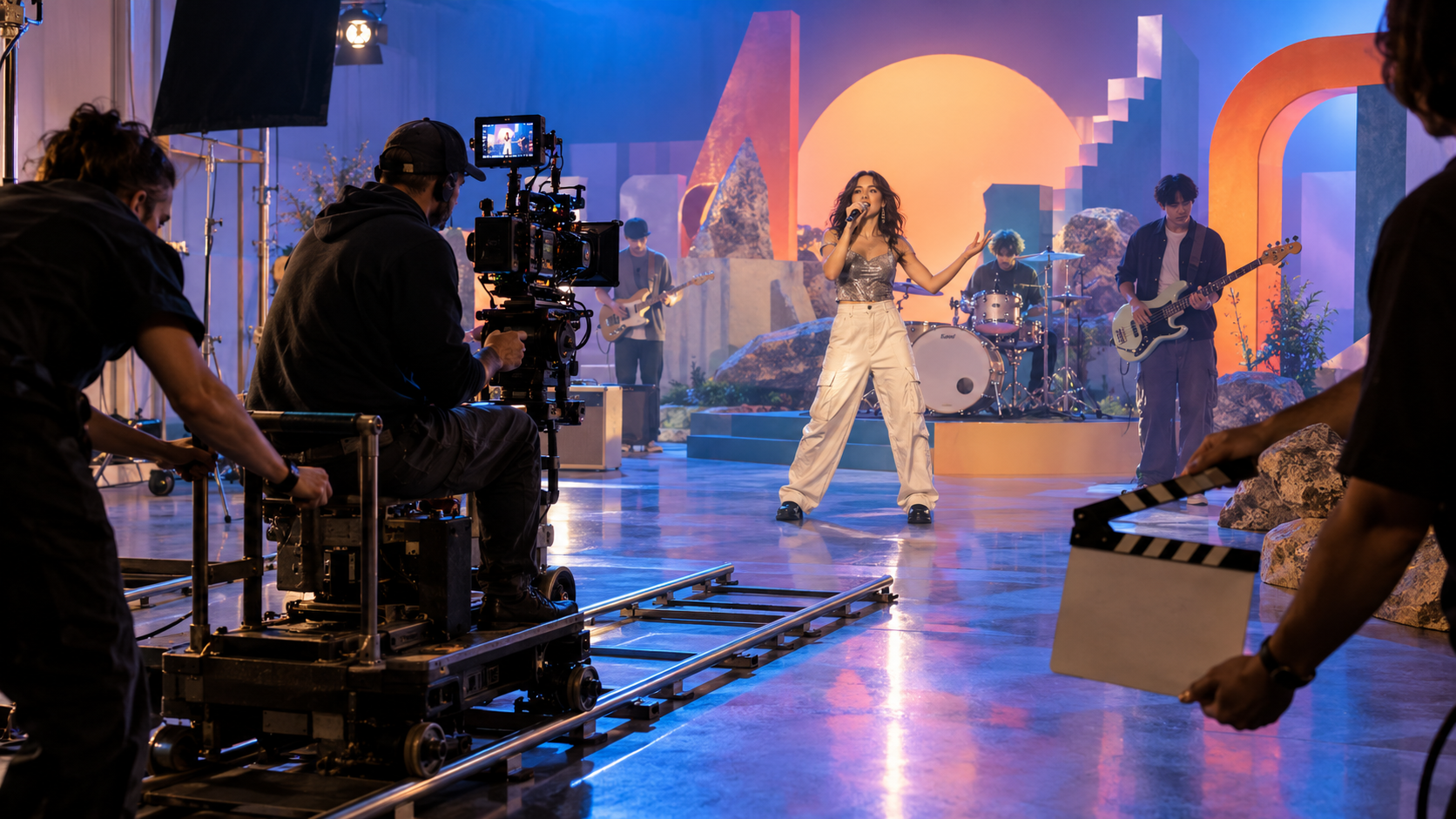
Development begins with the track, budget, schedule, and intended audience. Directors or production companies may submit treatments describing the concept, visual references, locations, casting, choreography, effects, and practical approach. Once approved, producers coordinate crew, permits, sets, wardrobe, equipment, and safety. Performance scenes often use playback so the artist can synchronize with the final audio. Narrative or dance-heavy work may demand the logistics of a short film even when the finished piece lasts only a few minutes.
Editing connects image rhythm to musical structure. Cuts can follow beats, lyrical phrases, instrumentation, or emotional changes, but constant beat-matching can become predictable. Speed changes, repeated actions, transitions, visual effects, color grading, and alternate aspect ratios all affect how the video feels. The director and editor also balance close artist identification with a coherent visual progression. Versions may be created for broadcast standards, vertical platforms, captions, short previews, and territories with different requirements.
Rights extend beyond permission to use the recording. The production may need agreements for performers, locations, artwork, choreography, wardrobe, archival footage, trademarks, and other visible material. The song itself involves composition and master rights, while the audiovisual work can be registered as a motion picture or other audiovisual creation. Ownership and approval terms depend on the artist, label, commissioners, and production contracts. A high view count does not reveal who owns each element or how revenue is divided. Music videos once reached mass audiences largely through television programming, but online platforms made on-demand discovery, sharing, and repeat viewing central. The form still serves several purposes at once: artistic statement, marketing asset, fan experience, and catalog object. A useful analysis asks how the camera, performance, design, and edit respond to the recording, and whether the images add a viewpoint rather than merely decorate the track. A practical way to read or discuss Music Videos is to begin with the basic definition and then identify the choices made in a particular example. A music video is an audiovisual work built around a recording; it can be performance-based, narrative, abstract, documentary, or hybrid. Next, ask who sets the relevant rules, who performs the work, and which results follow from creative judgment, law, contracts, technology, budget, or production limits. Similar-looking examples can operate differently because their audience, market, format, timing, and agreements are different. Editing can follow or resist musical rhythm, using visual structure to interpret the song rather than illustrate every lyric. It also helps to distinguish a formal industry category from an informal critical label or one organization's current practice. That separation keeps a memorable anecdote from becoming a false universal rule. Dates and territories matter: tools, distribution systems, audience behavior, and standard agreements change, while older examples can preserve assumptions that no longer apply everywhere. When a claim sounds absolute, compare it with a second kind of source and look for the conditions under which the claim is true. Then trace the process from the visible result back through the less visible decisions, handoffs, and quality checks that produced it. Broadcast, long-form online, vertical, captioned, and promotional cuts can all derive from the same production. Finally, compare the example with a contrasting case and note which part of the definition still holds. This method keeps the explanation grounded, highlights the people and systems behind the outcome, and leaves room for reasonable disagreement about hybrid or borderline cases.
A music video is an audiovisual work built around a recording; it can be performance-based, narrative, abstract, documentary, or hybrid.
A treatment communicates the proposed concept, tone, references, production needs, and approach before filming.
Playback lets performers synchronize with the released track while the crew records images from multiple setups and takes.
Editing can follow or resist musical rhythm, using visual structure to interpret the song rather than illustrate every lyric.
Contracts may address recording and composition permissions plus performers, locations, art, footage, choreography, and approvals.
Broadcast, long-form online, vertical, captioned, and promotional cuts can all derive from the same production.
Explore more "Explainers"
Discover additional explainers across politics, science, business, technology, and other fields. Each explainer breaks down a complex idea into clear, everyday language—helping you better understand how major concepts, systems, and debates shape the world around us.