

Stop-Motion Animation Explainer
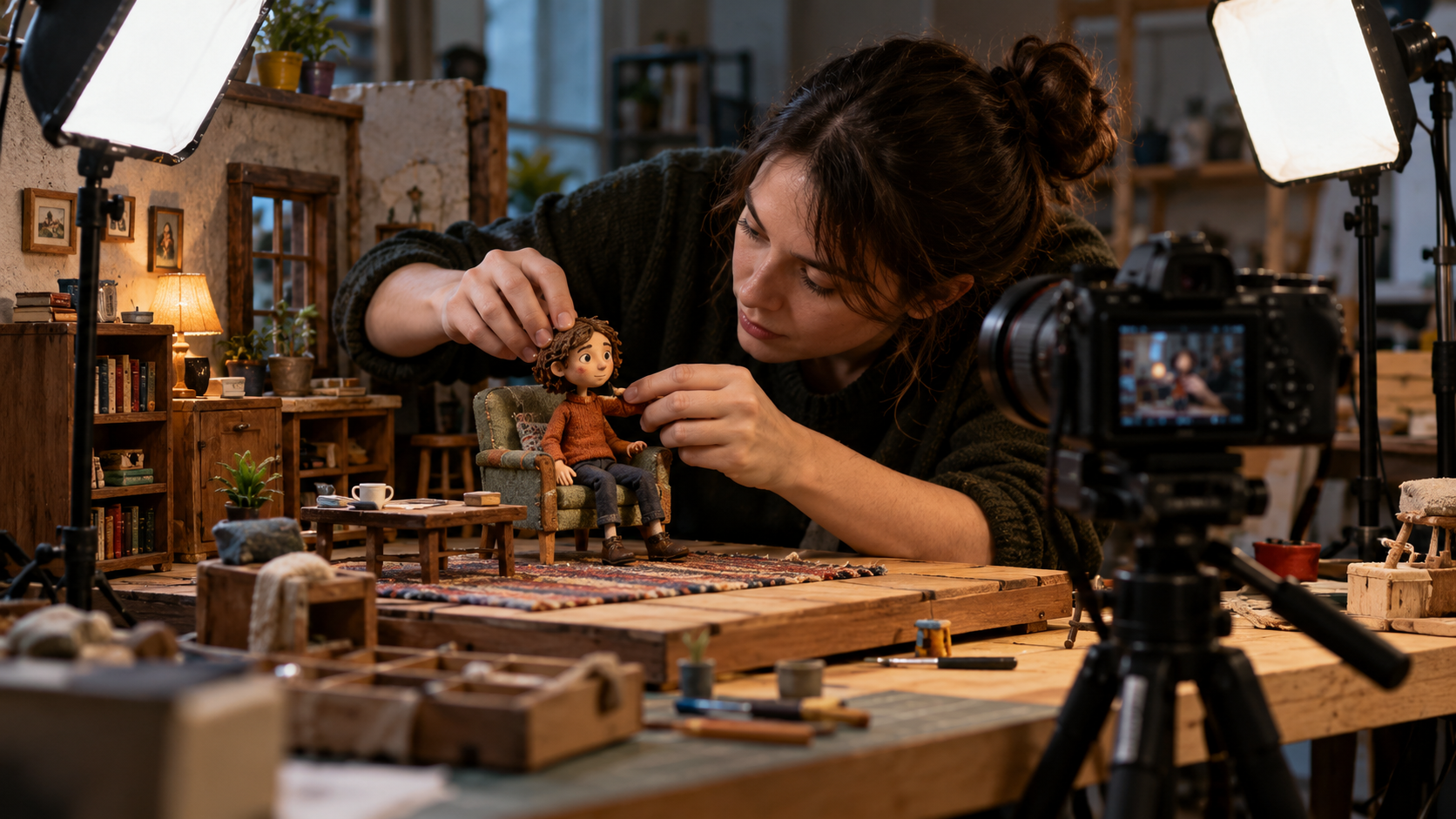
Stop-motion animation creates the illusion of movement by photographing physical subjects one frame at a time and changing them slightly between exposures. When the frames play in sequence, the object appears to move on its own. Puppets, clay, paper cutouts, household objects, sand, and people can all be animated this way. The defining feature is not a particular material but the frame-by-frame manipulation of something present in front of the camera.
Production begins much like live action, with a story, storyboard, designs, sets, lighting, camera placement, and a plan for each shot. Animators break an action into poses and decide how many incremental steps will create the desired timing. Large changes between frames feel fast or abrupt; smaller changes feel slower and smoother. Key poses establish intention, while in-between positions control acceleration, weight, anticipation, and follow-through. Playback tests reveal rhythm that is difficult to judge from isolated poses.
Puppets often contain armatures that hold a pose without drifting. Replaceable faces or mouth pieces can create expressions, while removable panels give access to joints. Sets must survive repeated handling and remain stable under lights. Cameras, tripods, and focus are locked when movement is not intended. Animators use reference marks and capture software to compare the current frame with earlier ones, but accidental bumps, flicker, dust, or changing materials can still break continuity.
The craft mixes physical and digital work. Wires and rigs may support a jump, replacement parts may simulate blur, and several exposures can be combined. Compositing can remove supports, extend sets, and add atmospherics, but the photographed texture and tiny variations of real materials remain central to the look. Sound is usually created later because the set is not recording a continuous performance. Dialogue may be pre-recorded so mouth movement and timing can be planned against it. Stop motion is sometimes described as primitive because its principle is easy to demonstrate, yet sustained character performance demands extraordinary precision. Every frame preserves a choice that cannot be adjusted by simply replaying a continuous take. The medium can embrace visible fingerprints and handmade irregularity or aim for polished realism. Viewers can appreciate it by watching how spacing creates weight, how objects settle after movement, and how lighting and scale make a miniature world feel coherent. A practical way to read or discuss Stop-Motion Animation is to begin with the basic definition and then identify the choices made in a particular example. Stop motion photographs physical subjects in separate frames, with small deliberate changes creating apparent movement during playback. Next, ask who sets the relevant rules, who performs the work, and which results follow from creative judgment, law, contracts, technology, budget, or production limits. Similar-looking examples can operate differently because their audience, market, format, timing, and agreements are different. Capture software can compare adjacent frames, but the animator still judges performance, weight, arcs, and the clarity of each pose. It also helps to distinguish a formal industry category from an informal critical label or one organization's current practice. That separation keeps a memorable anecdote from becoming a false universal rule. Dates and territories matter: tools, distribution systems, audience behavior, and standard agreements change, while older examples can preserve assumptions that no longer apply everywhere. When a claim sounds absolute, compare it with a second kind of source and look for the conditions under which the claim is true. Then trace the process from the visible result back through the less visible decisions, handoffs, and quality checks that produced it. Handmade texture is not automatically an error; productions decide whether small material variations should remain visible or be polished away. Finally, compare the example with a contrasting case and note which part of the definition still holds. This method keeps the explanation grounded, highlights the people and systems behind the outcome, and leaves room for reasonable disagreement about hybrid or borderline cases.
Stop motion photographs physical subjects in separate frames, with small deliberate changes creating apparent movement during playback.
Animators plan key poses and the spacing between them because distance traveled from frame to frame controls timing and acceleration.
Armatures, replacement faces, rigging, stable sets, locked cameras, and consistent lights help physical materials repeat predictably.
Capture software can compare adjacent frames, but the animator still judges performance, weight, arcs, and the clarity of each pose.
Digital cleanup may remove support rigs or extend scenery without changing the medium's foundation in photographed physical objects.
Handmade texture is not automatically an error; productions decide whether small material variations should remain visible or be polished away.
Explore more "Explainers"
Discover additional explainers across politics, science, business, technology, and other fields. Each explainer breaks down a complex idea into clear, everyday language—helping you better understand how major concepts, systems, and debates shape the world around us.