

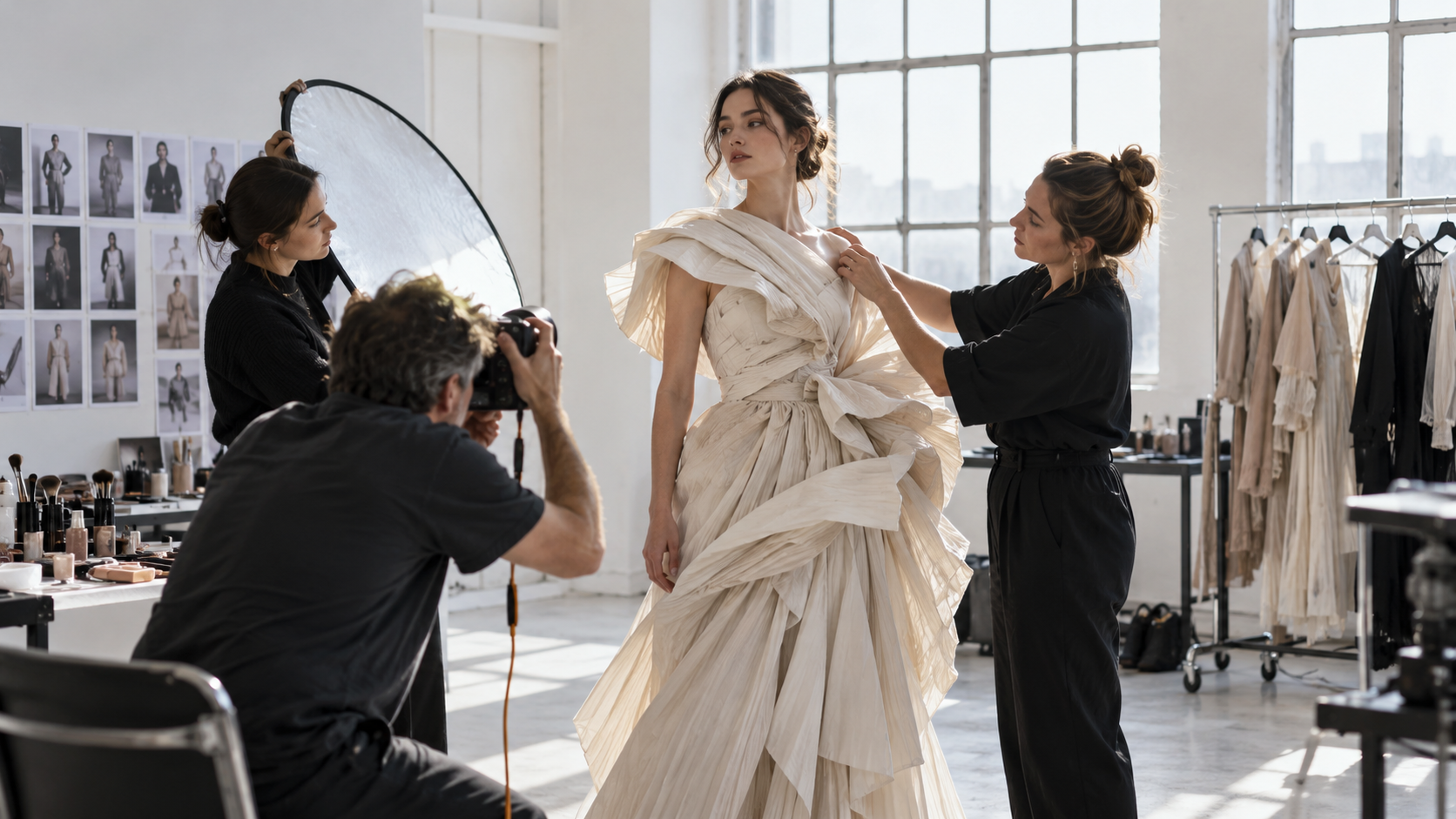
Fashion Editorial Photography Explainer
Fashion editorial photography presents clothing within a visual idea, mood, character, or story for a publication or editorial platform. Unlike a straightforward catalog image whose main job is to document a product clearly, an editorial can use setting, pose, cropping, sequence, and atmosphere to interpret fashion. It may still support commercial interest, but its immediate language is cultural and narrative rather than a complete inventory of fit and features.
The process begins with a brief or concept shaped by an editor, art director, or creative team. References become a mood board that guides casting, garments, location, set, hair, makeup, props, light, and camera approach. A stylist sources and combines clothing, tracks samples, protects fragile pieces, and manages continuity. The photographer translates the concept through viewpoint, timing, lens, exposure, and direction, while the model contributes movement and performance.
A shoot is collaborative and constrained. Garments may arrive late, fit differently than expected, or require careful handling. The location must support changes, privacy, power, weather protection, and safe movement. Assistants manage lights, digital capture, equipment, and files; producers manage schedule, permissions, transport, and budget. The strongest image may be discovered in the interaction among clothing, person, and environment rather than reproduced exactly from the initial sketch.
Editing turns individual frames into an editorial. Selects need variation and continuity across a spread, with room for layout and captions. Retouching can correct temporary distractions and prepare color, but it also raises questions about body representation, skin, garment accuracy, and disclosure. Publications set standards for how far alteration should go. Credits must identify the team and clothing accurately, and image, location, and model releases support lawful publication. Editorial and advertising can share talent and aesthetics, yet the commissioning purpose and control differ. An advertisement serves a brand's campaign; an editorial is commissioned under a publication's concept and standards, even when brands supply garments. Hybrid sponsored features should be labeled so readers can distinguish promotion from independent editorial choice. Viewers can read the images by asking whose perspective organizes the story, how clothing changes across the sequence, and whether the concept illuminates or overwhelms the garments. A practical way to read or discuss Fashion Editorial Photography is to begin with the basic definition and then identify the choices made in a particular example. Fashion editorials interpret garments through concept, mood, casting, setting, pose, sequence, and publication context rather than neutral product documentation. Next, ask who sets the relevant rules, who performs the work, and which results follow from creative judgment, law, contracts, technology, budget, or production limits. Similar-looking examples can operate differently because their audience, market, format, timing, and agreements are different. A stylist sources and combines clothing, tracks samples, protects garments, manages changes, and checks continuity across the shoot. It also helps to distinguish a formal industry category from an informal critical label or one organization's current practice. That separation keeps a memorable anecdote from becoming a false universal rule. Dates and territories matter: tools, distribution systems, audience behavior, and standard agreements change, while older examples can preserve assumptions that no longer apply everywhere. When a claim sounds absolute, compare it with a second kind of source and look for the conditions under which the claim is true. Then trace the process from the visible result back through the less visible decisions, handoffs, and quality checks that produced it. Advertising and editorial aesthetics can overlap, so commissioning purpose, brand control, sponsorship labels, and publication standards provide important context. Finally, compare the example with a contrasting case and note which part of the definition still holds. This method keeps the explanation grounded, highlights the people and systems behind the outcome, and leaves room for reasonable disagreement about hybrid or borderline cases.
Fashion editorials interpret garments through concept, mood, casting, setting, pose, sequence, and publication context rather than neutral product documentation.
Editors, art directors, photographers, stylists, models, hair and makeup artists, producers, assistants, and retouchers contribute distinct expertise.
Mood boards coordinate references, but the final images must respond to real garments, fit, location, weather, light, movement, and schedule.
A stylist sources and combines clothing, tracks samples, protects garments, manages changes, and checks continuity across the shoot.
Selection, layout, color work, retouching, captions, credits, and releases turn photographs into a publishable editorial sequence.
Advertising and editorial aesthetics can overlap, so commissioning purpose, brand control, sponsorship labels, and publication standards provide important context.
Explore more "Explainers"
Discover additional explainers across politics, science, business, technology, and other fields. Each explainer breaks down a complex idea into clear, everyday language—helping you better understand how major concepts, systems, and debates shape the world around us.