

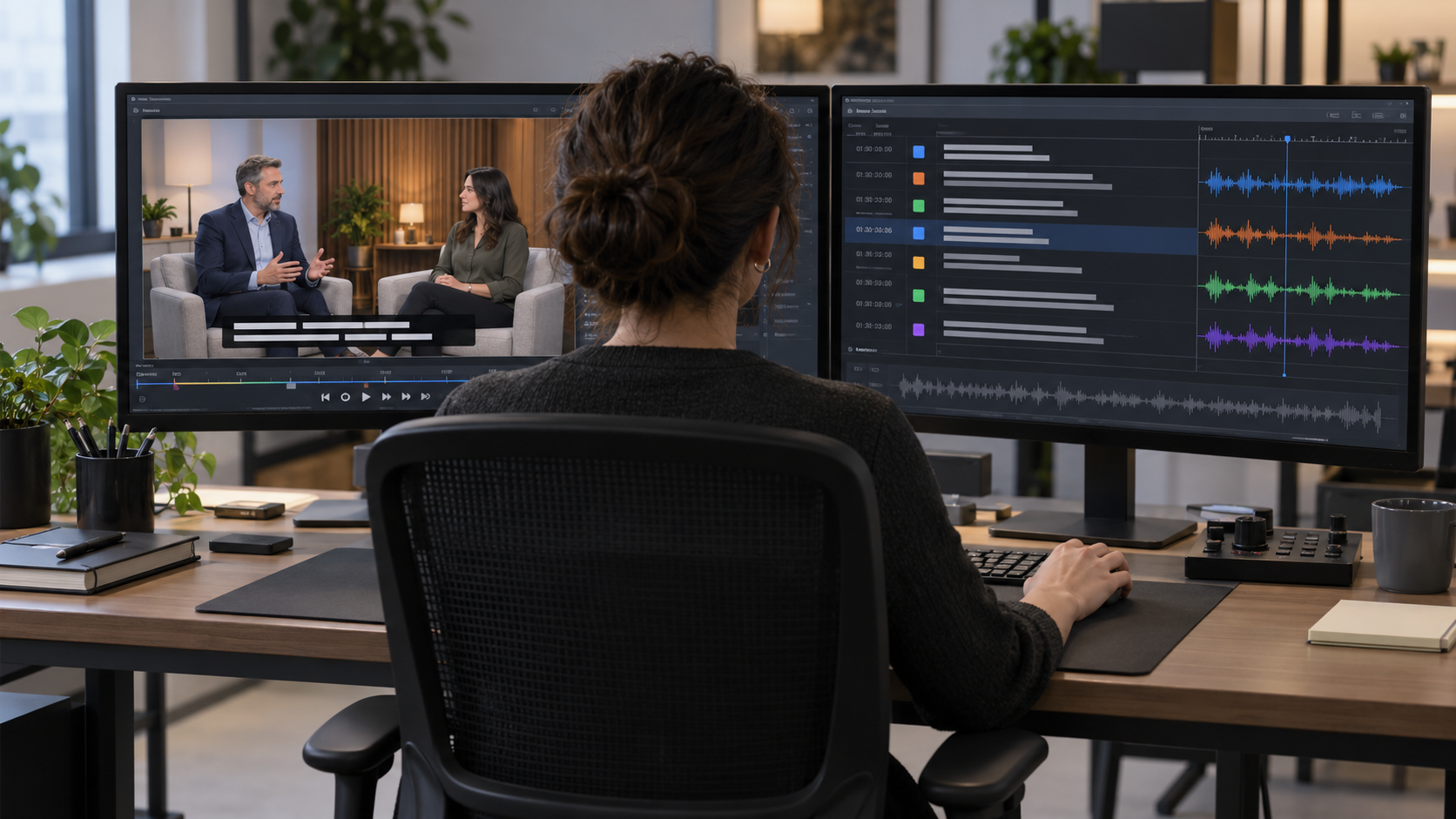
Closed Captioning Explainer
Closed captioning represents spoken dialogue and meaningful non-speech audio as timed text that viewers can enable or disable. Unlike subtitles created only to translate language, accessibility captions identify speakers when necessary and describe sounds or music that contribute to understanding. The word closed refers to user control over display; open captions are permanently visible in the picture. Captions serve deaf and hard-of-hearing viewers while also helping in noisy spaces, quiet settings, language learning, and search.
Quality depends on accuracy, synchronization, completeness, and placement. Captions should match the program's words and sounds, appear when they occur, cover the full program, and avoid obscuring faces, names, graphics, or other important information. Punctuation, speaker labels, sound descriptions, and line breaks make meaning easier to follow. Verbatim treatment is common, but readability and the actual communication goal still matter, especially when speakers overlap or audio is unclear.
Prerecorded programs allow captioners to work from final media, scripts, and reference documents, then review the complete result. Automatic speech recognition can provide a draft, but names, accents, music, crosstalk, specialized terms, and timing often need human correction. Captions must be checked against the delivered edit because even small picture changes can shift synchronization or remove events. Different platforms may require different file formats or positioning capabilities.
Live captioning has less time. Human stenographers, voice writers, respeakers, or automated systems create text as the program proceeds, often with a short delay. Preparation includes names, likely topics, pronunciations, and access to clean audio. Real-time systems must recover visibly from errors rather than silently leaving a misleading phrase on screen. Emergency information and unscripted speech make reliability, redundancy, and trained judgment especially important. In the United States, FCC rules and complaint processes address captioning on covered television programming, while online video obligations can depend on the program's broadcast history and applicable law. Compliance is a floor rather than the whole viewer experience. Audiences can assess captions by asking whether every meaningful segment is covered, whether timing follows the speaker, whether labels are clear, and whether placement respects the image. Good captions make the program accessible without becoming a separate puzzle to solve. A practical way to read or discuss Closed Captioning is to begin with the basic definition and then identify the choices made in a particular example. Closed captions are optional timed text for dialogue and relevant sounds; open captions are permanently embedded in the image. Next, ask who sets the relevant rules, who performs the work, and which results follow from creative judgment, law, contracts, technology, budget, or production limits. Similar-looking examples can operate differently because their audience, market, format, timing, and agreements are different. Prerecorded captioning supports detailed review; live captioning balances speed, preparation, correction, and the unavoidable delay of real-time work. It also helps to distinguish a formal industry category from an informal critical label or one organization's current practice. That separation keeps a memorable anecdote from becoming a false universal rule. Dates and territories matter: tools, distribution systems, audience behavior, and standard agreements change, while older examples can preserve assumptions that no longer apply everywhere. When a claim sounds absolute, compare it with a second kind of source and look for the conditions under which the claim is true. Then trace the process from the visible result back through the less visible decisions, handoffs, and quality checks that produced it. Rules vary by service and jurisdiction, so legal compliance should be checked separately from general quality best practices. Finally, compare the example with a contrasting case and note which part of the definition still holds. This method keeps the explanation grounded, highlights the people and systems behind the outcome, and leaves room for reasonable disagreement about hybrid or borderline cases.
Closed captions are optional timed text for dialogue and relevant sounds; open captions are permanently embedded in the image.
Accessible captions identify speakers and meaningful audio such as music, alarms, laughter, or off-screen events when context requires it.
Accuracy, timing, completeness, and placement work together, because correct words can still fail if they arrive late or cover key graphics.
Prerecorded captioning supports detailed review; live captioning balances speed, preparation, correction, and the unavoidable delay of real-time work.
Automatic speech recognition can assist, but human review remains important for names, crosstalk, accents, terminology, and editorial context.
Rules vary by service and jurisdiction, so legal compliance should be checked separately from general quality best practices.
Explore more "Explainers"
Discover additional explainers across politics, science, business, technology, and other fields. Each explainer breaks down a complex idea into clear, everyday language—helping you better understand how major concepts, systems, and debates shape the world around us.