

Video Game Remasters Explainer
A video game remaster brings an existing game to newer hardware or distribution while preserving much of its original design, content, and technical foundation. The term has no single industry test. Some remasters raise resolution and frame rate; others rebuild interfaces, replace textures, re-record audio, adjust controls, add accessibility or quality-of-life options, and repair old limitations. A remake generally reconstructs more of the game, but publishers and players do not always use the labels consistently.
The first challenge is often preservation. Original source code, art, tools, build scripts, documentation, or high-quality audio may be incomplete, stored on obsolete media, or dependent on hardware behavior that was never formally documented. Teams inspect surviving data, run original versions, compare releases, and sometimes recreate missing elements by hand. Emulation, source ports, and partial reimplementation each offer different balances of fidelity, performance, maintainability, and platform integration.
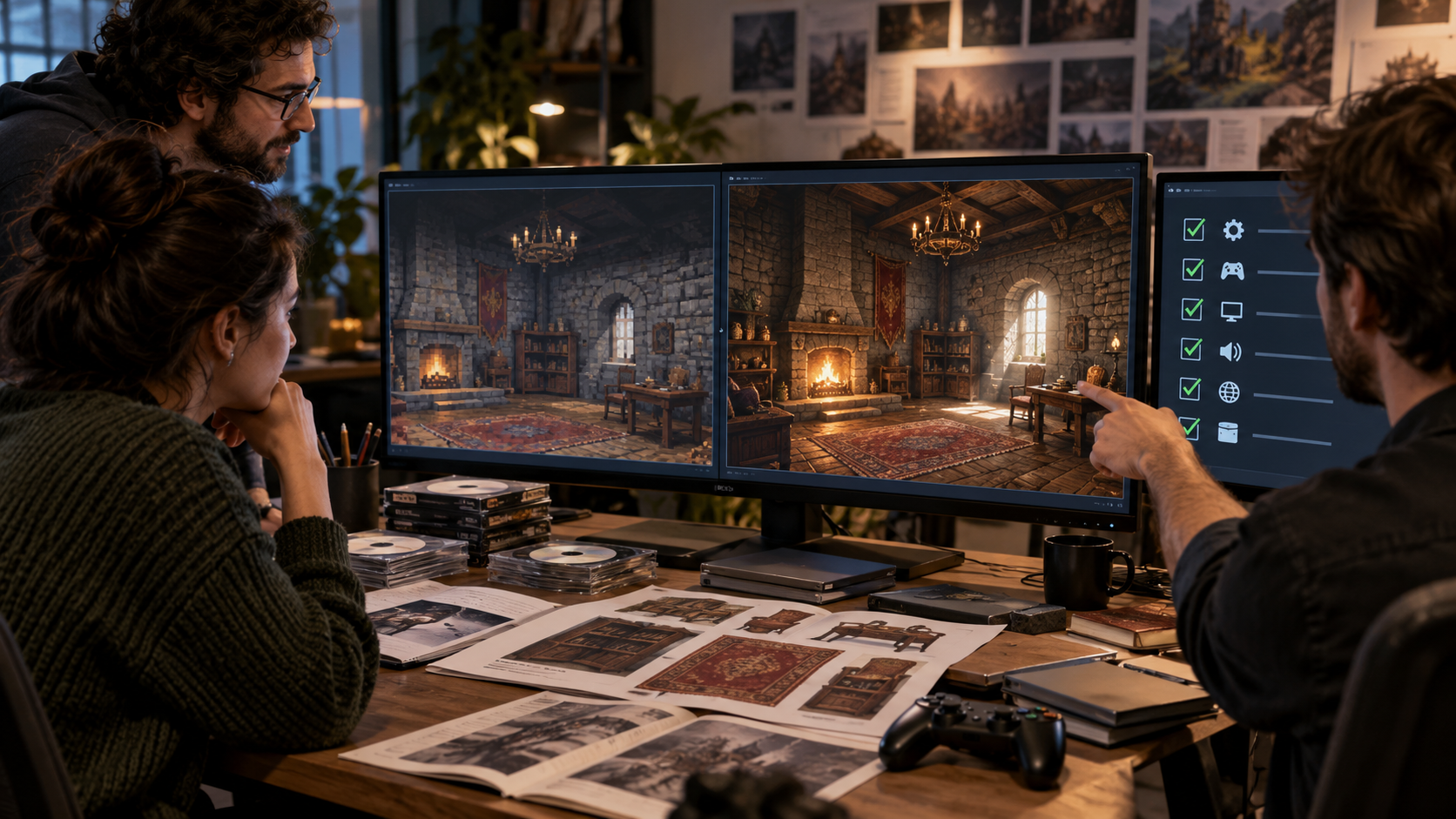
Visual improvement is not a simple sharpening pass. Old games may combine low-resolution backgrounds, sprites, polygons, pre-rendered video, fixed aspect ratios, and effects tuned to a particular display. Automated upscaling can introduce artifacts or invent inconsistent detail, so artists review and repair results. Higher frame rates can alter timing, physics, animation, or input when original logic is tied to refresh rate. Modern displays also expose seams that older screens softened.
Design choices require restraint. Faster movement, autosave, revised inventory, difficulty options, camera control, or reduced repetition can make a game more approachable but can also change pacing and challenge. Some remasters provide classic and modern modes. Consulting original staff, archival references, and experienced players can clarify intent without assuming that every old constraint was artistic. New translations and voice work add further questions of accuracy, tone, and continuity. A remaster also needs contemporary platform services, certification, privacy, network behavior, achievements, save handling, and store assets. To evaluate one, ask what code and assets were preserved, what changed, which mode is closest to the original, and whether the earlier version remains accessible. A successful remaster does more than increase pixel count. It creates a reliable path between historical design and present-day hardware while documenting the compromises required. A practical way to read or discuss Video Game Remasters is to begin with the basic definition and then identify the choices made in a particular example. A remaster updates an existing game for new hardware while usually retaining more original design and code than a remake. Next, ask who sets the relevant rules, who performs the work, and which results follow from creative judgment, law, contracts, technology, budget, or production limits. Similar-looking examples can operate differently because their audience, market, format, timing, and agreements are different. Upscaling needs human review because automated tools can invent detail, sharpen noise, or make different assets feel inconsistent. It also helps to distinguish a formal industry category from an informal critical label or one organization's current practice. That separation keeps a memorable anecdote from becoming a false universal rule. Dates and territories matter: tools, distribution systems, audience behavior, and standard agreements change, while older examples can preserve assumptions that no longer apply everywhere. When a claim sounds absolute, compare it with a second kind of source and look for the conditions under which the claim is true. Then trace the process from the visible result back through the less visible decisions, handoffs, and quality checks that produced it. Strong remasters explain their sources and changes and, when practical, offer a way to understand or access the earlier presentation. Finally, compare the example with a contrasting case and note which part of the definition still holds. This method keeps the explanation grounded, highlights the people and systems behind the outcome, and leaves room for reasonable disagreement about hybrid or borderline cases.
A remaster updates an existing game for new hardware while usually retaining more original design and code than a remake.
Incomplete source code, missing assets, obsolete tools, and undocumented hardware behavior can turn preservation into reconstruction.
Higher resolution, frame rate, aspect ratio, and display clarity can expose artifacts or change logic tied to old hardware.
Upscaling needs human review because automated tools can invent detail, sharpen noise, or make different assets feel inconsistent.
Quality-of-life, control, accessibility, interface, and difficulty changes improve access but may alter the original experience.
Strong remasters explain their sources and changes and, when practical, offer a way to understand or access the earlier presentation.
Explore more "Explainers"
Discover additional explainers across politics, science, business, technology, and other fields. Each explainer breaks down a complex idea into clear, everyday language—helping you better understand how major concepts, systems, and debates shape the world around us.