

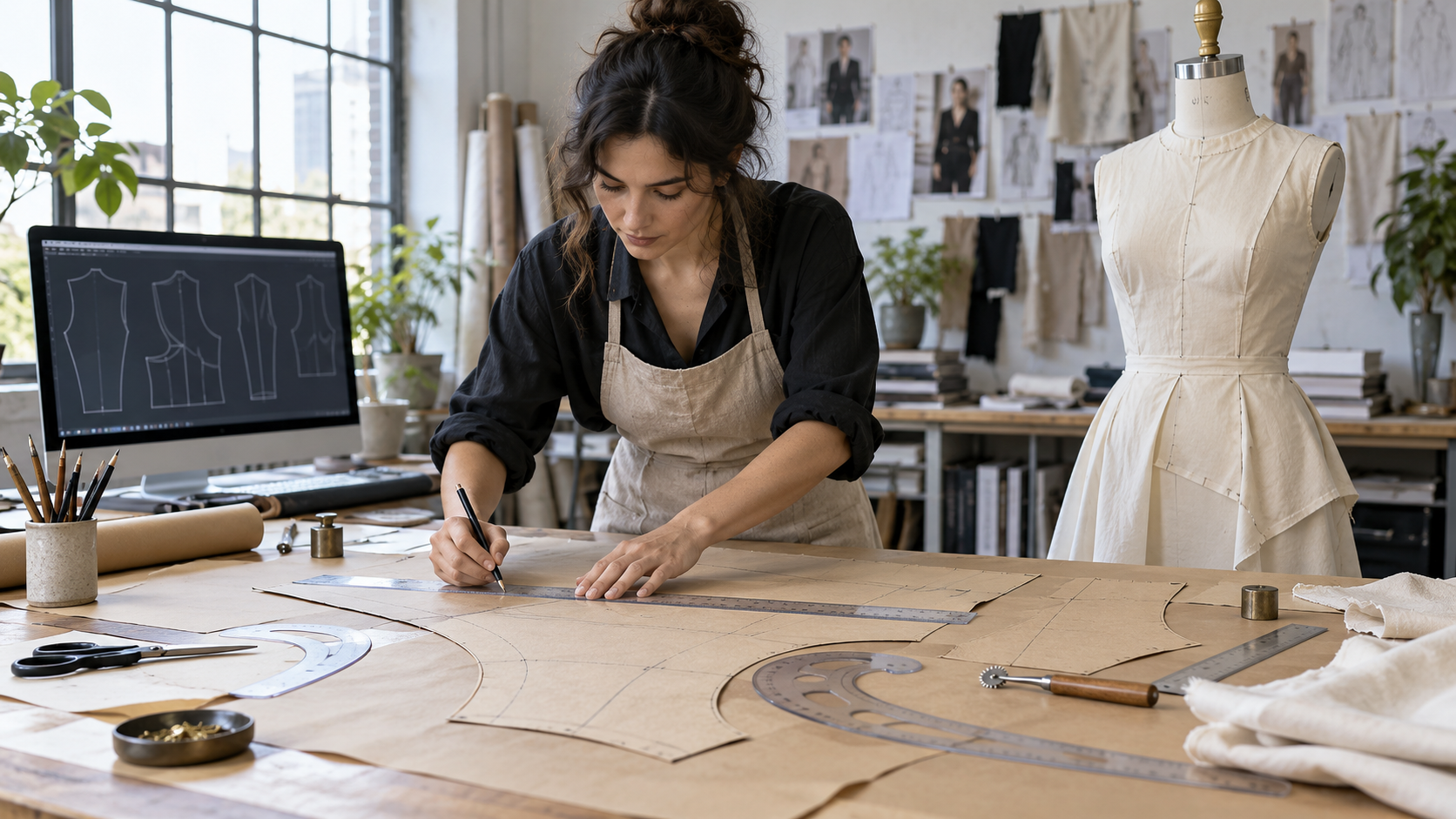
Patternmaking Explainer
Patternmaking is the process of translating a garment design into precise flat or digital shapes that guide cutting and assembly. Those pieces encode dimensions, seams, darts, ease, grain direction, balance, notches, drill marks, and construction relationships. A sketch can suggest silhouette and detail, but the pattern determines how fabric becomes three-dimensional around a body. Patternmakers work between design, technical development, sample sewing, fitting, costing, and factory production.
A pattern can begin from a sloper or block, from draping fabric on a form, from measurements, or from an existing approved style. Flat-pattern methods manipulate basic shapes through pivots, slashes, spreads, seams, and added volume. Draping discovers form directly in material before transferring it to paper or software. Digital systems support precise editing, version control, grading, markers, and three-dimensional simulation, but the operator still needs knowledge of bodies, fabric behavior, and construction.
The first pattern produces a sample or toile that exposes problems a drawing cannot show. During a fitting, the team examines balance, proportion, mobility, drag lines, seam position, length, ease, and the relationship between the garment and its intended layer or understructure. Pinning and notes lead to pattern corrections and another sample when necessary. Changing one area can affect several connected pieces, so accurate notches, measurements, and revision tracking prevent new errors.
After the base size is approved, grading creates a range of sizes according to defined rules. Grading is not simply enlarging every dimension by the same percentage; growth is distributed among points to maintain fit and design relationships. Size charts and target bodies vary by brand and market. Marker making then arranges pieces on fabric widths to respect grain, nap, print direction, pairs, defects, and cutting methods while controlling material consumption and cost. Production patterns must survive repeated use outside the sample room. Specifications, tolerances, construction notes, piece labels, and digital file formats help factories interpret intent. A beautiful sample can fail if the pattern is inefficient, ambiguous, or unsuitable for the chosen cloth and equipment. To understand patternmaking, look inside a garment at how seams create volume and movement. The craft is the hidden geometry that makes design reproducible without treating every body or fabric as identical. A practical way to read or discuss Patternmaking is to begin with the basic definition and then identify the choices made in a particular example. Patternmaking converts garment design into measured pieces that define shape, seams, ease, grain, notches, and assembly. Next, ask who sets the relevant rules, who performs the work, and which results follow from creative judgment, law, contracts, technology, budget, or production limits. Similar-looking examples can operate differently because their audience, market, format, timing, and agreements are different. Corrections must be transferred across every connected piece with clear version control, measurements, and construction references. It also helps to distinguish a formal industry category from an informal critical label or one organization's current practice. That separation keeps a memorable anecdote from becoming a false universal rule. Dates and territories matter: tools, distribution systems, audience behavior, and standard agreements change, while older examples can preserve assumptions that no longer apply everywhere. When a claim sounds absolute, compare it with a second kind of source and look for the conditions under which the claim is true. Then trace the process from the visible result back through the less visible decisions, handoffs, and quality checks that produced it. Markers arrange pattern pieces for efficient cutting while respecting width, grain, nap, print direction, pairs, and production cost. Finally, compare the example with a contrasting case and note which part of the definition still holds. This method keeps the explanation grounded, highlights the people and systems behind the outcome, and leaves room for reasonable disagreement about hybrid or borderline cases.
Patternmaking converts garment design into measured pieces that define shape, seams, ease, grain, notches, and assembly.
Patterns can be developed from blocks, measurements, draping, existing garments, paper methods, or digital systems.
Samples and fittings reveal balance, proportion, mobility, drag lines, seam placement, and the behavior of the intended fabric.
Corrections must be transferred across every connected piece with clear version control, measurements, and construction references.
Grading creates related sizes through distributed rules rather than enlarging the entire garment by one uniform percentage.
Markers arrange pattern pieces for efficient cutting while respecting width, grain, nap, print direction, pairs, and production cost.
Explore more "Explainers"
Discover additional explainers across politics, science, business, technology, and other fields. Each explainer breaks down a complex idea into clear, everyday language—helping you better understand how major concepts, systems, and debates shape the world around us.