

Bookbinding Explainer
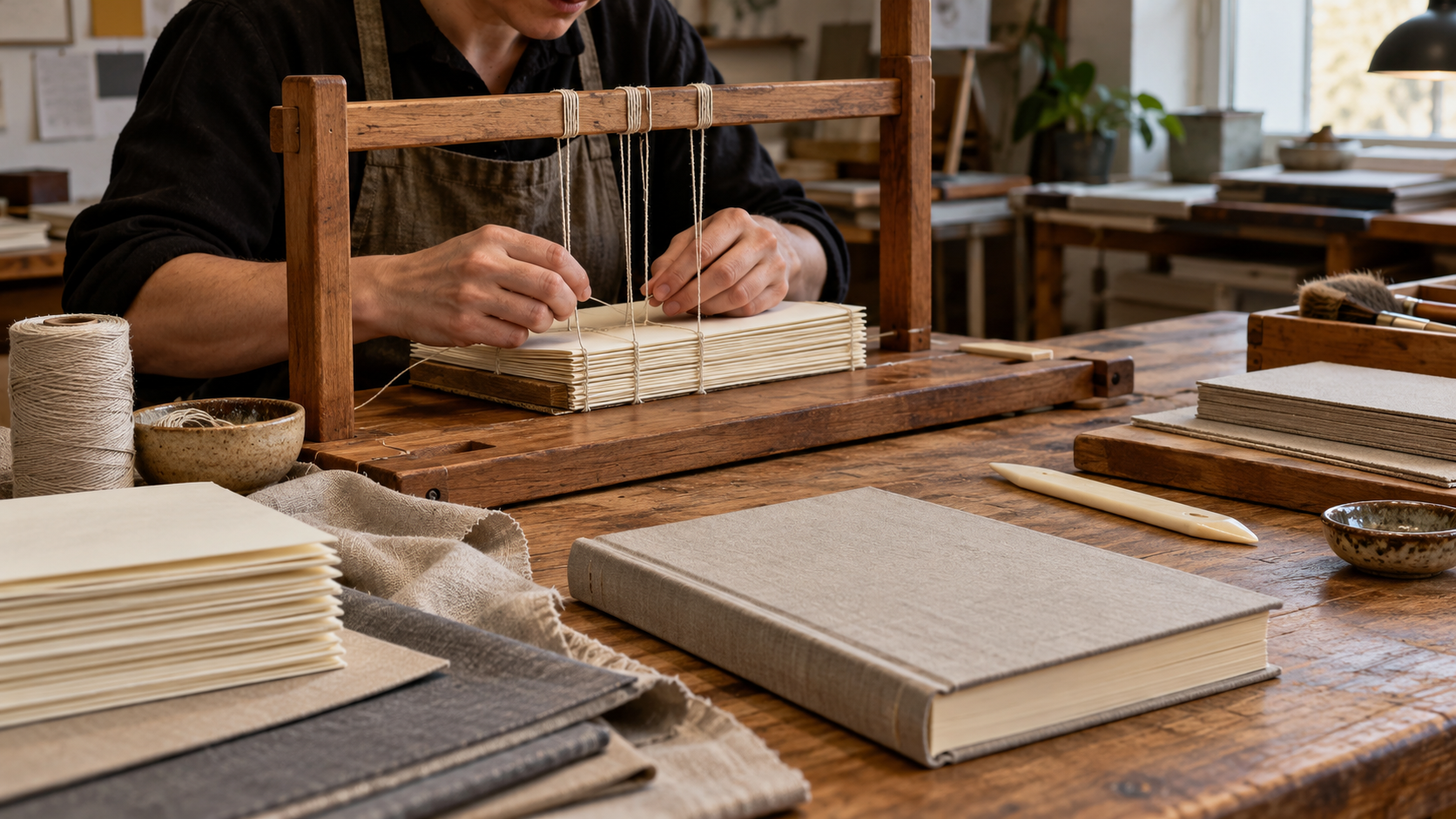
Bookbinding is the set of processes that joins pages into a text block and attaches a protective structure so the book can be handled and read. It ranges from industrial adhesive binding to sewn case binding, library rebinding, and individual craft work. The visible cover is only one component. Paper grain, folds, gatherings, sewing or adhesive, spine shape, endleaves, boards, cloth, and joints all influence durability and opening.
Many books begin as large printed sheets folded into sections called signatures or gatherings. Those sections are assembled in order and can be sewn through their folds. Other books use individual leaves whose prepared spine edge receives adhesive, as in perfect binding. Mechanical methods such as wire or spiral binding serve different uses. The chosen structure depends on page count, paper, trim size, print method, cost, expected use, and desired appearance.
In a casebound book, the text block and the cover case are often made separately. Boards and covering material form the case; endpapers help connect it to the book block; spine linings and joints support movement. Rounding, backing, headbands, edge treatment, stamping, and jackets can add function or finish. Terminology varies across historical traditions, conservation, craft, and modern manufacturing, so a familiar label may hide several constructions.
Openability involves tradeoffs. Adhesive, grain direction, margin, sewing, spine flexibility, and binding thickness determine how comfortably a book lies open and how much text disappears into the gutter. A stiff book is not necessarily stronger, and a flexible one is not automatically weak. Conservation binding also differs from ordinary repair: interventions should respect the material, history, and future handling of the particular object rather than forcing every volume into a new uniform structure. Binding succeeds when structure and intended use agree. A workbook may need to lie flat; a paperback needs economical production; an art book may prioritize image spreads; a library volume must withstand repeated circulation. The craft makes reading physical. Every page turn transfers force through paper, adhesive, thread, hinges, and cover, and the design decides how that force is distributed over the life of the book. A practical way to read or discuss Bookbinding is to begin with the basic definition and then identify the choices made in a particular example. Bookbinding creates and protects the text block, not merely the decorative surface of a cover. Next, ask who sets the relevant rules, who performs the work, and which results follow from creative judgment, law, contracts, technology, budget, or production limits. Similar-looking examples can operate differently because their audience, market, format, timing, and agreements are different. Case binding commonly joins a separately made cover case to the prepared text block through endpapers and linings. It also helps to distinguish a formal industry category from an informal critical label or one organization's current practice. That separation keeps a memorable anecdote from becoming a false universal rule. Dates and territories matter: tools, distribution systems, audience behavior, and standard agreements change, while older examples can preserve assumptions that no longer apply everywhere. Because the concept sits inside a larger workflow, examine what comes before and after it, which records move between stages, and where responsibility changes hands. This broader view prevents one visible task from being mistaken for the entire system. When a claim sounds absolute, compare it with a second kind of source and look for the conditions under which the claim is true. Then trace the process from the visible result back through the less visible decisions, handoffs, and quality checks that produced it. Conservation work evaluates a particular object's history and materials instead of assuming a modern rebinding is best. Finally, compare the example with a contrasting case and note which part of the definition still holds. This method keeps the explanation grounded, highlights the people and systems behind the outcome, and leaves room for reasonable disagreement about hybrid or borderline cases.
Bookbinding creates and protects the text block, not merely the decorative surface of a cover.
Folded signatures may be sewn, individual leaves may be adhesive bound, and mechanical structures serve other uses.
Paper grain, margins, spine flexibility, page count, trim size, materials, cost, and expected handling shape the method.
Case binding commonly joins a separately made cover case to the prepared text block through endpapers and linings.
A binding's strength, flexibility, openability, and repairability are related but not interchangeable qualities.
Conservation work evaluates a particular object's history and materials instead of assuming a modern rebinding is best.
Explore more "Explainers"
Discover additional explainers across politics, science, business, technology, and other fields. Each explainer breaks down a complex idea into clear, everyday language—helping you better understand how major concepts, systems, and debates shape the world around us.