

How Telescopes Use Adaptive Optics Explainer
Stars twinkle because their light passes through constantly shifting pockets of air with different temperatures and densities. Those pockets bend different portions of an incoming wavefront by slightly different amounts. A large ground-based telescope therefore receives a distorted wave rather than the smooth wave that left a distant star. Long exposures average the shifting distortions into a blurred image.
Adaptive optics corrects much of that blur while observations are underway. A wavefront sensor measures how light from a reference source has been warped. A fast computer converts the measurement into commands for a deformable mirror. Small actuators change the mirror’s shape by tiny amounts, adding an opposite distortion so the reflected wavefront becomes closer to the desired form.
The measurement and correction loop may run hundreds or thousands of times each second because atmospheric turbulence evolves rapidly. Another adjustable mirror can remove larger image motions caused by wind or vibration. The exact architecture varies: some systems use one deformable mirror, while advanced designs use several mirrors conjugated to different atmospheric altitudes to correct a wider field.
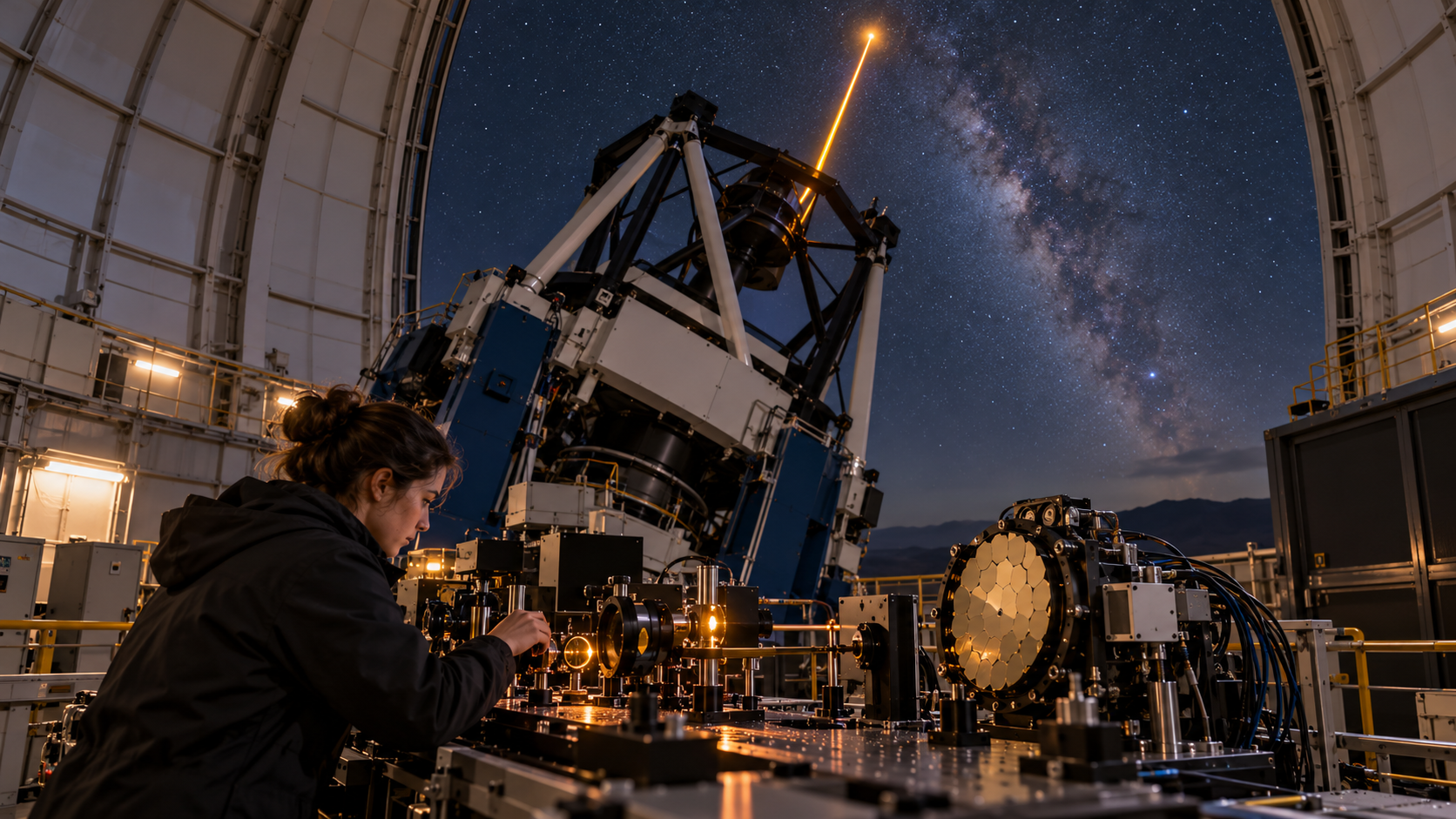
The system needs a bright reference near the target. A natural guide star can provide it, but the sky does not always contain one in the right place. Laser guide-star systems project a beam upward and use light returned from a high atmospheric layer as an artificial reference. Additional measurements are still needed for image motions that the laser geometry cannot determine by itself.
Adaptive optics works best over a limited patch of sky and often at infrared wavelengths, where turbulence changes the wavefront more slowly relative to wavelength. Clouds, poor seeing, guide-star brightness, sensor noise, and the number and spacing of mirror actuators limit correction. The technique cannot recover photons blocked by the atmosphere or replace a dark, stable observing site.
When conditions and design align, adaptive optics lets large ground telescopes approach their diffraction-limited sharpness. Astronomers use it to separate close binary stars, study planets around other stars, resolve crowded galactic centers, and examine surfaces in the solar system. The atmosphere remains present; the instrument repeatedly measures its optical fingerprints and cancels much of their effect in real time.
Turbulent air bends different parts of incoming starlight unevenly. Adaptive optics measures the warped wavefront and applies an opposing correction.
Without correction, rapid distortions average into a broader image during an exposure, even when the telescope optics are excellent.
A wavefront sensor samples the reference light, a computer calculates the error, and actuators reshape a deformable mirror many times per second.
Some systems use several mirrors and sensors to correct turbulence at different altitudes or across a larger field of view.
Natural or laser guide stars provide the reference. Infrared observations and narrow fields generally allow stronger correction than broad visible-light images.
Adaptive optics cannot see through clouds or remove every atmospheric effect. Its performance depends on turbulence, brightness, hardware, and control speed.
Explore more "Explainers"
Discover additional explainers across politics, science, business, technology, and other fields. Each explainer breaks down a complex idea into clear, everyday language—helping you better understand how major concepts, systems, and debates shape the world around us.