

How Fossils Form in Sedimentary Rock Explainer
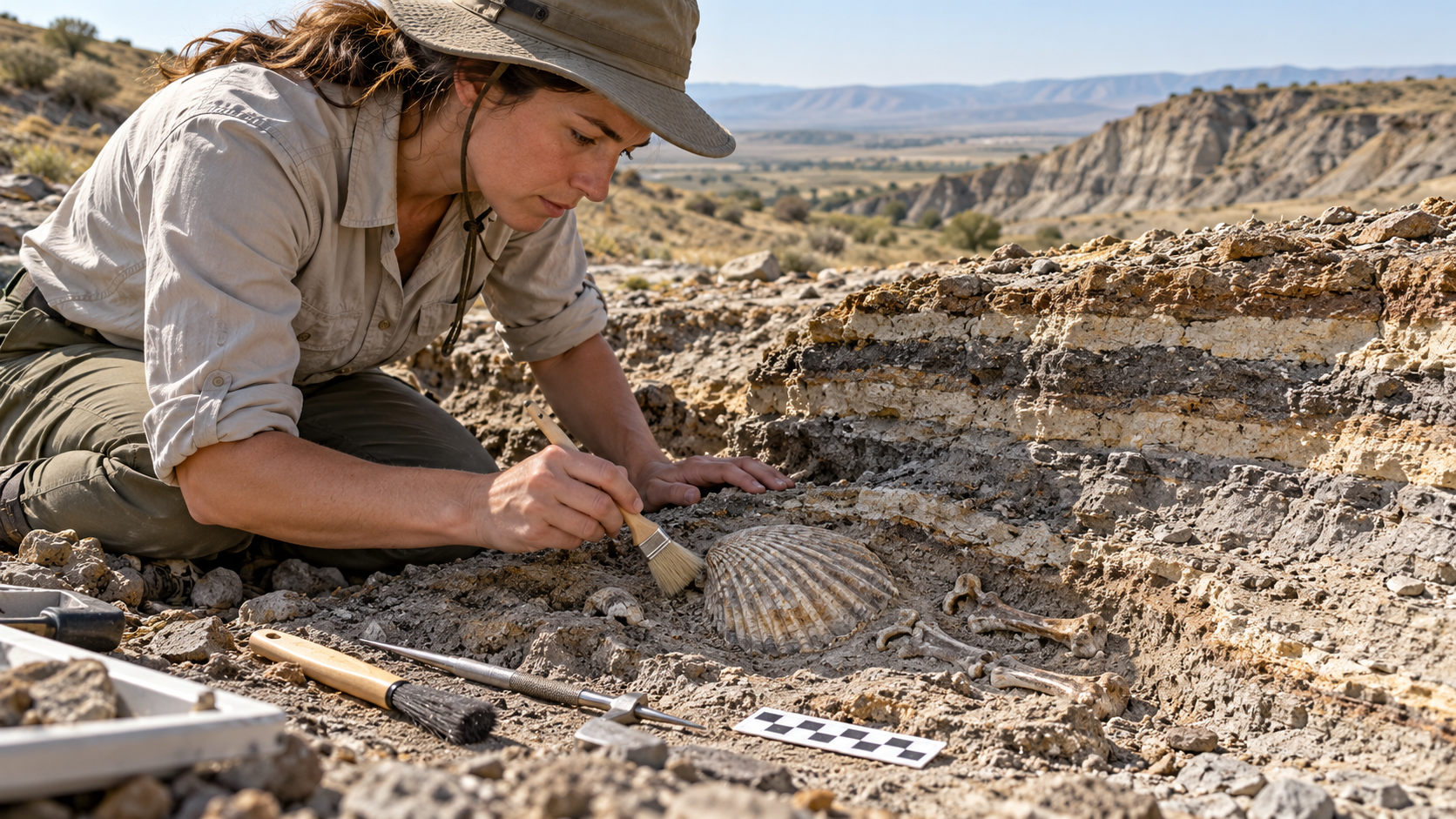
Most organisms never become fossils. Bodies are eaten, decomposed, scattered, dissolved, or destroyed by weather and erosion. Preservation becomes more likely when an organism or its trace is buried quickly by mud, sand, volcanic ash, or other sediment. Burial limits scavenging and physical disturbance and can slow decay, especially where oxygen is scarce.
Hard parts such as shells, bones, and teeth usually resist decay better than soft tissues. Groundwater moving through buried sediment carries dissolved minerals. Pore spaces in remains may fill with minerals in a process called permineralization, or original material may gradually be replaced. Chemical changes can also leave a thin carbon-rich film that records an organism’s outline.
Sometimes the original material dissolves and leaves a hollow impression, or mold, in the surrounding rock. If minerals or sediment later fill that space, the result is a cast. Recrystallization can change the microscopic arrangement of a shell while preserving its overall form. Exceptional conditions may preserve soft tissues, but these cases are much rarer than mineralized hard parts.
Fossils also record activity rather than bodies. Footprints, burrows, nests, feeding marks, and fossilized waste are trace fossils. They can reveal how an organism moved or behaved even when no body remains. A trace must be buried and preserved like other evidence, and later geologists must distinguish biological structures from cracks, ripples, and other nonliving features.
As layers accumulate, pressure compacts sediment and mineral cements bind grains into sedimentary rock. The fossil’s age is interpreted from its position, associated layers, and radiometric dates where suitable minerals occur. The fossil itself may be younger than the grains around it if material was reworked, so geologists study the full depositional context rather than an isolated specimen.
Heat and pressure that form metamorphic rock can distort or erase fossils, while melting destroys them, which is why sedimentary rocks hold most of the fossil record. That record is incomplete and biased toward durable organisms and depositional settings. Even so, consistent sequences of fossils across rock layers document biological change, past environments, extinction, and the deep history of life.
Rapid burial protects remains or traces from scavengers, oxygen, currents, and weather. Hard parts usually have a better chance of surviving.
Fossilization is uncommon because decay and destruction normally act before sediments can seal evidence away.
Permineralization fills pore spaces, replacement substitutes minerals, molds preserve hollows, and casts fill those hollows with new material.
Footprints, burrows, nests, and feeding marks are trace fossils that record behavior rather than the organism's body.
Compaction and cementation turn sediment into rock. Layer relationships and radiometric dates help place fossils in time.
The fossil record favors durable remains and certain environments. Metamorphism, erosion, and missing deposition erase large parts of the history.
Explore more "Explainers"
Discover additional explainers across politics, science, business, technology, and other fields. Each explainer breaks down a complex idea into clear, everyday language—helping you better understand how major concepts, systems, and debates shape the world around us.