

How Atmospheric Pressure Drives Wind Explainer
Atmospheric pressure is the force exerted by the weight and motion of air molecules. It varies from place to place because the atmosphere is heated unevenly and because air columns differ in temperature, density, moisture, and mass. When pressure is higher in one area than another, the pressure-gradient force accelerates air toward lower pressure. That acceleration begins wind.
Uneven solar heating is the ultimate source of many pressure differences. Warm air expands and becomes less dense, changing how pressure decreases with height. Cold air is denser and produces a different vertical pressure pattern. These contrasts across coastlines, weather fronts, continents, and latitudes create horizontal pressure gradients at the surface and aloft, driving circulations from local breezes to jet streams.
Air does not usually rush straight from a high-pressure center into a low. Because Earth rotates, moving air is deflected by the Coriolis effect—to the right in the Northern Hemisphere and to the left in the Southern Hemisphere. High above the ground, a balance between pressure-gradient and Coriolis forces can produce winds that flow roughly parallel to pressure contours.
Near the surface, friction with vegetation, buildings, waves, and terrain slows the wind. A slower flow experiences less Coriolis deflection, so it crosses pressure contours at an angle toward lower pressure. Friction also creates turbulence and gusts. Mountains channel wind through gaps, force air upward, and create waves and sheltered zones; cities produce roughness and heating contrasts of their own.
Closely spaced pressure contours indicate a strong gradient and generally stronger winds than widely spaced contours. The relationship is not a simple conversion because altitude, latitude, curvature, stability, and friction matter. A sea breeze is a useful small-scale example: land heats faster during the day, pressure patterns develop, and cooler marine air moves inland while return flow occurs aloft.
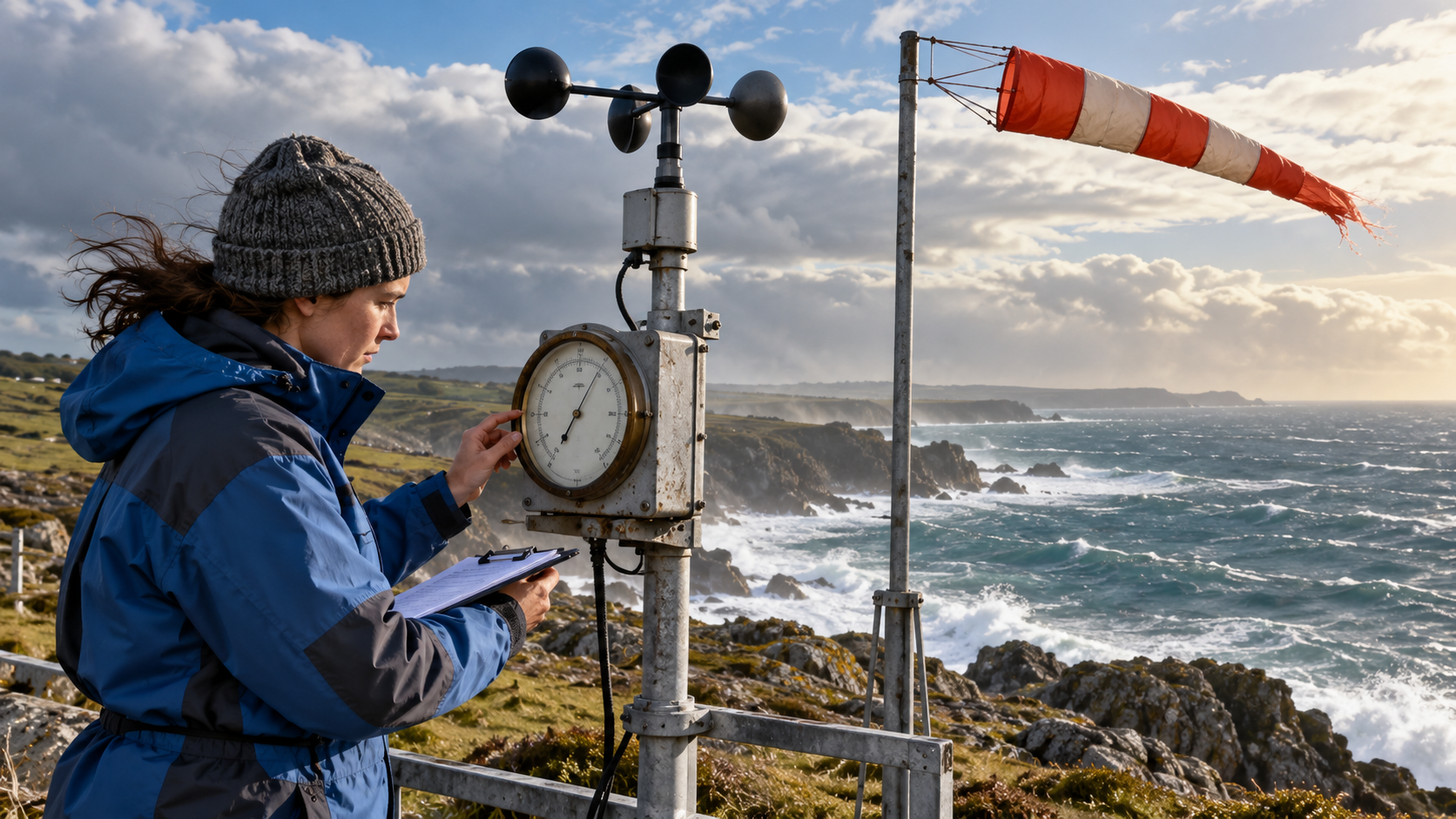
A barometer measures pressure, while an anemometer measures wind speed and a vane measures direction. Meteorologists combine these observations with temperature, humidity, satellites, balloons, radar, and numerical models. Air moves because forces act on it; pressure provides the primary push, but rotation and the physical surface determine where that moving air actually goes.
Air accelerates from higher toward lower pressure because the pressure-gradient force is unbalanced. Uneven heating creates many of those gradients.
Pressure reflects the air column, while temperature and moisture affect density and how pressure changes with height.
Earth's rotation deflects moving air through the Coriolis effect. Aloft, wind can flow nearly parallel to pressure contours.
Surface friction slows wind and turns it more directly toward low pressure. Terrain and buildings add turbulence, channels, and sheltered zones.
Sea breezes, fronts, cyclones, and jet streams operate on different scales but all involve pressure gradients and other balancing forces.
Closely spaced pressure contours often signal strong wind, yet latitude, altitude, curvature, stability, and roughness affect the outcome.
Explore more "Explainers"
Discover additional explainers across politics, science, business, technology, and other fields. Each explainer breaks down a complex idea into clear, everyday language—helping you better understand how major concepts, systems, and debates shape the world around us.