

How Fiber-Optic Cables Carry Information Explainer
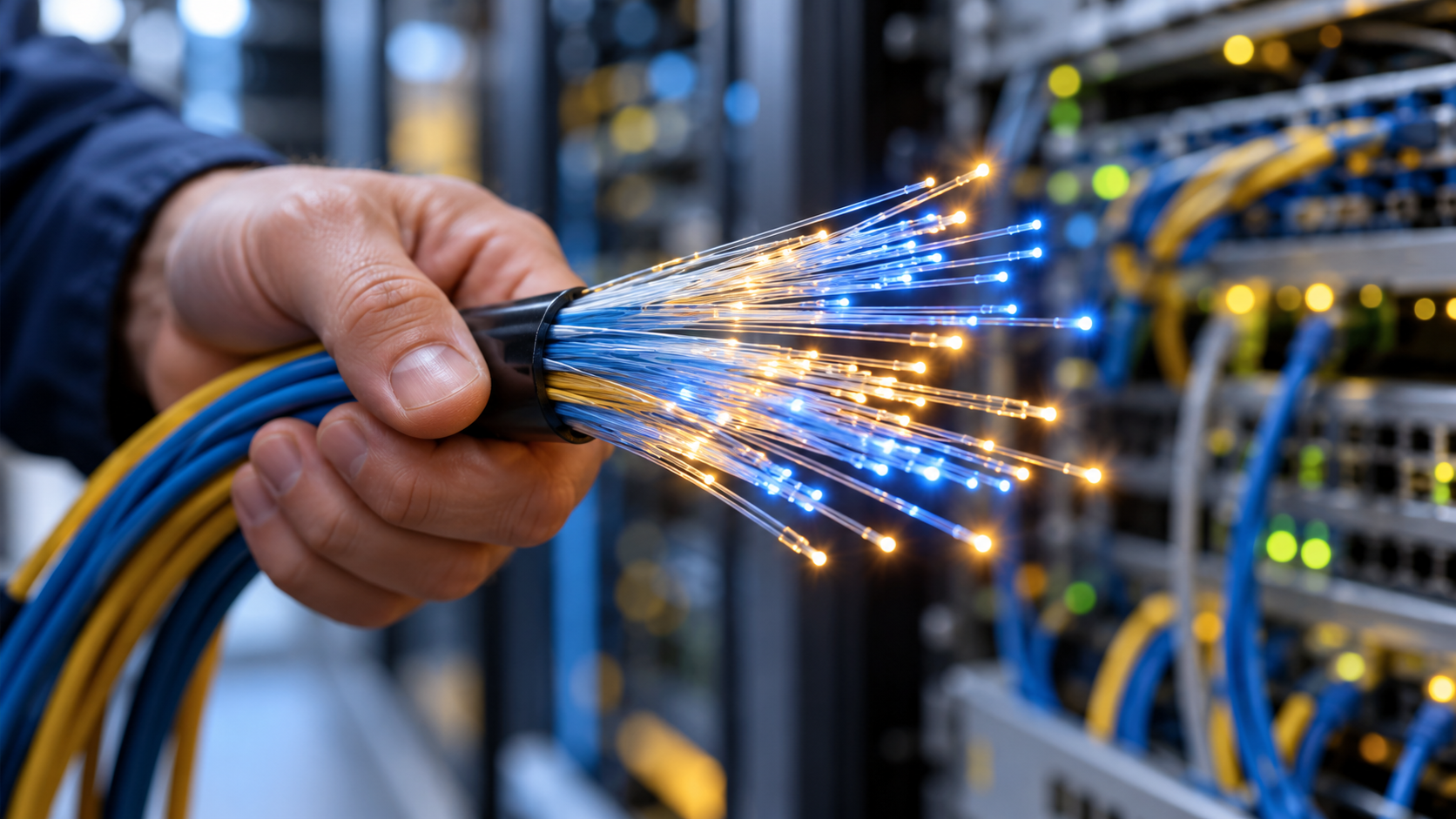
A fiber-optic link carries information as light rather than as electrical current in a metal conductor. A transmitter converts digital data into a pattern of optical pulses, often using a laser or light-emitting diode. Those pulses enter a hair-thin glass or plastic core and travel toward a receiver, which converts the arriving light back into an electrical signal that equipment can process.
The core is surrounded by cladding with a slightly lower refractive index. When light reaches that boundary at a suitable angle, it is reflected back into the core by total internal reflection. The light does not bounce like a ball from a mirror; its electromagnetic field interacts continuously with the boundary. The index difference confines most optical power to the guided mode.
Information can be encoded by switching light on and off, varying its phase or intensity, or combining more complex modulation methods. Multiple wavelengths can travel through one fiber at the same time, a technique called wavelength-division multiplexing. Each wavelength acts as a separate channel, greatly increasing the amount of data carried by a single strand.
Real fibers are not lossless. Absorption, microscopic scattering, bends, and imperfect connections reduce signal strength. Dispersion causes different parts of a pulse to arrive at slightly different times, which can blur neighboring bits at high data rates. Engineers choose wavelengths, fiber designs, transmitters, and error-correction methods to manage those limits.
Long routes use optical amplifiers or repeaters. An amplifier strengthens light directly over a band of wavelengths, while a repeater may detect, reconstruct, and retransmit the digital signal. Submarine systems also require pressure-resistant cable, power for undersea amplifiers, precise splicing, and protective layers around the delicate glass.
Fiber offers high capacity, low loss, and immunity to ordinary electromagnetic interference. It still depends on accurate alignment and clean connections, because dust or damage can scatter light. The core principle is simple but powerful: shape a transparent path that guides modulated light, preserve the signal over distance, and measure the pattern reliably at the far end.
A transmitter turns data into light pulses and a receiver converts the arriving optical pattern back into electrical information.
A higher-index core and lower-index cladding guide light through total internal reflection and supported optical modes.
Systems encode data in intensity, phase, or other properties and can carry many wavelengths through one fiber.
Absorption, scattering, bends, connector loss, and dispersion weaken or smear signals over distance.
Amplifiers and repeaters extend long links, while error correction helps recover data from imperfect signals.
Fiber combines high bandwidth and low loss but demands precise splicing, alignment, cleanliness, and protection.
Explore more "Explainers"
Discover additional explainers across politics, science, business, technology, and other fields. Each explainer breaks down a complex idea into clear, everyday language—helping you better understand how major concepts, systems, and debates shape the world around us.