

How Bioluminescence Produces Living Light Explainer
Bioluminescence is light produced by a chemical reaction inside or closely associated with a living organism. A light-emitting molecule commonly called a luciferin is oxidized in a reaction controlled by a luciferase enzyme or a photoprotein. The reaction creates an excited product that releases a photon as it returns to a lower-energy state.
Different lineages evolved different luciferins, enzymes, cellular structures, and control systems. Some organisms make all of the components themselves, while others obtain luciferin from food or host luminous bacteria. Calcium ions, oxygen, pH, nerve impulses, or mechanical disturbance may trigger the reaction. Reflectors, lenses, filters, and specialized organs shape the light after it is produced.
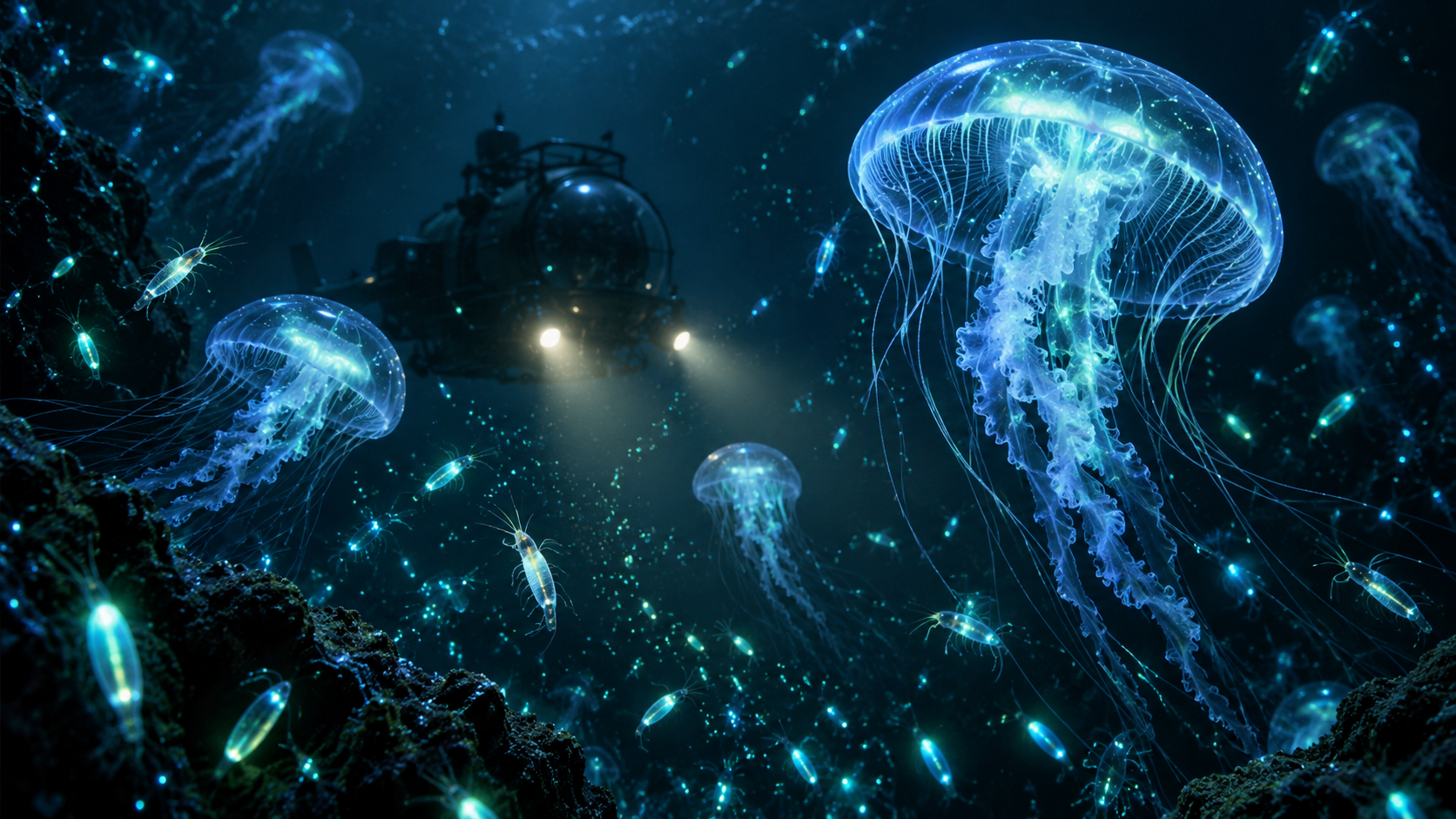
Most open-ocean bioluminescence appears blue or blue-green because those wavelengths travel farthest through seawater and many marine eyes are sensitive to them. Coastal dinoflagellates can flash when waves or motion disturb them. On land, fireflies use yellow-green signals, while fungi, beetles, worms, and other groups produce their own colors and patterns.
Living light serves several functions. Predators use lures or searchlights, prey startle attackers or release glowing decoys, and some animals erase their silhouette with counterillumination that matches downwelling light. Species also signal to mates or coordinate with members of their own kind. A single flash may have different effects depending on the observer.
Bioluminescence is efficient because little energy becomes heat, but it is not free. Organisms must synthesize or obtain reactants and control when light is useful. Fluorescence is different: a fluorescent material absorbs external light and re-emits another wavelength, whereas bioluminescence supplies chemical energy from within the organism or its symbiont.
Researchers use sensitive cameras, submersibles, molecular analysis, and laboratory cultures to study luminous systems. Luciferase reactions have become important tools for tracking genes, cells, contamination, and biochemical activity. The visible glow is therefore both an ecological adaptation and a measurable chemical signal that scientists can repurpose.
A luciferin-based reaction creates an excited product that releases a photon as it returns to lower energy.
Luciferases, photoproteins, oxygen, ions, and cellular controls determine when and where light appears.
Blue-green dominates in the ocean because those wavelengths travel efficiently through seawater.
Organisms use light for hunting, defense, camouflage, mating, and communication.
Bioluminescence uses chemical energy, whereas fluorescence requires incoming light to excite the material.
Luciferase systems are widely used as sensitive reporters in medicine, genetics, ecology, and food testing.
Explore more "Explainers"
Discover additional explainers across politics, science, business, technology, and other fields. Each explainer breaks down a complex idea into clear, everyday language—helping you better understand how major concepts, systems, and debates shape the world around us.