

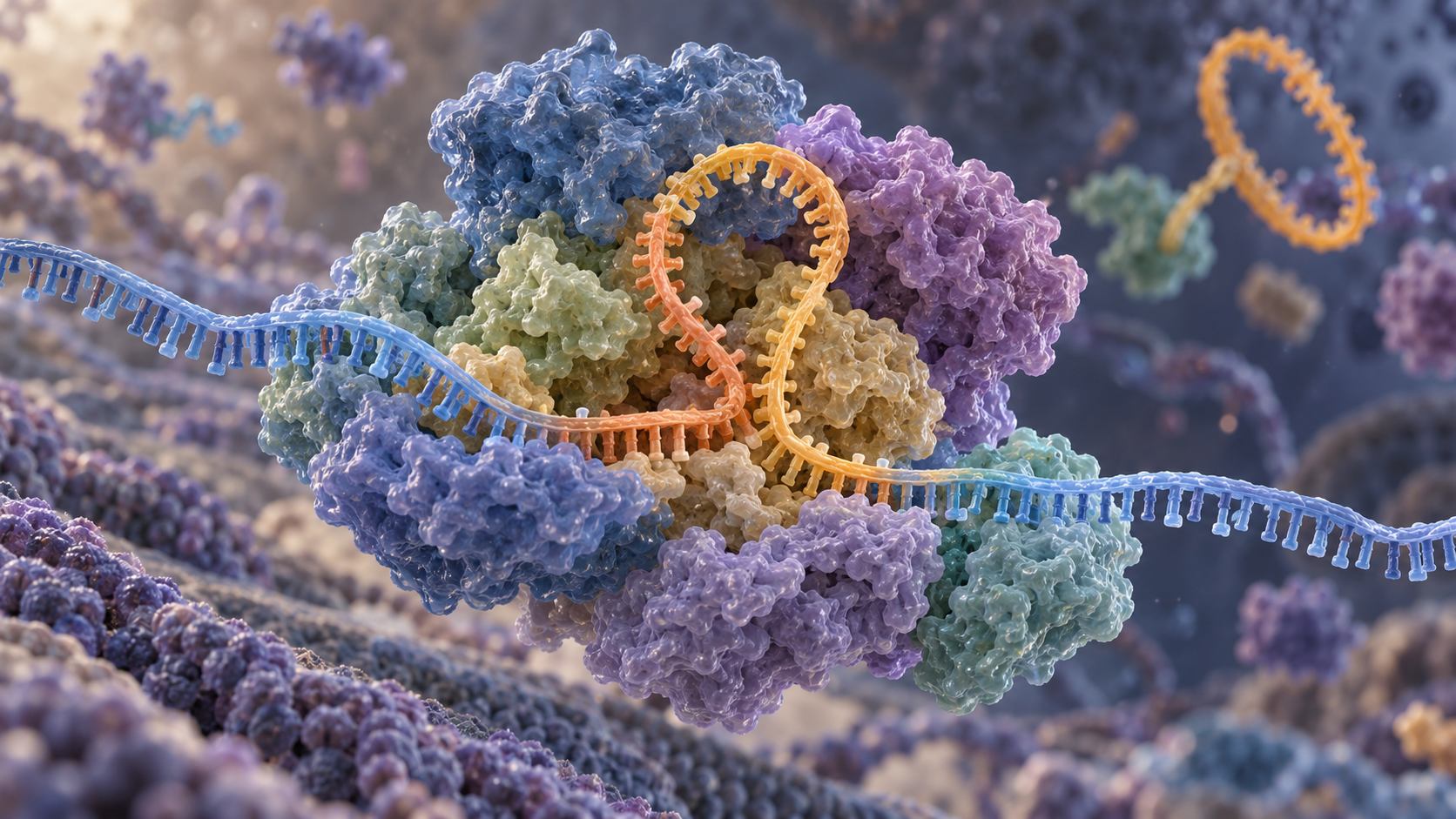
How RNA Splicing Edits Genetic Messages Explainer
Many eukaryotic genes are copied into precursor messenger RNA that contains exons interrupted by introns. Before the RNA can direct protein synthesis, most introns must be removed and the exons joined in the correct order. This processing occurs in the nucleus and is coordinated with transcription, capping, and formation of the RNA’s poly(A) tail.
Short sequence signals mark the ends of an intron and an internal branch point. Small nuclear ribonucleoproteins recognize these features and assemble with many other proteins into a spliceosome. The complex rearranges repeatedly, bringing the reacting RNA sites close together and checking interactions that help define the splice boundaries.
Splicing proceeds through two transfer reactions. First, a branch-point adenosine attacks the intron’s 5-prime splice site and forms a looped lariat. The newly freed end of the upstream exon then attacks the 3-prime splice site. The exons are ligated, and the intron lariat is released and usually broken down.
A single pre-mRNA can often be spliced in more than one way. Alternative splicing may include or skip an exon, choose different splice sites, or retain an intron. Regulatory proteins, RNA structure, cell type, developmental stage, and signaling determine which pattern dominates. This allows one gene to produce multiple RNA and protein forms.
Alternative splicing expands diversity but also creates opportunities for error. A sequence variant may weaken a splice site or activate a hidden one, and altered regulatory proteins can shift patterns across many genes. Cells monitor mature RNA and destroy many messages with premature stop codons through nonsense-mediated decay, although some faulty transcripts escape.
Researchers map splice junctions with RNA sequencing and test mechanisms with genetic and biochemical experiments. Some therapies use short antisense molecules to redirect splice-site choice for particular diseases. Splicing is therefore not cosmetic trimming. It is a central layer of gene regulation that determines which coding information reaches the ribosome.
Pre-mRNA contains exons and introns, and most introns must be removed before translation.
Sequence signals recruit small nuclear ribonucleoproteins and other factors to assemble the spliceosome.
Two RNA reactions form an intron lariat and join the neighboring exons.
Alternative splicing selects different exon combinations and lets one gene produce multiple products.
Mutations or regulatory changes can disrupt splice choice and contribute to disease.
RNA sequencing, quality-control pathways, and antisense therapies reveal and sometimes redirect splicing.
Explore more "Explainers"
Discover additional explainers across politics, science, business, technology, and other fields. Each explainer breaks down a complex idea into clear, everyday language—helping you better understand how major concepts, systems, and debates shape the world around us.