

How Groundwater Aquifers Store Water Explainer
Groundwater is water that fills cracks and pore spaces beneath the land surface. An aquifer is a body of rock or sediment that stores enough water and allows it to move readily enough to supply wells or springs. It is not usually an underground lake. Water occupies countless connected openings between sand grains, within gravel, along fractures in rock, or through channels dissolved in limestone.
Porosity describes how much open space a material contains, while permeability describes how easily water can flow through connected spaces. Clay can have high porosity but very low permeability because its pores are tiny and poorly connected. Sand and gravel commonly transmit water more readily. Fractured rock may have little overall pore space yet carry substantial groundwater along a network of cracks.
Recharge occurs when rain, melting snow, stream water, or intentionally applied water infiltrates the ground and reaches the saturated zone. The top of that zone is the water table in an unconfined aquifer. A confined aquifer lies beneath a low-permeability layer, and its water may be pressurized. A well drilled into it can rise above the aquifer and, in some cases, flow at the surface.
Groundwater moves from areas of higher hydraulic head toward lower head, often slowly. Pumping lowers pressure around a well and forms a cone of depression that draws water inward. If withdrawals exceed recharge for long periods, water levels fall, wells may fail, streams can lose base flow, and compacting sediments may cause land subsidence that permanently reduces storage space.
Aquifers also carry dissolved substances. Fertilizer, leaking fuel, industrial chemicals, saltwater, or pathogens can move with recharge and groundwater flow. Contamination may persist because subsurface water moves slowly and is difficult to clean. Wellhead protection, careful waste handling, land-use controls, and monitoring help keep pollutants away from vulnerable recharge areas.
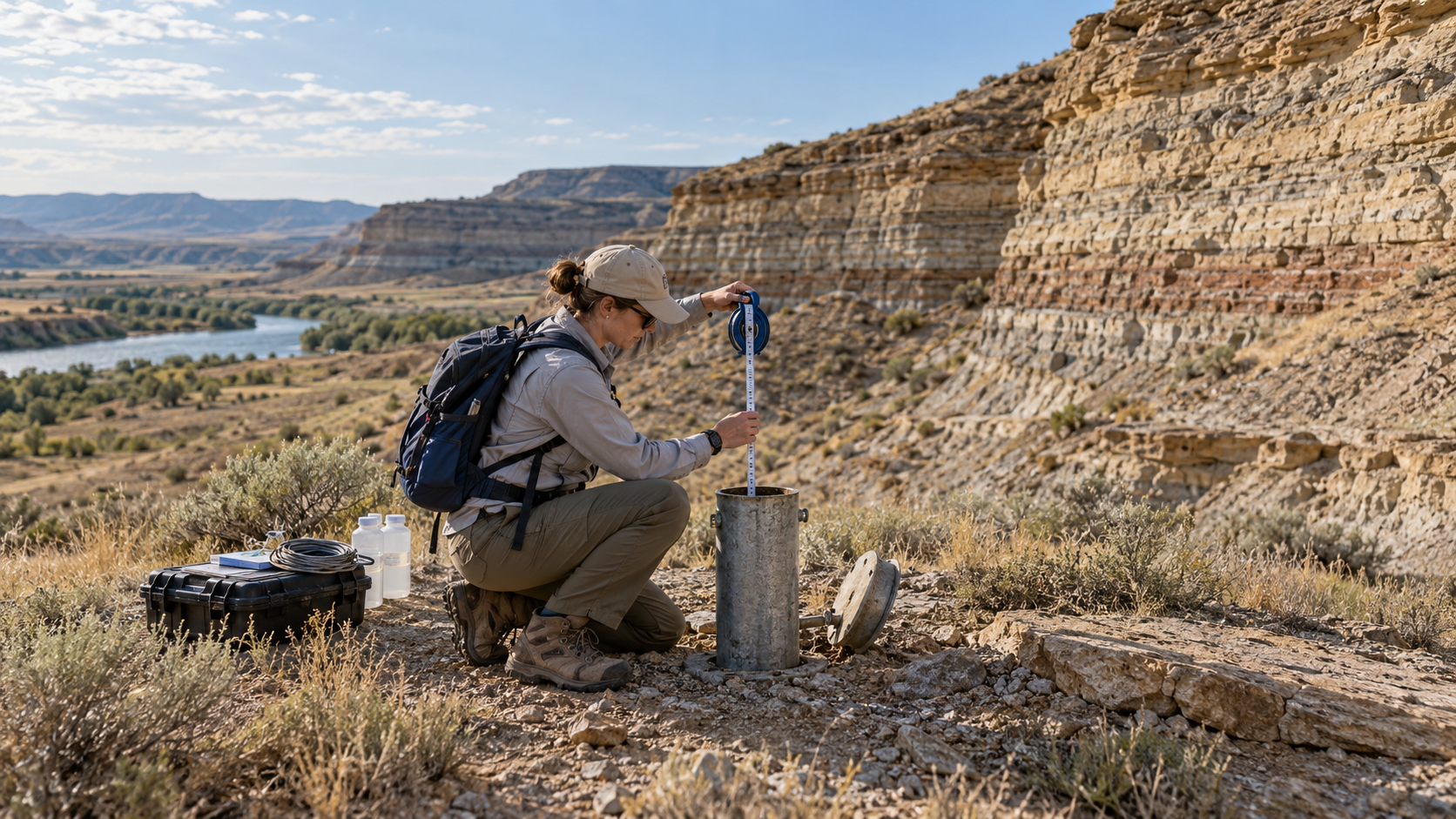
Hydrogeologists map layers, measure water levels, pump test wells, sample chemistry, and build flow models to estimate aquifer behavior. No single value defines safe pumping everywhere because recharge changes with climate, surface use, and geology. An aquifer is a dynamic part of the water cycle whose long-term reliability depends on both its physical structure and how people manage withdrawals and contamination.
Aquifers hold water in connected pores and fractures rather than in a single open underground cavern.
Porosity controls storage, while permeability controls how readily groundwater can move.
Recharge carries surface water downward to the saturated zone and replenishes aquifer storage.
Confining layers can pressurize groundwater; pumping creates a local cone of depression.
Overpumping can lower wells, reduce streamflow, cause saltwater intrusion, and compact sediments.
Monitoring, chemistry, pump tests, and flow models guide protection and sustainable use.
Explore more "Explainers"
Discover additional explainers across politics, science, business, technology, and other fields. Each explainer breaks down a complex idea into clear, everyday language—helping you better understand how major concepts, systems, and debates shape the world around us.