

How Tsunamis Cross Oceans Explainer
A tsunami begins when a large volume of water is displaced suddenly. Most are caused by strong undersea earthquakes that move the seafloor vertically, but landslides, volcanic activity, and rare impacts or atmospheric disturbances can also generate them. The displacement creates a series of very long gravity waves that radiate outward. A tsunami is not a tide, and its behavior differs from ordinary wind waves.
In the deep ocean, tsunami wavelength can span tens or hundreds of kilometers while wave height may be modest. The whole water column participates, so a passing wave may be difficult to notice from a ship. Its speed depends mainly on water depth: deeper water supports faster propagation. Because the wavelength is so long, the wave can carry energy across an ocean basin with comparatively little loss.
Seafloor shape bends and redirects the wave through refraction. Islands, ridges, continental margins, and basins can focus energy in some directions and reduce it in others. A single source therefore does not produce the same arrival height everywhere. Numerical models combine the initial seafloor motion with bathymetry to forecast travel times and possible coastal effects.
As a tsunami enters shallow water, its speed decreases and its wavelength shortens. Energy becomes compressed into a smaller horizontal distance, and wave height and currents can grow. The result may resemble a rapidly rising flood, a turbulent bore, or repeated surges rather than a curling beach wave. Bays, harbors, river mouths, and local topography can amplify or prolong inundation.
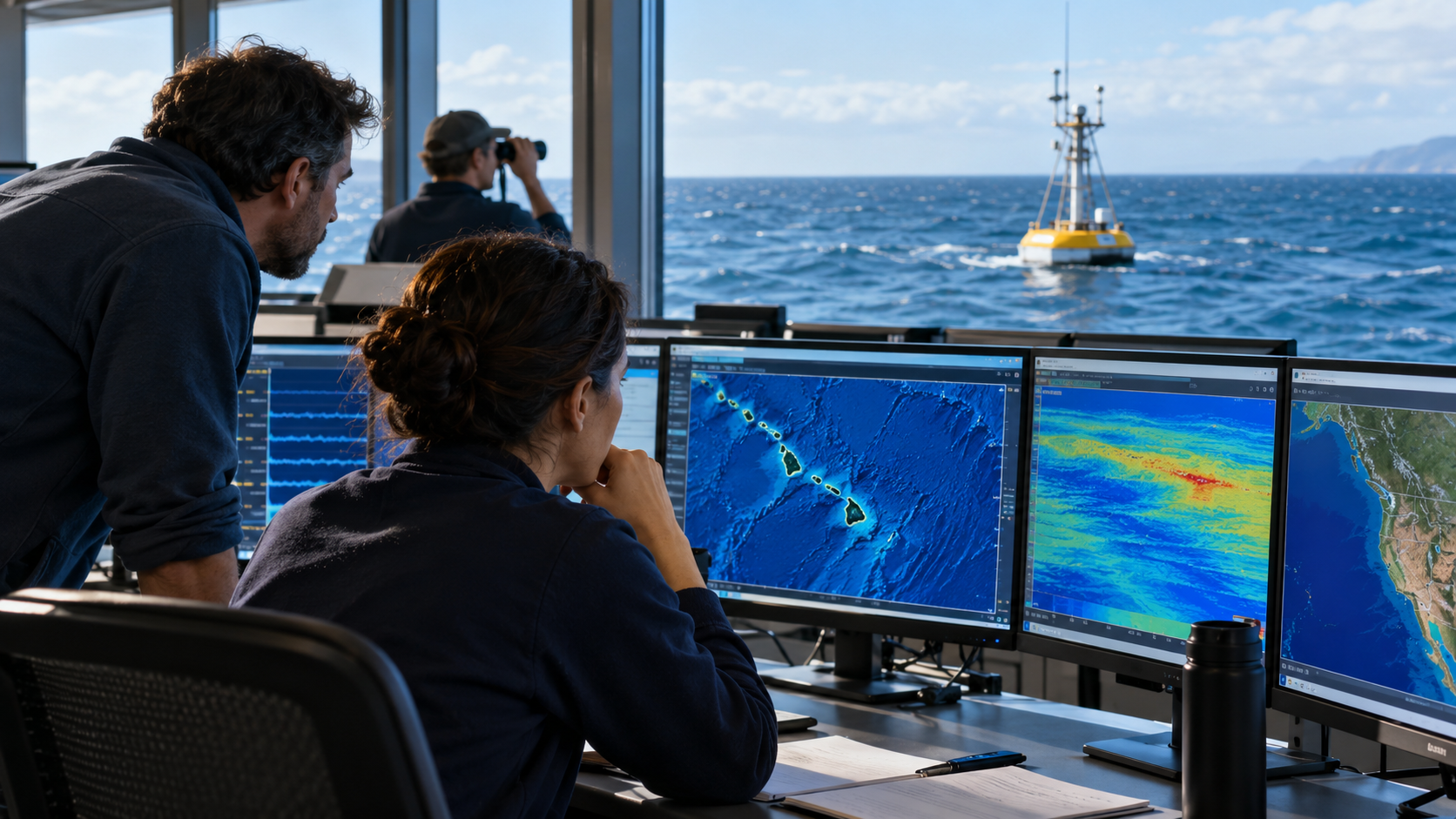
Seismometers quickly locate and characterize earthquakes, but not every large earthquake creates a dangerous tsunami. Deep-ocean pressure sensors detect the passing wave and relay measurements through buoys and satellites. Coastal gauges confirm water-level changes. Warning centers compare observations with models and issue alerts, but nearby coasts may have only minutes before arrival.
The first wave may not be the largest, and dangerous currents can continue for hours. Natural signs such as strong or long ground shaking, a sudden sea retreat, or a loud ocean roar require immediate movement to high ground without waiting for an official message. Science improves forecasts, but local preparation, evacuation routes, and rapid action remain essential parts of tsunami safety.
Sudden displacement of a large water volume creates a train of extremely long waves.
Deep-ocean tsunamis can move rapidly with low height because the full water column is involved.
Bathymetry refracts and focuses energy, producing different effects along different coasts.
Shoaling slows and shortens the wave while increasing height and destructive currents.
Seismic networks, deep-ocean pressure sensors, gauges, and models support warnings.
Several surges can arrive, so natural warning signs and evacuation remain critical.
Explore more "Explainers"
Discover additional explainers across politics, science, business, technology, and other fields. Each explainer breaks down a complex idea into clear, everyday language—helping you better understand how major concepts, systems, and debates shape the world around us.