

How Tidal Locking Synchronizes Rotation Explainer
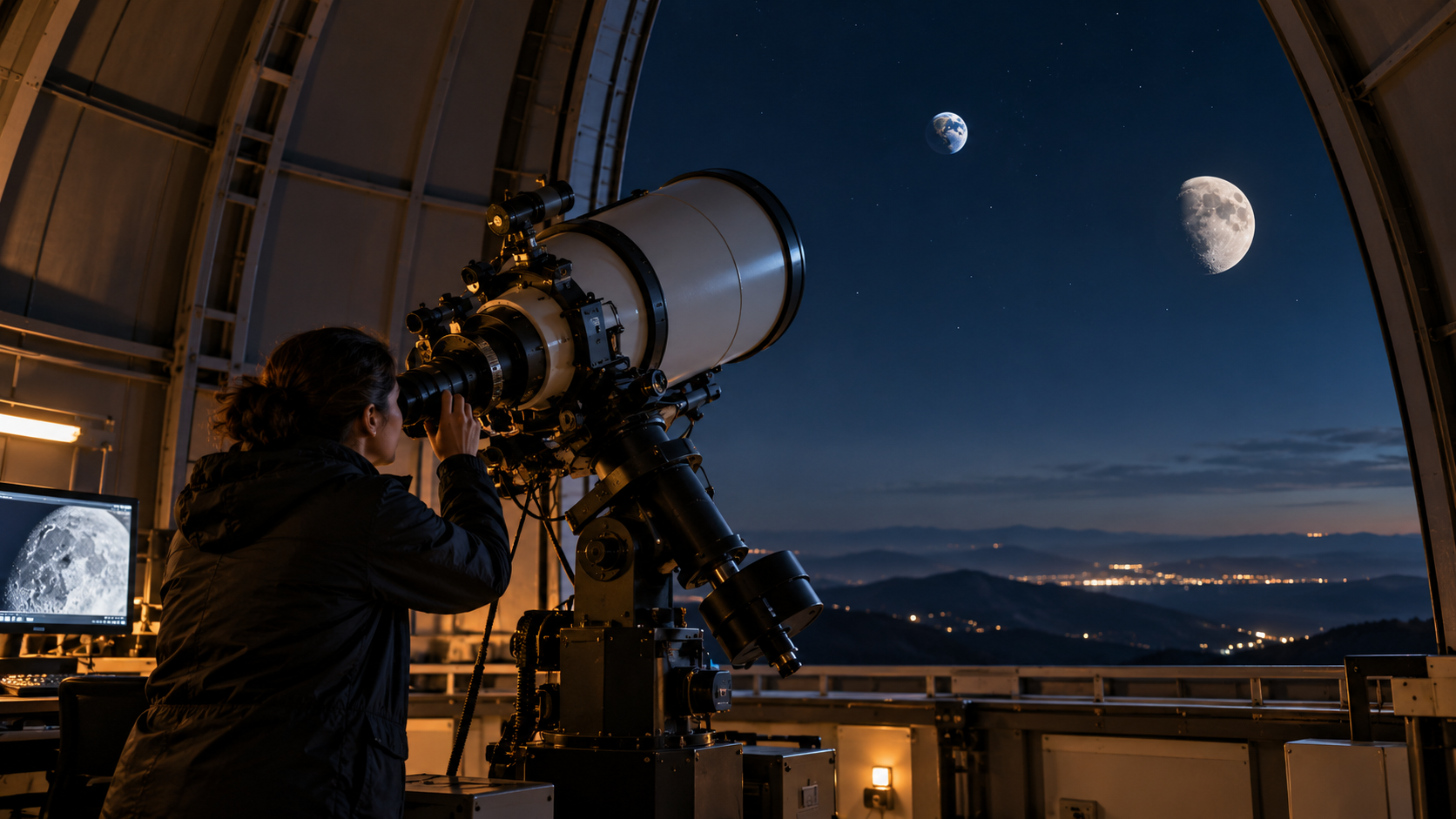
Tidal locking is a state in which an object’s rotation becomes synchronized with its orbit, often so the same hemisphere continually faces its partner. Earth’s Moon rotates once during each orbit, which is why it keeps nearly the same face toward Earth. It is not motionless: without rotation, every lunar longitude would eventually face us as the Moon traveled around its orbit.
Gravity is stronger on the near side of a moon than on the far side, stretching it into a slight tidal bulge. If the moon spins faster than it orbits, the bulge is carried away from perfect alignment. The planet’s gravity pulls on the offset bulge, exerting a torque that changes the spin. The deforming interior also converts some mechanical energy into heat.
As energy is dissipated, the spin approaches a stable resonance. In the simplest case, one rotation takes one orbit and the long axis of the tidal bulge stays aligned with the planet. The orbital angular momentum can change at the same time. In the Earth-Moon system, tides raised on Earth slow Earth’s rotation and transfer angular momentum that gradually moves the Moon outward.
Perfect alignment is not visually exact because orbits are elliptical and axes can be tilted. The Moon appears to rock slightly through libration, letting observers on Earth see more than half its surface over time. Other bodies occupy different spin-orbit resonances. Mercury rotates three times for every two orbits because its eccentric orbit and permanent shape favor a 3:2 state.
Locking time depends on distance, mass, size, internal rigidity, dissipation, and initial rotation. Stronger tides at close range usually synchronize a body faster. Large moons in the solar system are commonly locked to their planets, and some close exoplanets may be locked to their stars. Atmospheres, oceans, companions, and orbital eccentricity can complicate the final rotation.
A tidally locked planet does not necessarily have one permanently frozen side and one permanently scorched side. Atmospheres or oceans can redistribute heat, and orbital or rotational resonances may differ from simple one-to-one locking. Tidal locking describes coupled rotation and orbit; climate consequences require additional information about the world’s air, water, surface, and star.
A locked moon still rotates, but its spin period matches its orbital period.
Gravity creates a tidal bulge, and torque on an offset bulge changes the rotation rate.
Internal deformation dissipates energy while angular momentum can move between spin and orbit.
Libration and resonances such as Mercury’s 3:2 state complicate the simplest picture.
Mass, distance, rigidity, dissipation, and initial conditions control locking time.
Climate on a locked world depends on atmospheric and oceanic heat transport as well as rotation.
Explore more "Explainers"
Discover additional explainers across politics, science, business, technology, and other fields. Each explainer breaks down a complex idea into clear, everyday language—helping you better understand how major concepts, systems, and debates shape the world around us.