

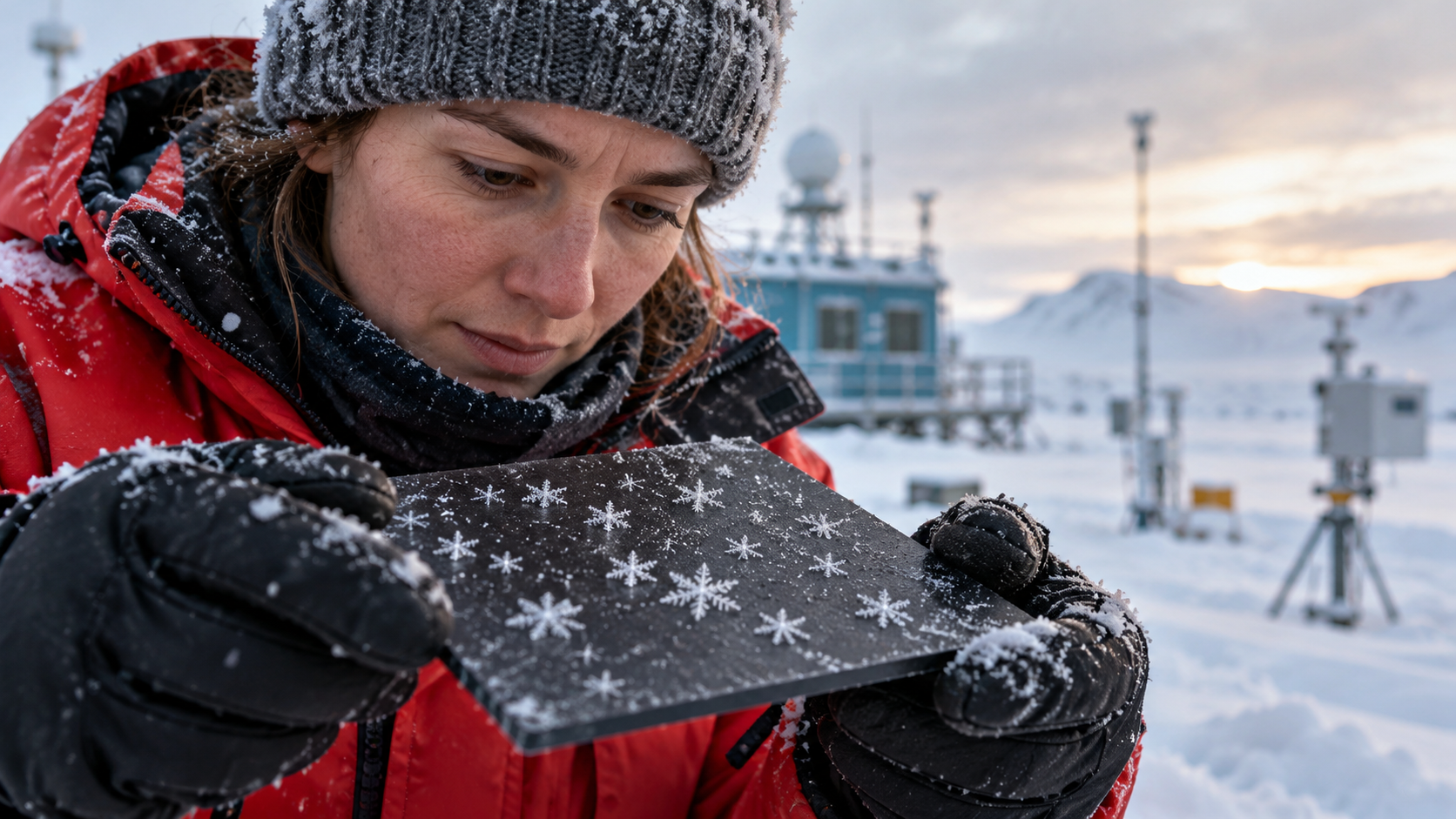
How Snowflakes Form Six-Sided Shapes Explainer
A snowflake begins in a cold cloud when water vapor deposits onto a tiny ice nucleus or a supercooled droplet freezes. It is not simply a raindrop that turned solid on the way down. Additional water molecules join the crystal directly from vapor, building ordered ice. The arrangement of molecules in ordinary atmospheric ice gives the crystal six equivalent directions of growth.
Water molecules connect through hydrogen bonds in a hexagonal lattice. At the visible scale, that internal symmetry produces six-sided plates, columns, needles, or six main arms. A perfect six-pointed star is only one form. The crystal can also collect frozen droplets, collide with other crystals, or partially melt, creating irregular snow particles that look very different from textbook photographs.
Branches form through an instability in growth. A small bump projects slightly farther into humid air and intercepts more water vapor, so it grows faster and becomes an even better collector. Similar protrusions develop along the six equivalent directions. Side branches repeat the process, producing elaborate dendrites when temperature and water-vapor supply favor branching.
Temperature and supersaturation—the amount of water vapor beyond equilibrium—control which crystal faces grow fastest. As a flake moves through layers of a cloud, those conditions change, switching growth among plates, columns, and branches. All six arms share nearly the same journey at the same time, so they develop related patterns even though tiny differences prevent perfect identity.
Riming occurs when supercooled droplets freeze onto a crystal, sometimes turning it into a rounded pellet called graupel. Aggregation joins crystals into larger flakes. Wind, collisions, sublimation, and melting further modify what reaches the ground. The weather term snow therefore covers particles with different microscopic histories, not only pristine single crystals.
Two flakes could in principle share the same broad type, but matching every branch at molecular detail is extraordinarily unlikely because each follows a unique path through fluctuating air. The dependable feature is the underlying ice symmetry, not identical decoration. Snowflake form is a visible record of crystal physics interacting with the changing temperature and humidity inside a cloud.
Snow crystals grow mainly by water vapor depositing onto an ice nucleus in a cold cloud.
The hexagonal molecular lattice of ordinary ice creates six equivalent growth directions.
Small protrusions collect vapor faster, amplifying them into branches and side branches.
Temperature and supersaturation select plates, columns, needles, or dendritic forms.
Riming, aggregation, sublimation, collision, and melting modify crystals during descent.
Six arms share conditions closely, but microscopic fluctuations make exact matches improbable.
Explore more "Explainers"
Discover additional explainers across politics, science, business, technology, and other fields. Each explainer breaks down a complex idea into clear, everyday language—helping you better understand how major concepts, systems, and debates shape the world around us.