

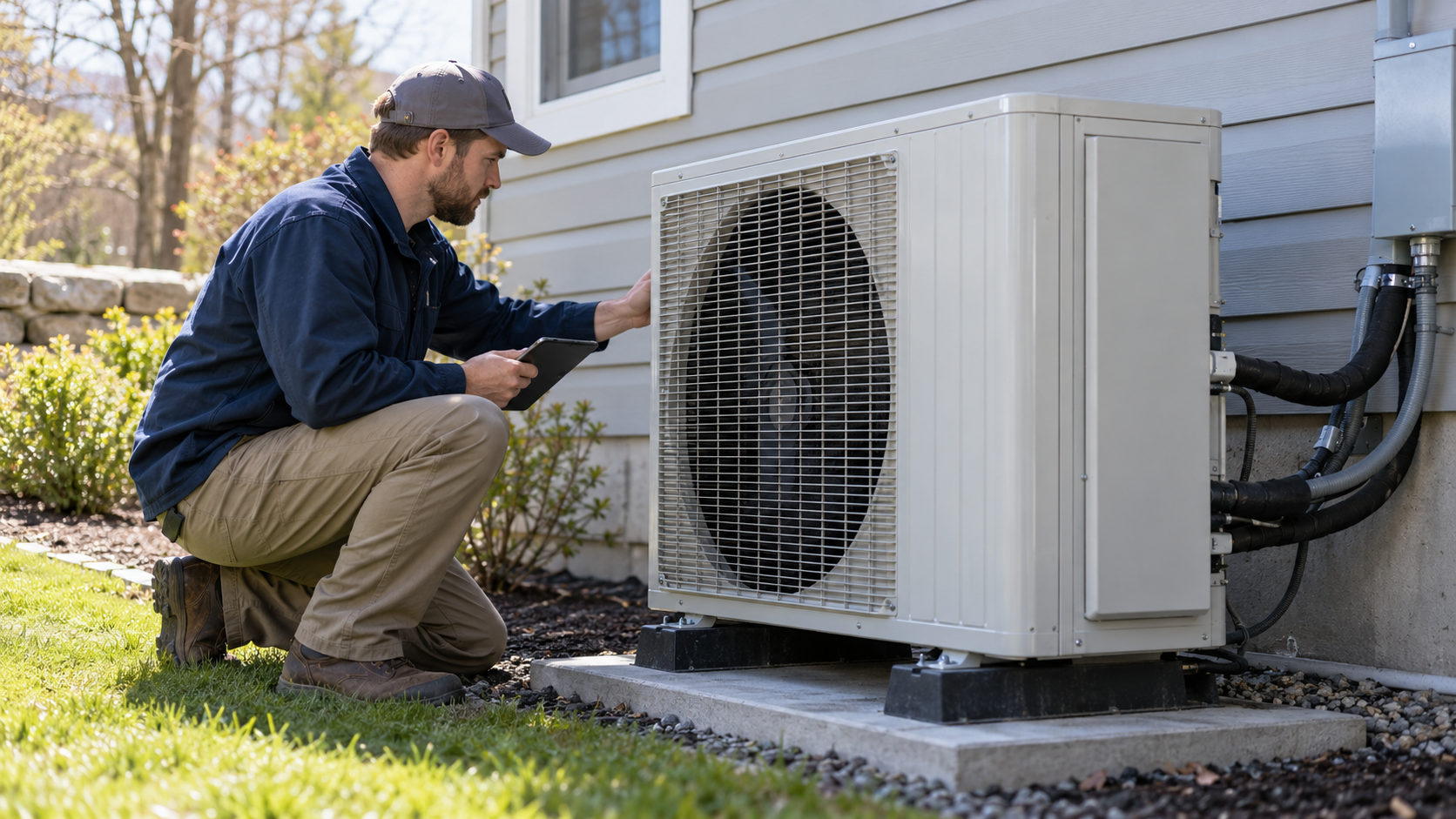
How Heat Pumps Move Heat Explainer
A heat pump transfers thermal energy rather than producing all of its heat by burning fuel or passing electricity through a resistance element. In heating mode, it absorbs heat from outdoor air, the ground, or water and releases that heat indoors. The source can feel cold and still contain usable thermal energy. Electricity powers the compressor, fans, and pumps needed to move that energy to a warmer place.
Most building heat pumps use a vapor-compression cycle. Cold, low-pressure refrigerant flows through an outdoor heat exchanger and evaporates as it absorbs heat. The compressor then squeezes the vapor, raising its pressure and temperature. Hot high-pressure refrigerant reaches the indoor heat exchanger, condenses to liquid, and releases heat into indoor air or water.
The liquid passes through an expansion device that sharply lowers its pressure and temperature, preparing it to absorb heat again. A reversing valve can swap which coil acts as evaporator and condenser, allowing the same equipment to cool a building in summer. In cooling mode, the indoor coil absorbs heat and the outdoor coil rejects it, just as an air conditioner does.
Performance depends strongly on the temperature lift between source and destination. Moving heat across a small difference requires less compressor work than lifting it across a large one. Air-source capacity and efficiency can decline in very cold weather, although modern cold-climate systems operate at low temperatures. Ground-source systems use steadier underground temperatures but require buried loops or wells and higher installation effort.
When an outdoor coil falls below freezing, moisture can accumulate as frost and block airflow. The system periodically enters a defrost cycle, temporarily reversing operation or using another heat source to melt it. Sizing, ductwork, refrigerant charge, airflow, controls, and building insulation strongly affect real performance. Oversized equipment can cycle poorly rather than automatically providing better comfort.
Efficiency is often expressed as a coefficient of performance: heat delivered divided by electrical energy used. A value above one is possible because the electricity is moving existing heat, not being converted one-for-one into heat. That does not violate thermodynamics, and efficiency still falls under demanding conditions. Heat pumps matter because they can provide heating and cooling with one reversible process whose impact depends on equipment, climate, and electricity supply.
The refrigerant absorbs heat while evaporating at low pressure and releases it while condensing at high pressure.
Compression raises refrigerant pressure and temperature so heat can flow into the warmer destination.
An expansion device lowers pressure and resets the refrigerant for another cycle.
A reversing valve swaps indoor and outdoor coil roles for heating or cooling.
Temperature lift, frost, sizing, airflow, insulation, and controls determine field performance.
A coefficient above one reflects transferred environmental heat, not creation of energy.
Explore more "Explainers"
Discover additional explainers across politics, science, business, technology, and other fields. Each explainer breaks down a complex idea into clear, everyday language—helping you better understand how major concepts, systems, and debates shape the world around us.