

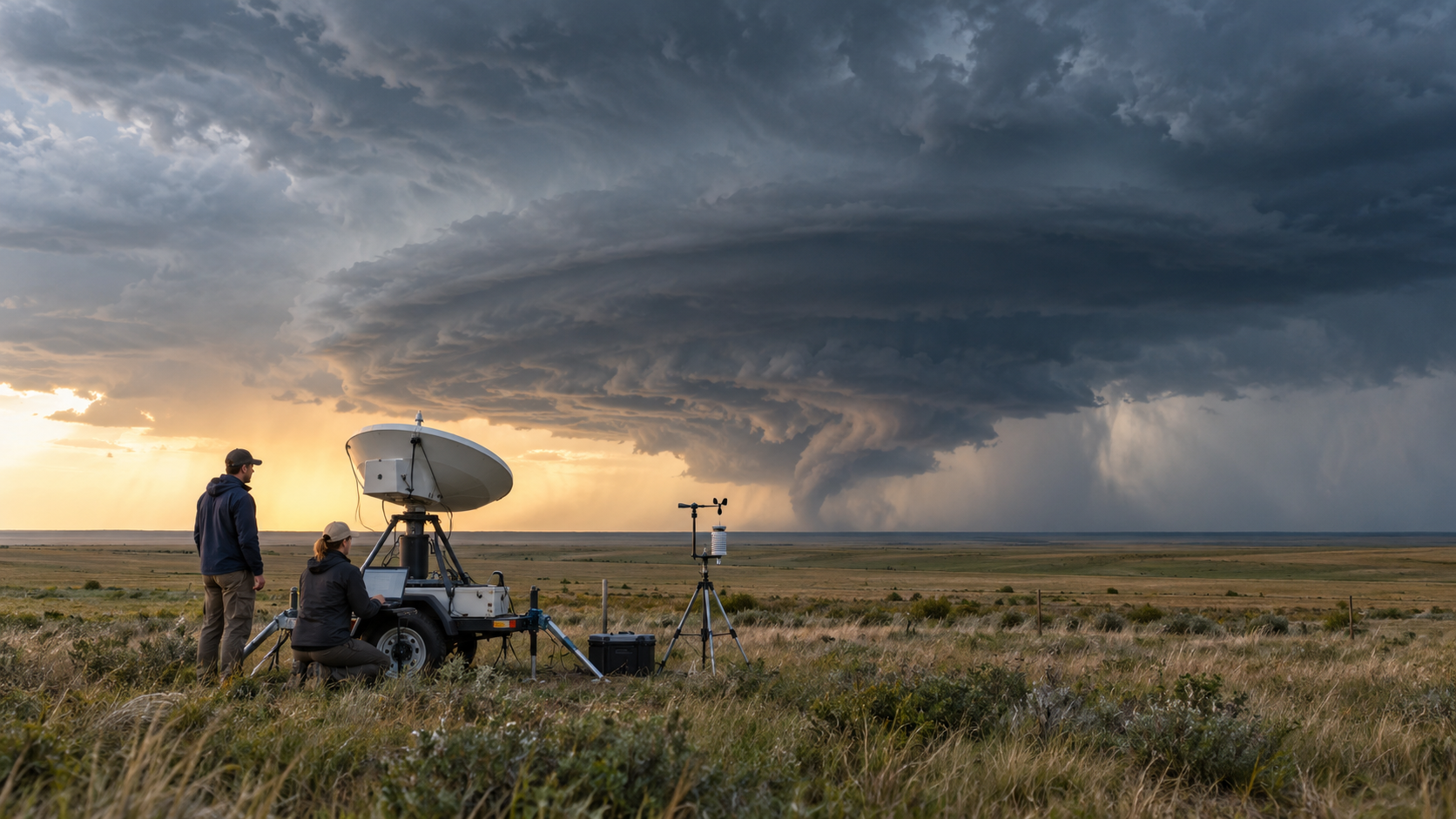
How Tornadoes Form Explainer
A tornado is a violently rotating column of air connected to a thunderstorm and in contact with the ground. The strongest and most studied tornadoes often come from supercells, long-lived storms with a rotating updraft called a mesocyclone. Yet most supercells do not produce tornadoes, and some tornadoes arise from storm lines or developing clouds without a classic mesocyclone.
A favorable environment usually supplies warm moist air near the ground, colder air aloft, and enough instability for vigorous updrafts. Wind that changes speed or direction with height creates horizontal rotation in the environment. A thunderstorm updraft can tilt some of that rotation into the vertical and stretch it, increasing the storm-scale spin while precipitation and downdrafts reorganize airflow around the updraft.
Tornadogenesis requires rotation to intensify close to the ground. In many supercells, descending air wraps around the mesocyclone and interacts with warm inflow. Temperature, moisture, pressure, friction, and the position of downdrafts all matter. If air near the ground becomes too cold and stable, it can cut off the updraft; in other cases, a favorably placed boundary helps concentrate vertical vorticity.
As rotating air narrows and stretches upward, conservation of angular momentum can increase spin, but that simple analogy does not explain how the circulation was created or maintained. A condensation funnel becomes visible when pressure and cooling allow water droplets to form. The tornado can already be in contact with the ground even if the visible funnel has not reached all the way down.
Doppler radar detects winds moving toward and away from the instrument and may reveal tight rotation or lofted debris. Spotters provide essential ground truth, and warnings combine radar, environment, reports, and storm motion. Radar cannot predict the exact path, intensity, or lifetime of every tornado, especially at long distance or when rotation develops rapidly below the beam.
Scientists use field observations, damage surveys, laboratory vortices, and high-resolution simulations to test competing mechanisms. Uncertainty is central: there is no one recipe that guarantees a tornado. The useful explanation is conditional—instability builds the storm, shear organizes rotation, storm-scale flows concentrate it near the ground, and only some combinations become a sustained tornado.
Strong tornadoes often come from supercells with rotating updrafts called mesocyclones.
Instability supports deep updrafts while wind shear supplies and organizes rotation.
Updrafts tilt horizontal rotation and stretching can intensify vertical spin.
Near-ground downdrafts, boundaries, temperature, moisture, and friction influence tornadogenesis.
A visible condensation funnel is not the same as the full wind circulation.
Radar, spotters, simulations, and field data help, but exact formation remains uncertain.
Explore more "Explainers"
Discover additional explainers across politics, science, business, technology, and other fields. Each explainer breaks down a complex idea into clear, everyday language—helping you better understand how major concepts, systems, and debates shape the world around us.