

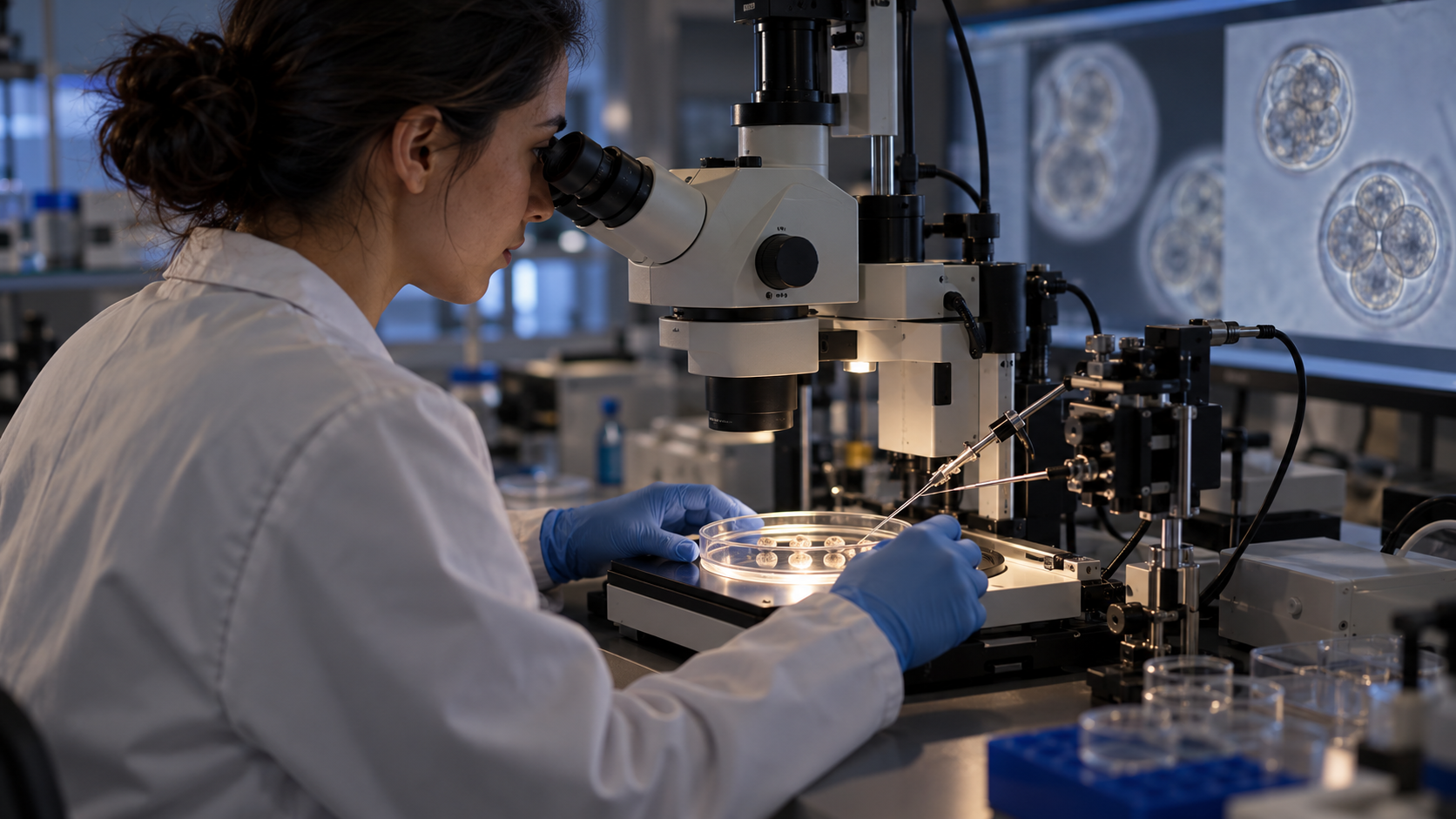
How Embryos Establish Body Axes Explainer
An embryo begins with cells that must agree on direction before organs can form in the right places. The major axes define head versus tail, back versus belly, and left versus right. Their molecular details differ among animals, but a shared principle is symmetry breaking: a small initial asymmetry is amplified by signaling and gene regulation into stable, large-scale positional information.
Some asymmetries come from molecules placed in the egg by the mother; others arise after fertilization through cell interactions or movement. Localized signaling centers release molecules that spread, are transported, or are broken down at different rates. Cells interpret concentration, duration, and combinations of these signals, often called morphogens, through thresholds and regulatory feedback.
During gastrulation, large groups of cells move, change neighbors, and form germ layers. Organizer regions emit signals that pattern nearby tissue and can help define the back-to-belly axis. Wnt, BMP, Nodal, Hedgehog, and related pathways appear repeatedly, but their meaning depends on place and time. The same pathway may promote one fate early and a different fate later.
Head-to-tail identity is reinforced by ordered gene expression, including Hox genes whose chromosomal arrangement broadly parallels their domains of action. These genes do not build body parts by themselves; they regulate networks that give repeated segments or regions distinct identities. Growth, tissue mechanics, and ongoing signals then convert positional identity into anatomy.
Left-right asymmetry is established later in many vertebrates. Rotating cilia at an embryonic node can create directional fluid movement or asymmetric sensing, leading to stronger Nodal-pathway activity on one side. That information guides the usual placement of organs such as the heart and stomach. Different species use related but not identical mechanisms, and variation can reverse or randomize organ positions.
Embryos are partly self-correcting: cell communication and feedback can restore patterns after small disturbances. That robustness has limits, and genetic changes or environmental insults can alter axis formation. Researchers study embryos, organoids, live imaging, and gene perturbations under strict ethical frameworks. Axis formation shows how anatomy emerges from dynamic decisions rather than a miniature body simply enlarging.
Body axes arise when small molecular or physical asymmetries are amplified.
Localized signals and morphogen gradients give cells positional information.
Gastrulation combines patterning with coordinated cell and tissue movement.
Hox networks help assign distinct identities along the head-to-tail axis.
Cilia and asymmetric Nodal signaling help establish vertebrate left and right.
Feedback makes early development robust but not immune to disruption.
Explore more "Explainers"
Discover additional explainers across politics, science, business, technology, and other fields. Each explainer breaks down a complex idea into clear, everyday language—helping you better understand how major concepts, systems, and debates shape the world around us.