

How LEDs Produce Light Explainer
A light-emitting diode is a semiconductor device that converts electrical energy directly into light. It contains regions engineered with different impurities: an n-type side rich in mobile electrons and a p-type side containing mobile vacancies called holes. Their boundary forms a p-n junction with an internal electric field and an energy barrier.
Applying forward voltage lowers that barrier and injects electrons and holes toward the junction. In a suitable semiconductor, an electron can fall into an empty lower-energy state and recombine with a hole. The energy difference is released as a photon. This process is electroluminescence, and it does not require heating a filament until it glows.
The semiconductor band gap sets the photon energy and therefore the basic color. Compound semiconductors using gallium, indium, aluminum, nitrogen, phosphorus, or arsenic cover different wavelength ranges. Device layers confine carriers and light near an active region, while surface shapes, reflectors, and transparent encapsulants help photons escape instead of being absorbed inside.
Many white LEDs begin with a blue or violet chip. A phosphor absorbs some of that light and re-emits a broader range of longer wavelengths. The mixture appears white. Phosphor composition and chip spectrum set color temperature and color rendering. Other designs combine separate red, green, and blue emitters whose currents can be adjusted independently.
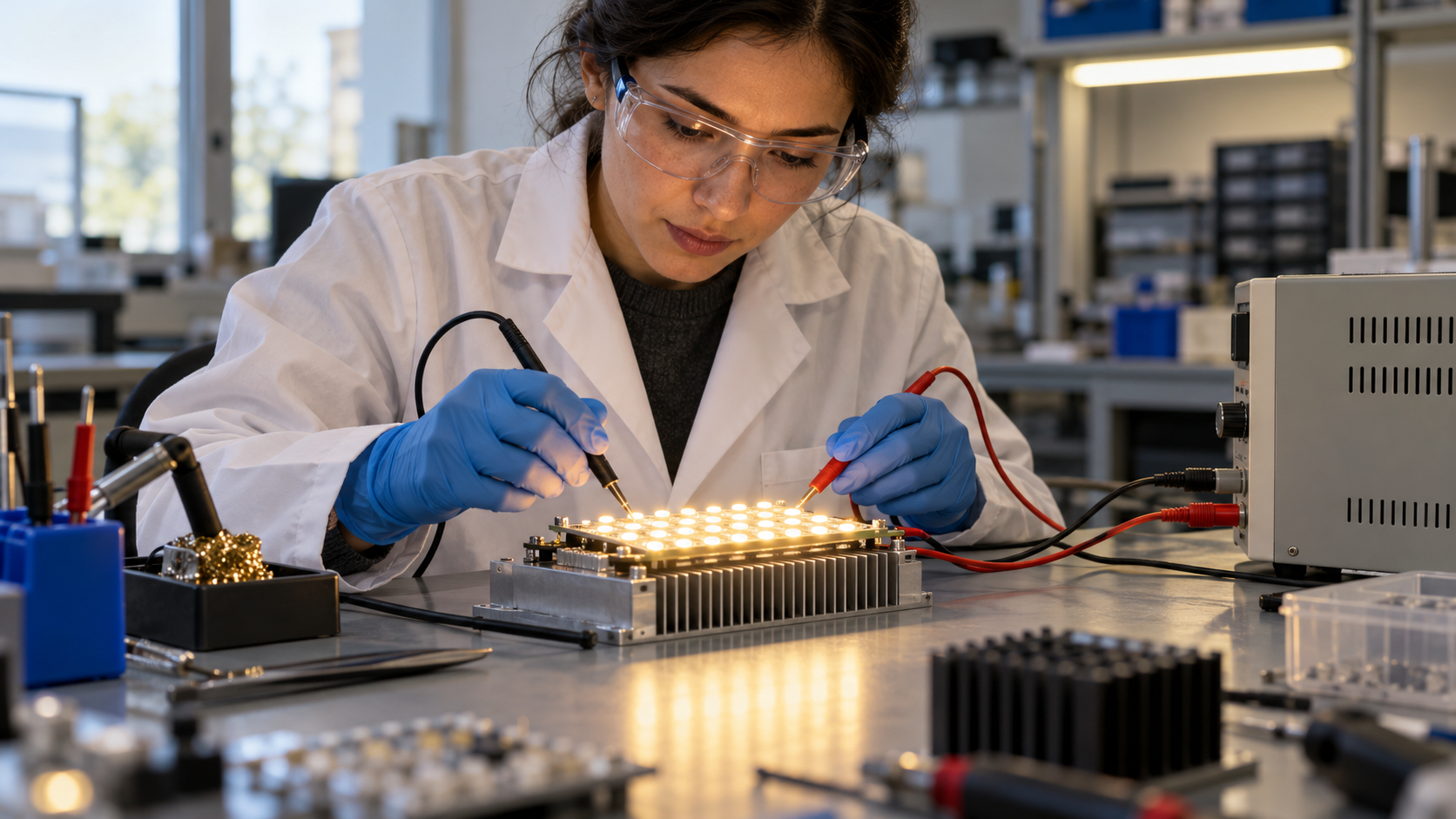
LED efficiency is high but not perfect. Electrical resistance, nonradiative recombination, and trapped light become heat. Junction temperature affects brightness, color, efficiency, and lifetime, so fixtures need thermal paths even though their beams feel cooler than incandescent light. Drivers regulate current because a small voltage change can otherwise produce a large current increase.
Engineers measure electrical power, optical output, spectrum, beam pattern, temperature, and aging. Laboratory efficiency does not equal total lamp efficiency because drivers, optics, and phosphors add losses. LEDs last by dimming gradually rather than remaining unchanged forever, and real lifetime depends strongly on temperature, current, materials, and packaging.
Forward bias injects electrons and holes into an active semiconductor region.
Electron-hole recombination releases energy as photons.
Band-gap energy determines the emitter’s basic wavelength.
Phosphors convert part of blue or violet light to make white light.
Heat removal and current regulation protect efficiency and lifetime.
Complete lamps include driver and optical losses beyond the LED chip.
Explore more "Explainers"
Discover additional explainers across politics, science, business, technology, and other fields. Each explainer breaks down a complex idea into clear, everyday language—helping you better understand how major concepts, systems, and debates shape the world around us.