

How Gravitational Waves Reveal Cosmic Collisions Explainer
General relativity predicts that changing distributions of mass can create gravitational waves: propagating distortions of spacetime. Strong detectable signals come from compact objects such as black holes or neutron stars orbiting rapidly. The system loses orbital energy, the objects spiral together, and wave frequency and amplitude rise in a characteristic chirp before merger.
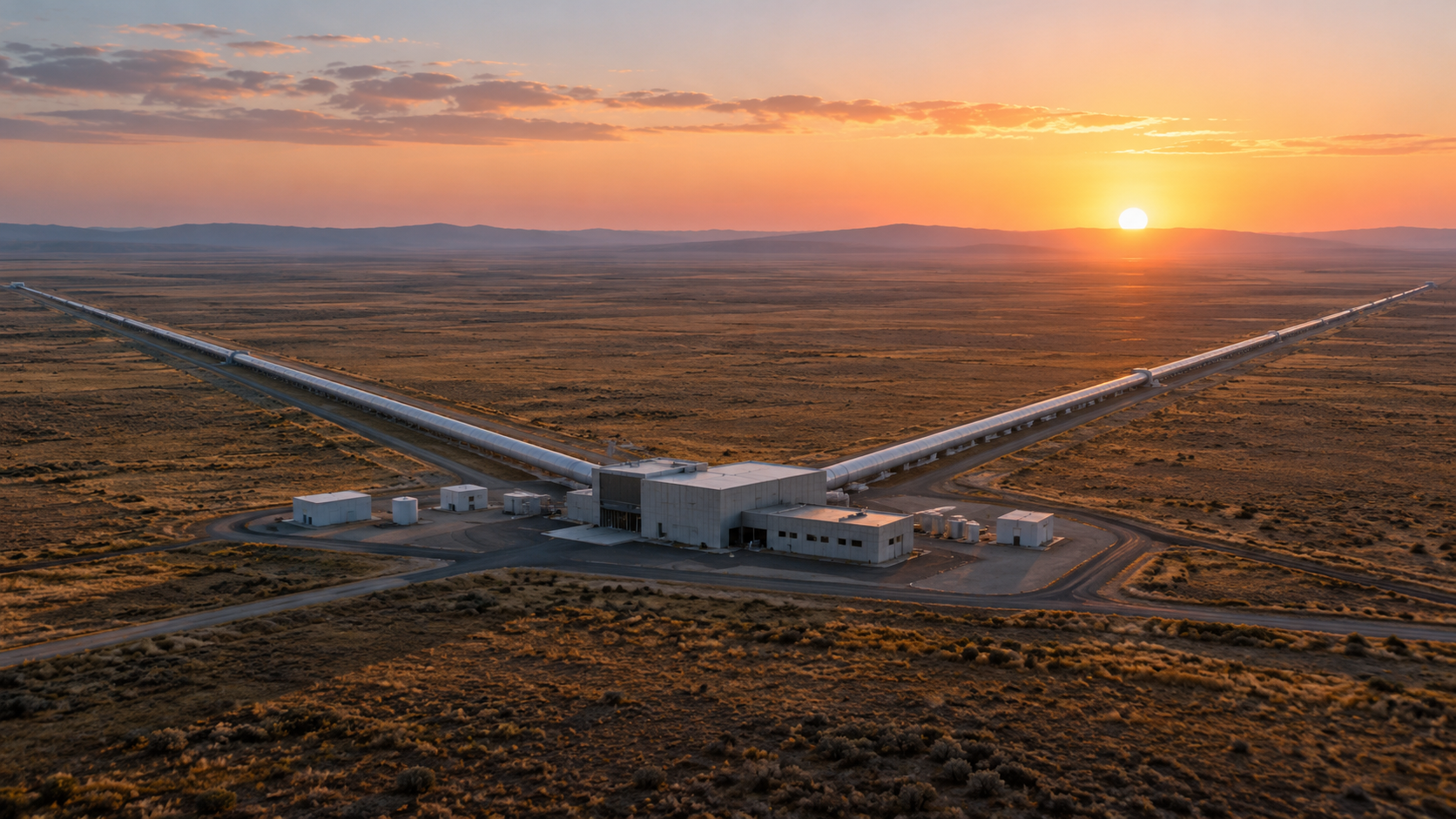
A passing wave alternately stretches one direction and compresses the perpendicular direction by an extraordinarily small fraction called strain. Laser interferometers send light along two long vacuum arms and compare the returning phases. Mirrors act as nearly free test masses. A wave changes the relative optical path lengths, producing a measurable interference variation.
The target displacement is far smaller than an atomic nucleus, so isolation and calibration dominate the instrument. Suspensions reduce ground vibration, ultra-high vacuum prevents air fluctuations, and control systems hold lasers and mirrors in operating range. Wind, earthquakes, thermal motion, scattered light, electronics, and quantum fluctuations create distinct noise that scientists monitor continuously.
Computers compare data with waveform models calculated from relativity. The evolution of frequency and phase encodes the objects’ combined mass, mass ratio, spins, orbital orientation, and tidal response. Signal strength and model assumptions constrain distance. For black-hole mergers, the final ringing reveals properties of the newly formed remnant.
One detector cannot determine a unique sky position. Arrival-time and amplitude differences across a global network triangulate a region and test polarization. Astronomers then search with telescopes and particle detectors. A neutron-star merger observed in gravitational waves and light can reveal heavy-element production, jet physics, and the expansion of the universe.
Detections are statistical claims, not audible recordings from space. The familiar sounds are data frequencies shifted or mapped into human hearing. Analysts use independent pipelines, simulated signals, environmental sensors, and background estimates. Gravitational-wave astronomy adds a new messenger because it measures bulk motion of compact masses rather than emitted light.
Rapidly accelerating compact objects generate measurable ripples in spacetime.
Binary inspirals produce a rising-frequency, rising-amplitude chirp.
Interferometers compare laser phase along perpendicular vacuum arms.
Isolation, calibration, and noise modeling are central to detection.
Waveforms encode mass, spin, orbit, distance, and merger dynamics.
A detector network and electromagnetic follow-up improve location and interpretation.
Explore more "Explainers"
Discover additional explainers across politics, science, business, technology, and other fields. Each explainer breaks down a complex idea into clear, everyday language—helping you better understand how major concepts, systems, and debates shape the world around us.