

How Microtubules Move Cargo Through Cells Explainer
Microtubules are hollow protein polymers that act as structural supports and long-distance transport tracks inside cells. Their two ends have different molecular orientations, giving the network polarity that lets motor proteins move cargo in a predictable direction. Cells regulate the pathway in context, so the outcome reflects both molecular recognition and cellular state.
Most microtubules assemble from alpha- and beta-tubulin units and repeatedly grow or shrink, a behavior called dynamic instability. Organizing centers and stabilizing proteins position the tracks so they can connect cell regions without forming a permanent rigid scaffold. Location matters because membranes and molecular partners determine which reactions can occur together.
Kinesin and dynein motors bind both a microtubule and cargo, often through adaptor proteins. Cycles of ATP binding, hydrolysis, and product release change the motor’s shape, causing its paired domains to step along the track. The sequence is coordinated rather than automatic, and checkpoints can redirect or stop it.
Many kinesins move toward a microtubule’s plus end, while cytoplasmic dynein usually travels toward the minus end. Vesicles can carry both motor types, and regulatory signals determine which engages, allowing pauses, reversals, and delivery to specific destinations. Different cell types tune the same core machinery to suit their structure, metabolism, and surroundings.
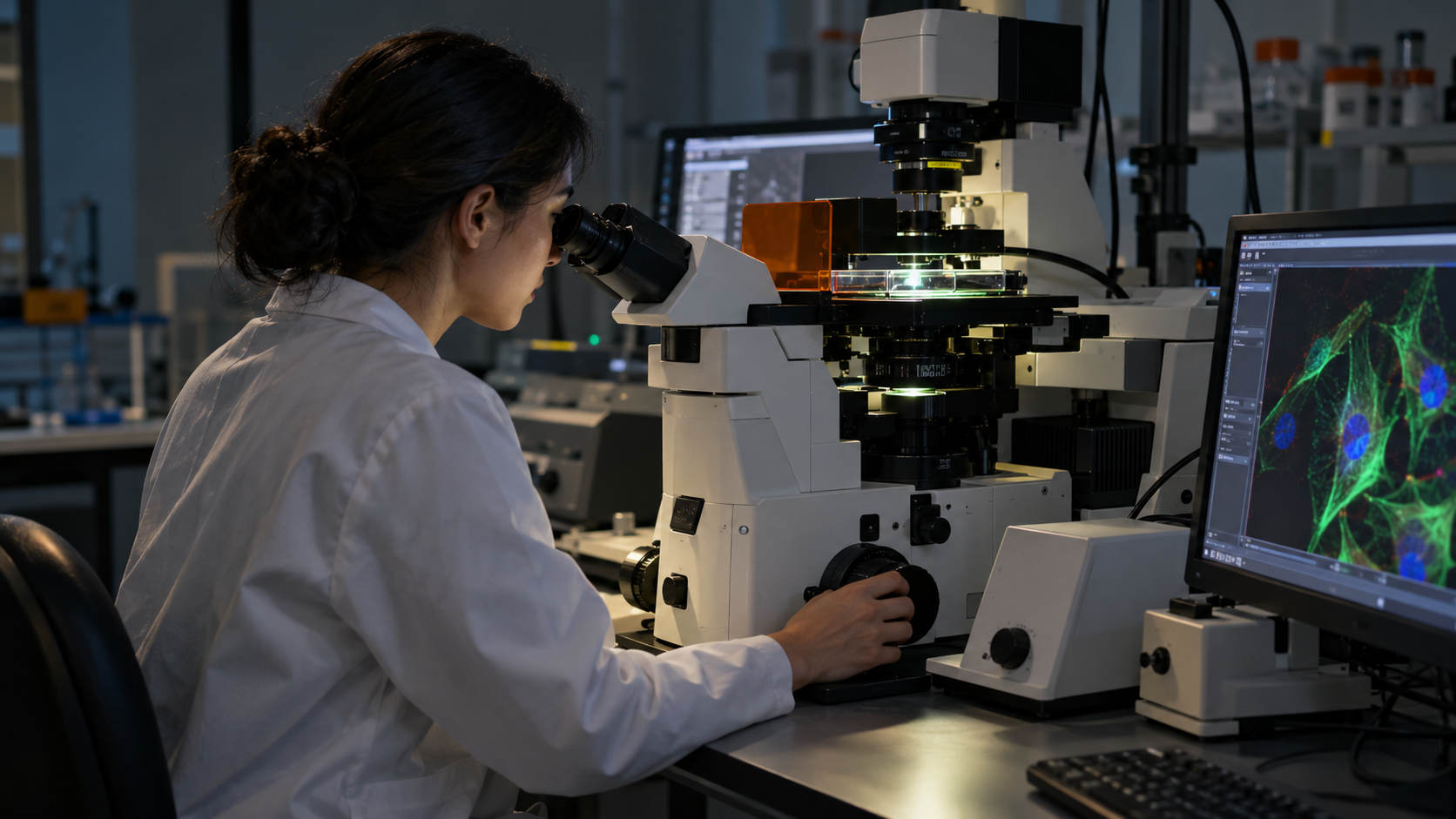
Fluorescent labeling and live-cell microscopy reveal individual cargo runs, while genetic or chemical perturbations test particular motors and adaptors. Speed, run length, direction, and arrival are measured because movement alone does not prove successful delivery or unloading. Researchers separate cause from correlation with imaging, molecular perturbations, and measurements over time.
This transport is especially important in long neurons, where materials must travel between the cell body and distant axon terminals. Congestion can result from damaged tracks, motors, adaptors, or cargo sorting, so the system behaves like coordinated logistics rather than a simple conveyor belt. That evidence supports a general mechanism while leaving room for variation among organisms and conditions.
Tubulin subunits assemble into polarized, dynamically changing microtubules.
Motor adaptors connect selected vesicles or organelles to the track.
ATP-driven shape changes make kinesin and dynein step.
Motor direction follows microtubule polarity.
Competing motors permit pausing, reversal, and destination control.
Live imaging measures whether cargo reaches and unloads at the right site.
Explore more "Explainers"
Discover additional explainers across politics, science, business, technology, and other fields. Each explainer breaks down a complex idea into clear, everyday language—helping you better understand how major concepts, systems, and debates shape the world around us.