

How Carbon Fiber Composites Combine Strength and Lightness Explainer
A carbon fiber composite is not one uniform substance. Thousands of thin carbon filaments carry much of the tensile load, while a surrounding polymer resin holds them in position, transfers stress between fibers, and protects them from abrasion and environment. The useful explanation follows energy and charge while respecting the material properties at each boundary.
Individual fibers are extremely stiff and strong along their length but much less capable across it. Engineers arrange woven cloth or unidirectional layers at chosen angles so the laminate resists the actual combination of tension, compression, shear, and bending. Geometry and composition set the available pathways, so small design changes can alter the response.
Manufacturing impregnates the reinforcement with resin, removes trapped air, shapes the stack, and cures the polymer with controlled heat and pressure. Fiber volume, alignment, voids, temperature history, and adhesion at the interface all influence the finished part. The process continues only while a driving difference overcomes losses, resistance, or competing motion.
Low density produces high specific stiffness and strength, which can reduce mass in aircraft, spacecraft, vehicles, sporting goods, and structures. The material remains anisotropic, meaning its properties depend strongly on direction rather than being equal in every orientation. Real devices add interfaces and imperfections that idealized diagrams usually leave out.
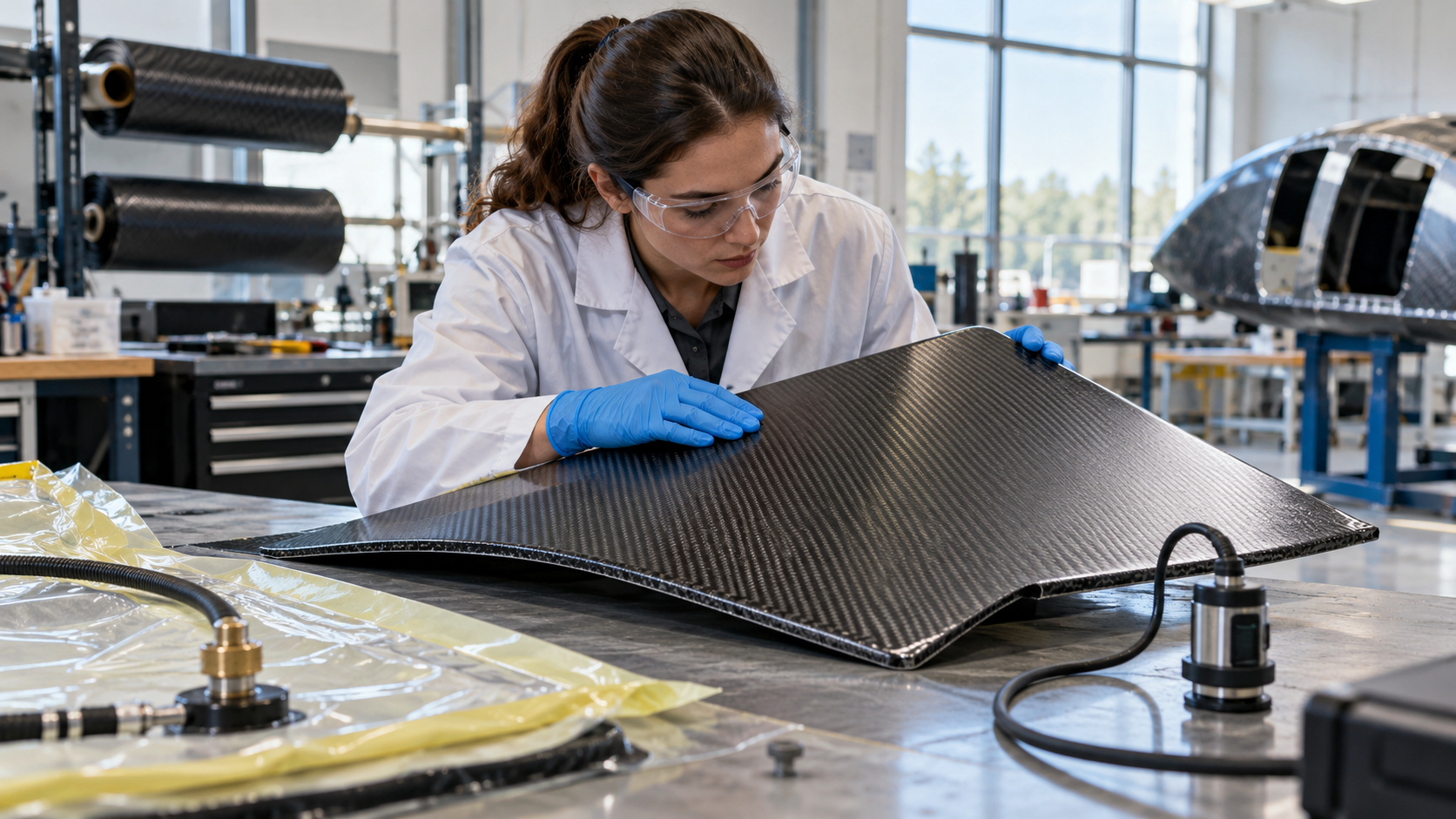
Inspection uses ultrasound, X-rays, thermography, and mechanical tests to find delamination, impact damage, resin-rich regions, or broken fibers. Damage can develop internally without the obvious bending or denting expected in many metals. Scientists test the model by changing one condition and measuring the predicted optical, thermal, or electrical signal.
Carbon composites are not automatically lighter or safer in every design. Joints, fire behavior, repair, recycling, cost, and quality control matter, and a poorly chosen layup can fail along a weak direction despite impressive fiber properties. The core physics is dependable, but efficiency and scale depend on engineering details and operating conditions.
Carbon fibers carry high loads mainly along their length.
The polymer matrix binds fibers and transfers stress.
Layer angles tailor the laminate to expected forces.
Curing controls resin structure, voids, and dimensional stability.
Internal delamination can be difficult to see from the surface.
Performance depends on the whole design, not fiber strength alone.
Explore more "Explainers"
Discover additional explainers across politics, science, business, technology, and other fields. Each explainer breaks down a complex idea into clear, everyday language—helping you better understand how major concepts, systems, and debates shape the world around us.