

How Fuel Cells Generate Electricity Explainer
A fuel cell generates electricity electrochemically rather than by burning fuel. It separates an oxidation reaction at the anode from a reduction reaction at the cathode, forcing electrons through an external circuit while ions cross an electrolyte. The useful explanation follows energy and charge while respecting the material properties at each boundary.
In a common proton-exchange membrane fuel cell, a catalyst splits hydrogen molecules into protons and electrons. The membrane conducts protons but blocks electrons and gases, so electrons travel through the load and provide usable direct current. Geometry and composition set the available pathways, so small design changes can alter the response.
At the cathode, oxygen combines with arriving protons and electrons to form water. The cell also releases heat, and pumps or flow channels must continuously deliver reactants, remove products, and keep temperature and humidity within a useful range. The process continues only while a driving difference overcomes losses, resistance, or competing motion.
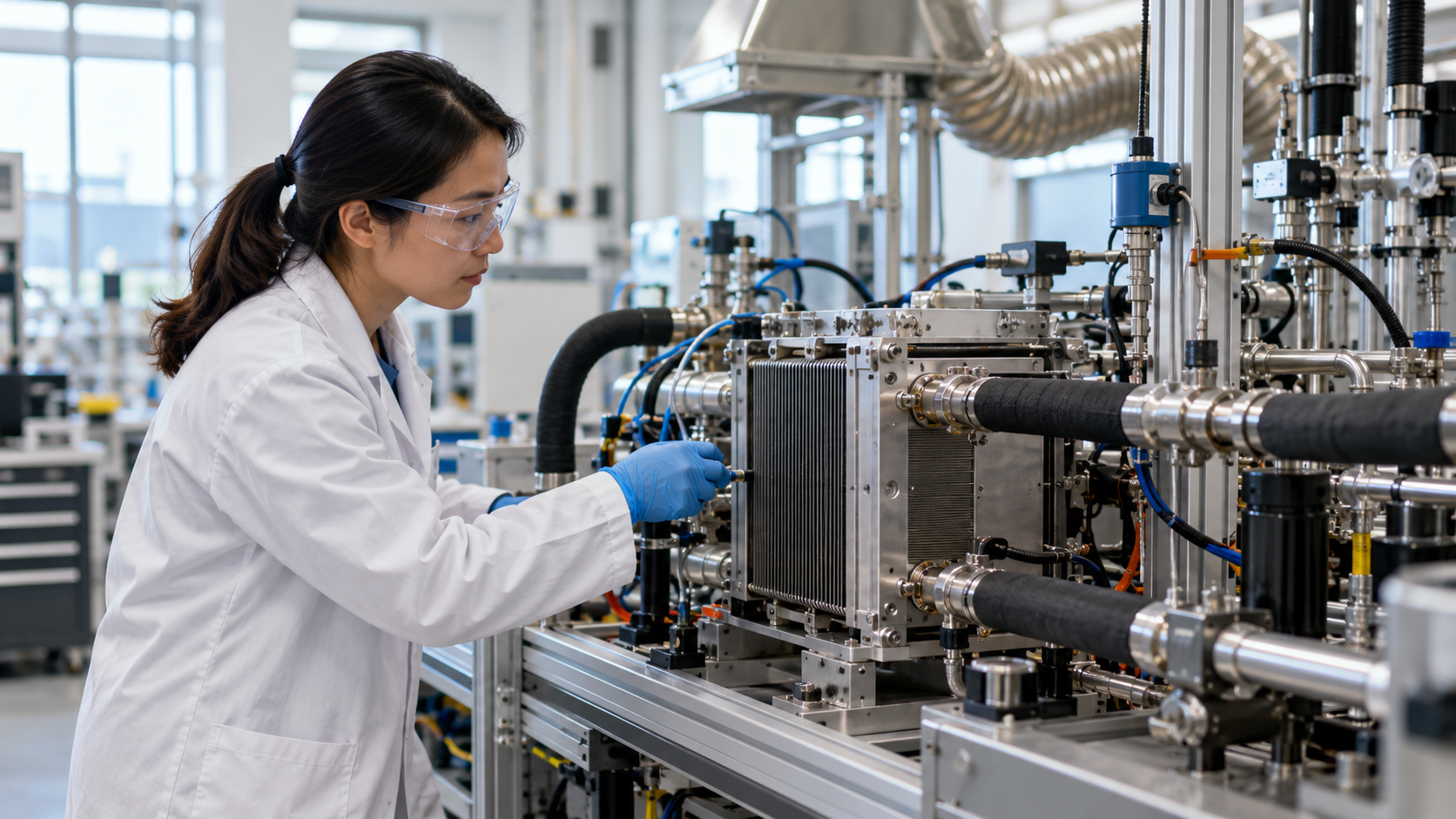
A single cell produces limited voltage, so practical systems connect many cells in a stack. Bipolar plates distribute gases and carry current between cells, while controls manage pressure, cooling, water balance, power conditioning, and safe fuel supply. Real devices add interfaces and imperfections that idealized diagrams usually leave out.
Other fuel-cell types conduct different ions and operate at different temperatures, changing compatible fuels, catalysts, startup time, and potential uses. System efficiency must include fuel production, storage, compression, transport, and auxiliary equipment, not just the stack. Scientists test the model by changing one condition and measuring the predicted optical, thermal, or electrical signal.
Fuel cells can run as long as reactants arrive, unlike batteries that store a finite charge internally. Their emissions and climate effects depend strongly on how the fuel is made, and durability, catalyst cost, contamination, and infrastructure remain practical constraints. The core physics is dependable, but efficiency and scale depend on engineering details and operating conditions.
Fuel oxidation occurs at the anode.
The electrolyte carries selected ions but blocks direct electron flow.
Electrons move through an external circuit and deliver electrical power.
Oxygen reduction at the cathode completes the reaction.
Stacks combine many cells and require thermal and fluid controls.
Whole-system impacts depend on fuel production and delivery.
Explore more "Explainers"
Discover additional explainers across politics, science, business, technology, and other fields. Each explainer breaks down a complex idea into clear, everyday language—helping you better understand how major concepts, systems, and debates shape the world around us.