

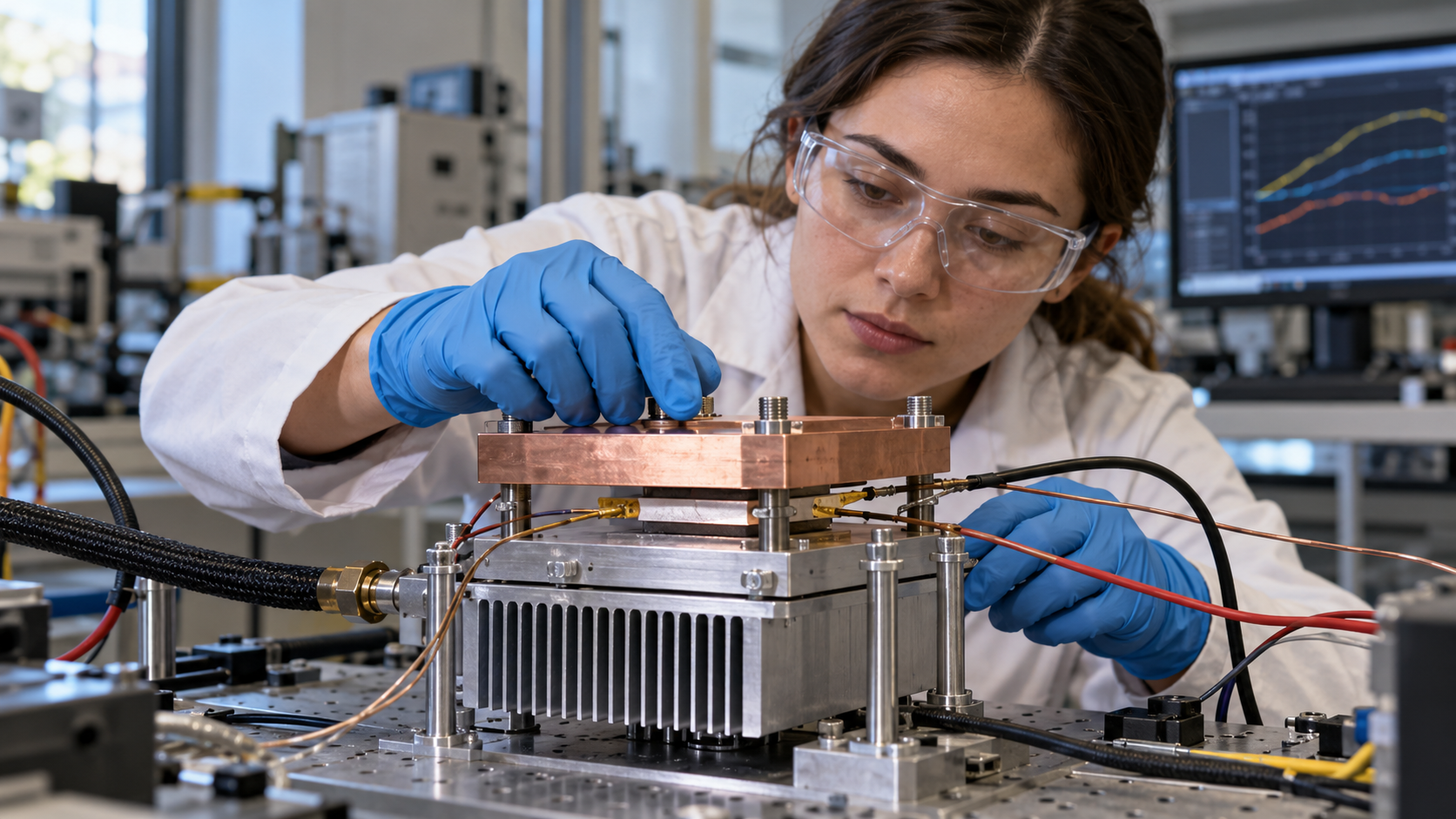
How Thermoelectric Materials Convert Heat Into Electricity Explainer
A thermoelectric material develops a voltage when its two ends are held at different temperatures, an effect called the Seebeck effect. Charge carriers at the hot side have a broader energy distribution and diffuse toward the colder side. The useful explanation follows energy and charge while respecting the material properties at each boundary.
That diffusion separates charge until the resulting electric field balances further motion. Connecting a load lets current flow, so some heat moving through the material is converted into electrical power without turbines, pistons, or a chemical reaction. Geometry and composition set the available pathways, so small design changes can alter the response.
Useful devices pair p-type and n-type semiconductor legs electrically in series and thermally in parallel. Metal interconnects combine their voltages, while ceramic plates provide electrical insulation and conduct heat between the source, legs, and sink. The process continues only while a driving difference overcomes losses, resistance, or competing motion.
Good thermoelectric performance requires a large Seebeck coefficient, high electrical conductivity, and low thermal conductivity. Those goals conflict because mobile electrons can carry both charge and heat, so material design manipulates composition, defects, and nanoscale structure. Real devices add interfaces and imperfections that idealized diagrams usually leave out.
Researchers measure voltage, current, temperature gradient, and heat flow to calculate efficiency and a material figure of merit. Contacts, thermal cycling, oxidation, toxicity, scarcity, and mechanical stress can matter as much as a record laboratory value. Scientists test the model by changing one condition and measuring the predicted optical, thermal, or electrical signal.
Thermoelectrics are valuable where reliability, silence, compact size, or waste-heat recovery outweigh modest efficiency. Reversing the current produces the Peltier effect for solid-state cooling, showing that the same coupled transport can move heat or generate power. The core physics is dependable, but efficiency and scale depend on engineering details and operating conditions.
A temperature gradient drives charge carriers from hot toward cold.
Charge separation creates a measurable Seebeck voltage.
A connected load allows current and useful power.
P-type and n-type legs add voltage in a module.
High electrical but low thermal conductivity improves performance.
Contact losses and heat-sink design affect the complete device.
Explore more "Explainers"
Discover additional explainers across politics, science, business, technology, and other fields. Each explainer breaks down a complex idea into clear, everyday language—helping you better understand how major concepts, systems, and debates shape the world around us.