

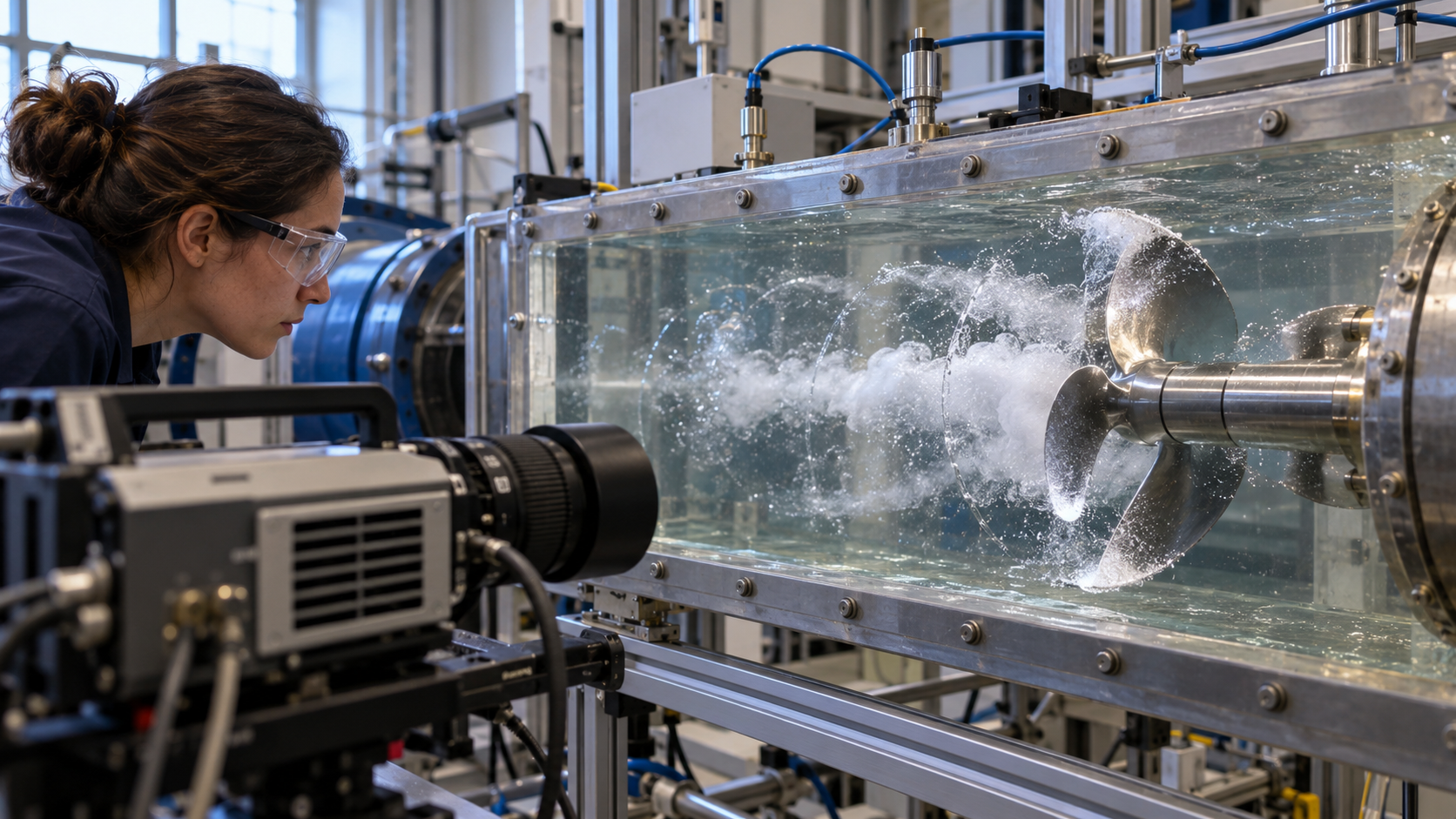
How Cavitation Forms Vapor Bubbles Explainer
Cavitation occurs when pressure in a flowing liquid falls to near or below the liquid’s vapor pressure, allowing vapor-filled cavities to appear. It is boiling caused by a pressure drop rather than by heating the entire liquid to its normal boiling point. The useful explanation follows energy and charge while respecting the material properties at each boundary.
Low-pressure regions develop around fast propeller blades, pump inlets, valves, hydrofoils, or abrupt changes in flow. Tiny gas pockets, surface defects, and suspended particles act as nuclei, reducing the barrier to bubble formation. Geometry and composition set the available pathways, so small design changes can alter the response.
A cavity grows while surrounding pressure remains low and vapor enters it. As the flow carries the bubble into a higher-pressure region, the pressure imbalance reverses and the surrounding liquid accelerates inward, producing a rapid, asymmetric collapse. The process continues only while a driving difference overcomes losses, resistance, or competing motion.
Collapse can generate intense local pressure pulses, microjets, noise, vibration, and brief heating. Repeated impacts pit metal surfaces and reduce pump or propeller performance, although controlled cavitation is also used for cleaning, mixing, and medical procedures. Real devices add interfaces and imperfections that idealized diagrams usually leave out.
Engineers observe bubbles with high-speed cameras, listen with hydrophones, measure pressure, and use a cavitation number to compare conditions. Water temperature, dissolved gas, surface roughness, geometry, and scale change when cavitation begins and how destructive it becomes. Scientists test the model by changing one condition and measuring the predicted optical, thermal, or electrical signal.
Not every visible bubble is cavitation; entrained air can expand without vaporization. The key evidence links local pressure, vapor formation, and collapse, and designs reduce damage by raising inlet pressure, smoothing flow, changing blade loading, or selecting resistant materials. The core physics is dependable, but efficiency and scale depend on engineering details and operating conditions.
Local liquid pressure drops toward the vapor pressure.
Nuclei provide starting points for vapor cavities.
Bubbles grow while they remain in the low-pressure region.
Higher surrounding pressure drives a rapid collapse.
Collapse can create microjets, noise, vibration, and erosion.
Flow design and inlet pressure help control cavitation.
Explore more "Explainers"
Discover additional explainers across politics, science, business, technology, and other fields. Each explainer breaks down a complex idea into clear, everyday language—helping you better understand how major concepts, systems, and debates shape the world around us.