

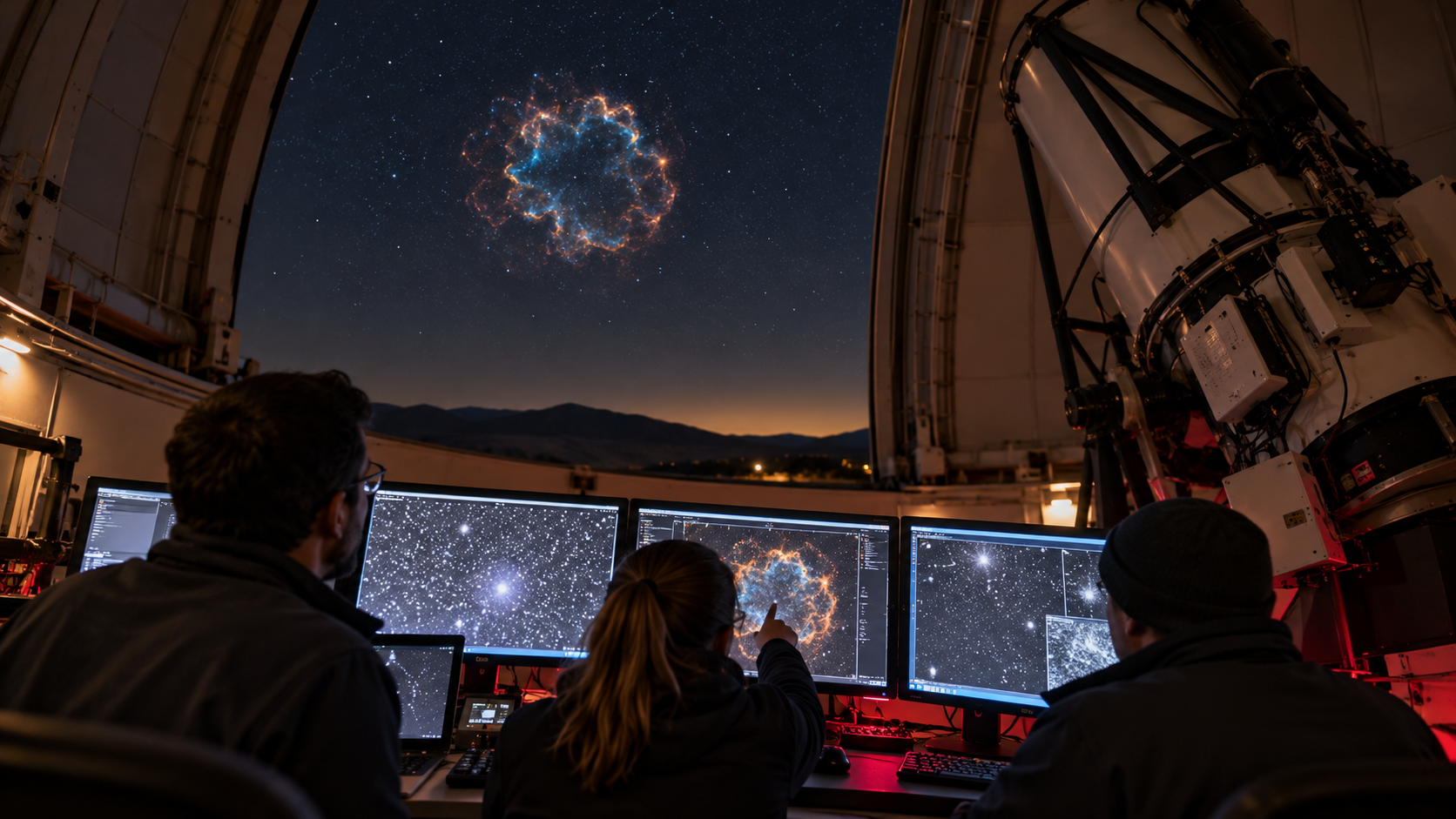
How Supernovae Explode Explainer
A supernova is a stellar explosion, but more than one physical route can produce it. Massive stars can undergo core collapse, while white dwarfs in binary systems can experience runaway thermonuclear burning after gaining or merging with material. The explanation combines gravity, motion, radiation, and plasma behavior across scales far beyond direct laboratory reach.
In a massive star, fusion builds progressively heavier nuclei until an iron-rich core can no longer release energy by further fusion. The core loses pressure support, collapses rapidly, and compresses matter to nuclear densities around a newborn neutron star or black hole. Initial mass and orbital conditions determine which pathways are available and how quickly the system changes.
The inner core rebounds and a shock forms, but the outgoing shock can stall as it loses energy. Neutrino heating, turbulent flow, rotation, and magnetic fields may help revive it and expel the star’s outer layers, although detailed explosion physics remains active research. Energy and angular momentum must be conserved even when matter heats, fragments, or changes direction.
In the thermonuclear route, a carbon-oxygen white dwarf approaches unstable conditions through accretion or merger. Burning races through much or all of the star, synthesizing radioactive elements and disrupting the dwarf without leaving the same kind of collapsed core. Astronomers infer the process from light, spectra, timing, and motion rather than watching every stage up close.
Astronomers distinguish types using spectra, light-curve shape, remnants, neutrinos, and the surrounding stellar population. Radioactive decay helps power the fading light, while expanding ejecta collide with nearby gas and shine across many wavelengths. Computer models are tested against those signals, and competing explanations survive only when they match several observations.
Supernovae distribute newly made elements, drive shocks, and influence later star formation. Their brightness also makes some types useful distance indicators, but classification labels describe observed features and do not always map to one simple progenitor history. The broad mechanism is established, while exact shapes, rates, and histories can remain uncertain for an individual object.
Massive stars can exhaust useful core-fusion support.
Core collapse creates a compact remnant and a stalled shock.
Neutrinos and turbulent motion can help revive the shock.
White dwarfs can instead undergo runaway thermonuclear burning.
Spectra and light curves distinguish explosion families.
Ejecta enrich surrounding space and create long-lived remnants.
Explore more "Explainers"
Discover additional explainers across politics, science, business, technology, and other fields. Each explainer breaks down a complex idea into clear, everyday language—helping you better understand how major concepts, systems, and debates shape the world around us.