

How Thermal Conduction Moves Heat Explainer
Thermal conduction moves internal energy through matter without requiring bulk transport of the material. A temperature difference provides the driving condition, and net heat flows from the hotter region toward the cooler one. The useful explanation follows energy, matter, and fields while respecting material properties at each boundary. Keeping track of losses explains why practical performance falls short of an ideal limit.
In nonmetallic solids, atoms vibrate around lattice positions and pass energy through coupled vibrations. In metals, mobile electrons can carry a large share of thermal energy, helping explain why many electrical conductors are also good heat conductors. Geometry and composition set the available pathways, so small design changes can alter the response.
Fourier’s law relates heat flux to the temperature gradient and thermal conductivity. A steeper gradient, larger area, or more conductive material increases the rate, while a longer path or insulating material reduces it. The process continues only while a driving difference overcomes losses, resistance, or competing motion.
Interfaces add thermal resistance because microscopic contact can be incomplete and energy carriers must cross dissimilar structures. Pores, grain boundaries, composition, and temperature can make the effective conductivity differ from a simple textbook value. Real systems add interfaces and imperfections that idealized diagrams usually leave out.
As heat moves, the temperature field changes until a steady gradient or equilibrium develops. Transient behavior also depends on heat capacity and density, combined with conductivity in a property called thermal diffusivity. Scientists test the model by changing one condition and measuring the predicted thermal, optical, or electrical signal.
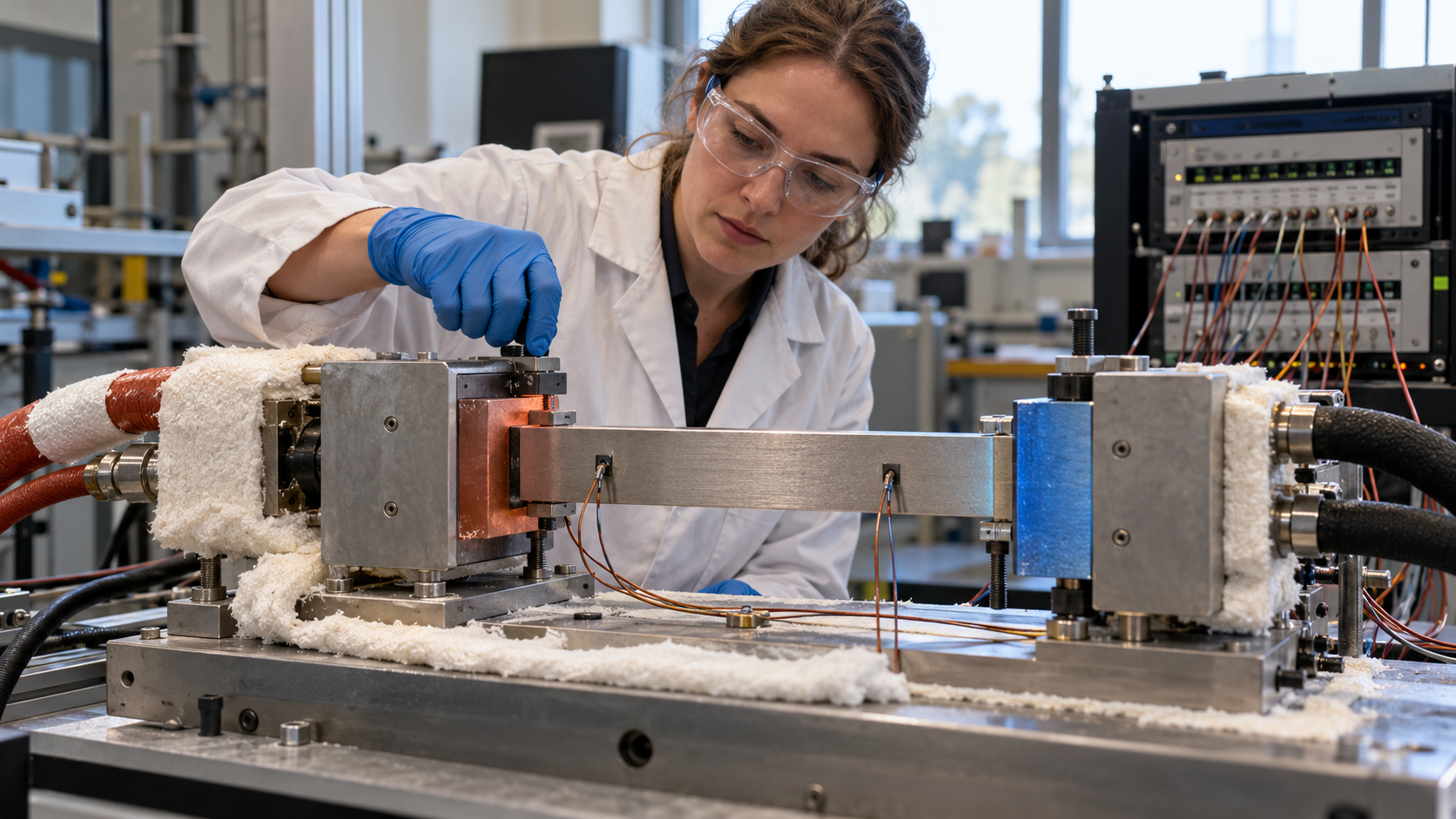
Researchers impose known heating, monitor temperatures at several locations, and account for radiation and convection losses. A warm surface alone does not identify conduction unless the full energy balance and boundary conditions are controlled. The core physics is dependable, but efficiency and scale depend on operating conditions and experimental uncertainty.
A temperature gradient supplies the thermodynamic drive.
Lattice vibrations and electrons carry microscopic energy.
Fourier’s law links heat flux to gradient and conductivity.
Thickness and area set the available conduction path.
Interfaces and defects add practical thermal resistance.
Heat capacity controls how quickly temperatures respond.
Explore more "Explainers"
Discover additional explainers across politics, science, business, technology, and other fields. Each explainer breaks down a complex idea into clear, everyday language—helping you better understand how major concepts, systems, and debates shape the world around us.