

How Magnetic Domains Create Permanent Magnets Explainer
In a ferromagnetic material, exchange interactions favor parallel alignment of neighboring atomic magnetic moments. The solid often divides into domains whose internal moments point similarly, separated by narrow regions called domain walls. The useful explanation follows energy, matter, and fields while respecting material properties at each boundary. Keeping track of losses explains why practical performance falls short of an ideal limit.
An unmagnetized sample can contain domains pointing in different directions, making their external fields largely cancel. Applying a magnetic field moves domain walls and rotates magnetization so favorably oriented regions grow. Geometry and composition set the available pathways, so small design changes can alter the response. Scale changes the balance among surface effects, bulk behavior, and heat flow.
When the field is removed, a soft magnetic material readily returns toward low net magnetization. A permanent-magnet material instead has strong anisotropy and microstructural barriers that keep many moments near selected crystal directions. The process continues only while a driving difference overcomes losses, resistance, or competing motion.
Defects, grain boundaries, particle shape, and secondary phases can pin domain walls or hinder reversed-domain nucleation. High coercivity means a substantial opposing field is required to erase the retained, or remanent, magnetization. Real systems add interfaces and imperfections that idealized diagrams usually leave out.
Heating reduces magnetic order and can permanently demagnetize a material above its Curie temperature. Even below that point, time, shock, corrosion, or a strong reverse field can alter the domain arrangement and reduce performance. Scientists test the model by changing one condition and measuring the predicted thermal, optical, or electrical signal.
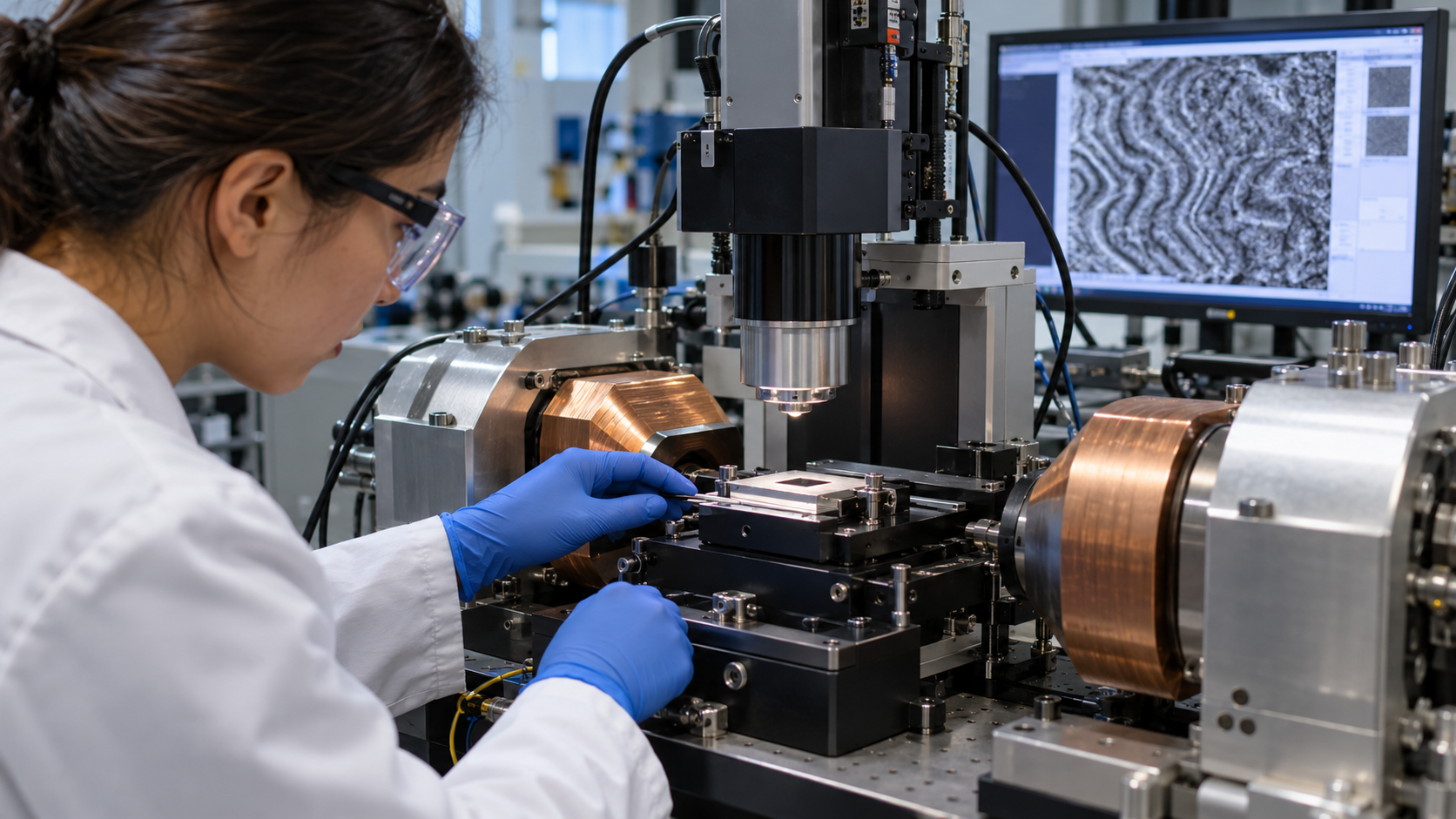
Researchers image domains and domain walls, measure hysteresis loops, and relate coercivity and remanence to composition and microstructure. A bar magnet’s field is a collective state, not millions of tiny compass needles physically sliding into rows. The core physics is dependable, but efficiency and scale depend on operating conditions and experimental uncertainty.
Exchange interactions align neighboring atomic moments.
Materials divide into regions called magnetic domains.
An applied field grows and rotates favorably aligned domains.
Anisotropy favors particular magnetization directions.
Microstructural barriers resist domain-wall reversal.
Remanence and coercivity quantify permanent-magnet behavior.
Explore more "Explainers"
Discover additional explainers across politics, science, business, technology, and other fields. Each explainer breaks down a complex idea into clear, everyday language—helping you better understand how major concepts, systems, and debates shape the world around us.