

How Catalytic Converters Transform Exhaust Gases Explainer
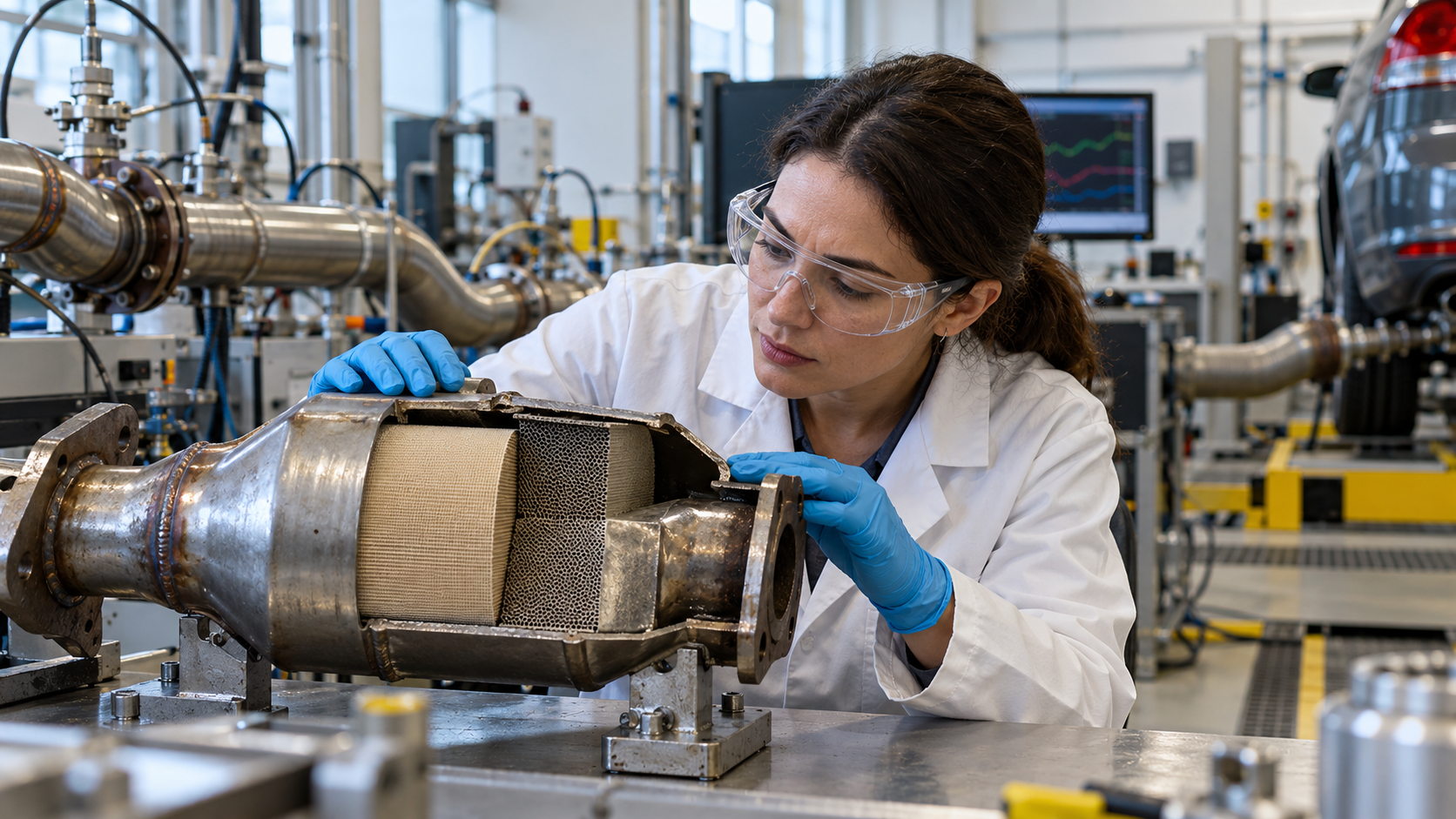
An automotive catalytic converter is a post-combustion reactor placed in the exhaust stream. A ceramic or metal honeycomb provides a large surface area while allowing gases to flow with limited pressure loss. The useful explanation follows electrons, bonds, transport, and molecular structure through each stage. Tracking side reactions explains why practical yields differ from an ideal equation.
A thin washcoat carries catalyst particles such as platinum, palladium, or rhodium. These surfaces lower activation barriers without being consumed as overall reactants, allowing useful reactions at practical exhaust temperatures. Composition and geometry control the available pathways, so small changes can alter the result. Scale changes the balance among surface effects, bulk behavior, and transport.
In a three-way gasoline catalyst, carbon monoxide and unburned hydrocarbons are oxidized toward carbon dioxide and water, while nitrogen oxides are reduced toward nitrogen. The reactions compete for oxygen and reducing molecules. The process proceeds only while the driving conditions overcome competing reactions and transport limits. Tracking side reactions explains why practical yields differ from an ideal equation.
Engine controls use oxygen-sensor feedback to keep the air-fuel mixture near the range where all three conversions can occur effectively. A mixture that is persistently too lean or rich weakens part of the chemistry. Real materials contain interfaces, impurities, and defects that ideal diagrams usually omit. Scale changes the balance among surface effects, bulk behavior, and transport.
The converter must warm before it works efficiently. Aging, overheating, sulfur, oil, fuel contaminants, physical damage, and catalyst sintering can reduce active surface area or block passages. Scientists change one condition at a time and measure the predicted chemical, optical, or mechanical response.
Engineers measure pollutant concentrations before and after the device across temperatures and operating conditions. A converter reduces specific pollutants but does not eliminate carbon dioxide produced by burning fuel. The core chemistry is dependable, while performance depends on formulation, processing, and measurement uncertainty.
Hot exhaust enters a high-area honeycomb substrate.
A washcoat exposes gases to catalyst particles.
Carbon monoxide and hydrocarbons undergo oxidation.
Nitrogen oxides undergo reduction toward nitrogen.
Oxygen-sensor feedback keeps chemistry near an effective balance.
Temperature and contamination determine real conversion efficiency.
Explore more "Explainers"
Discover additional explainers across politics, science, business, technology, and other fields. Each explainer breaks down a complex idea into clear, everyday language—helping you better understand how major concepts, systems, and debates shape the world around us.