

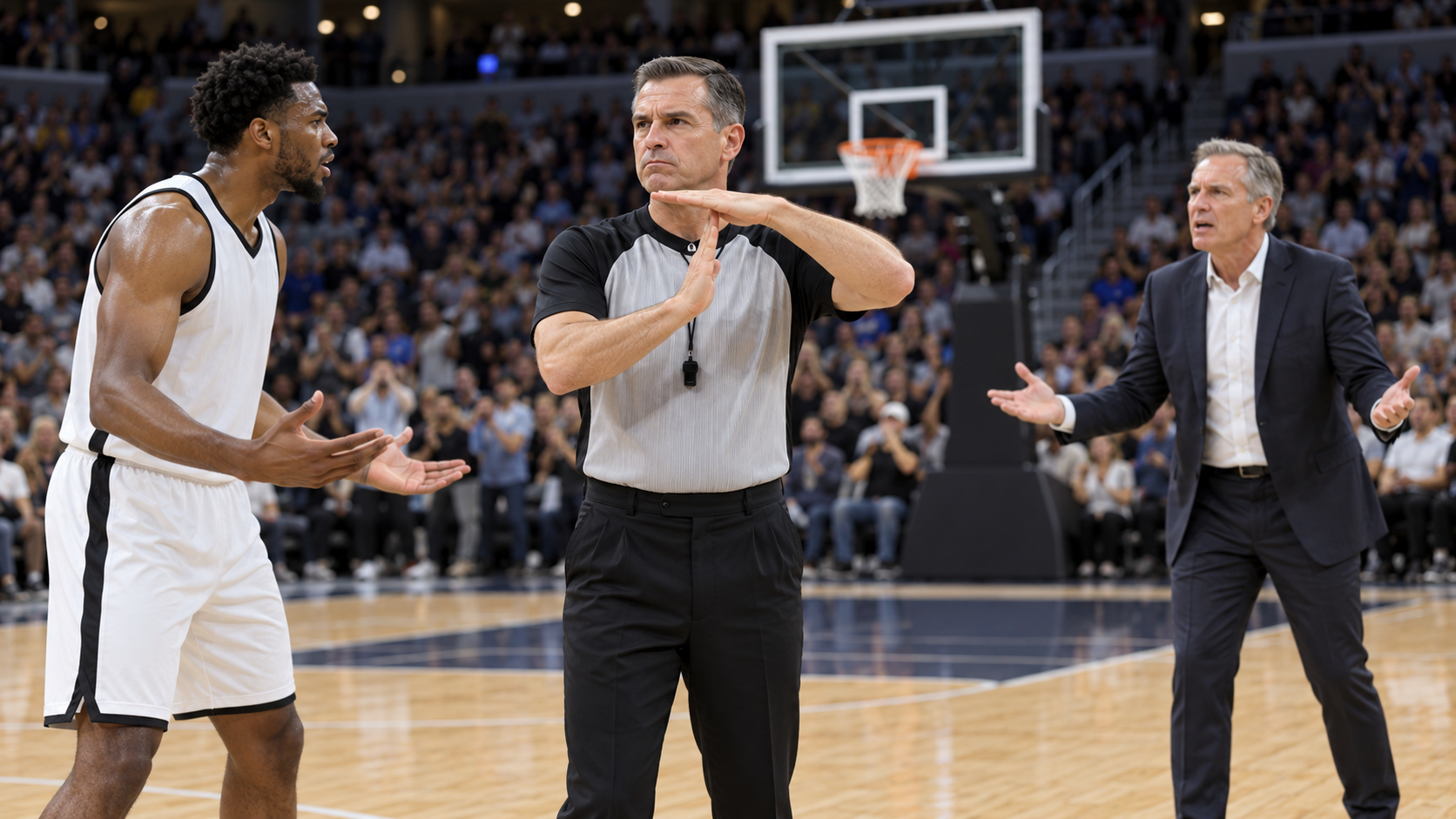
How Basketball Technical Fouls Work Explainer
A technical foul penalizes conduct or administrative violations that do not fit an ordinary personal foul. In the NBA, examples include disrespectfully addressing officials, delaying the game, hanging on the rim without a safety reason, illegal participation, and certain bench behavior.
Most technical fouls award the opponent one free throw. Play then resumes according to where it was interrupted or under the specific rule for the violation. The technical does not necessarily give the shooting team possession, which distinguishes it from some foul procedures in other leagues.
Technical fouls can be charged to players, coaches, bench personnel, or a team. Two unsportsmanlike technicals assessed to the same player or coach in one game generally require ejection. Some severe acts can produce an immediate ejection or a flagrant foul instead of, or alongside, a standard technical.
Not all technicals reflect misconduct. Defensive three seconds and some administrative errors also use a technical free throw, but their consequences and ejection treatment can differ. The referee’s signal tells only the category; the announced reason explains whether the call concerns behavior, delay, or a procedural rule.
The opponent receives one free throw, with play resumed according to the rule governing the interruption.
Two unsportsmanlike technicals to the same player or coach in one game generally require ejection.
No. Administrative violations and defensive three seconds can also be penalized with technical-foul procedures.
Explore more "Explainers"
Discover additional explainers across politics, science, business, technology, and other fields. Each explainer breaks down a complex idea into clear, everyday language—helping you better understand how major concepts, systems, and debates shape the world around us.