

Additive Manufacturing Explainer
Additive manufacturing is the family of technologies that build objects layer by layer instead of cutting, casting, or molding them from a solid block. If you’ve seen a desktop 3D printer slowly trace a shape in plastic, you’ve seen a simple example. Industrial systems apply the same idea with metals, ceramics, and advanced polymers to create parts strong enough for airplanes, medical implants, and factory equipment.
Traditional manufacturing is often “subtractive”: you start with more material than you need and remove the excess, or you carve expensive molds that must be reused thousands of times to make economic sense. Additive manufacturing flips that logic. A digital 3D model is sliced into ultra-thin layers, and the machine follows that blueprint, depositing or solidifying only the material required. That reduces waste, shortens the path from design to finished part, and makes it easier to customize each item without retooling an assembly line.
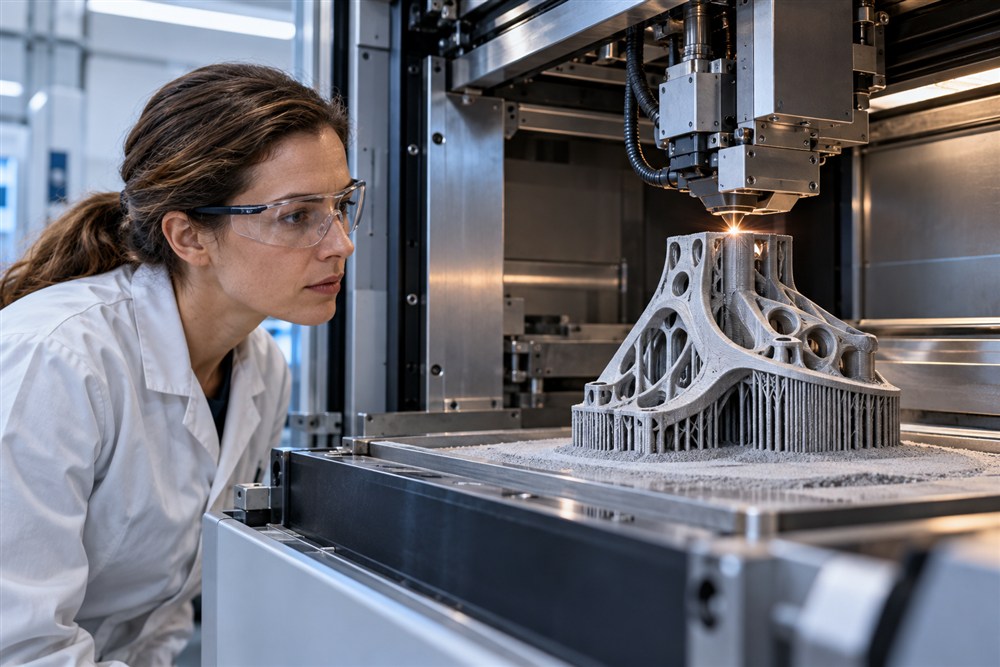
There are several major additive approaches. Fused filament printers melt plastic filament and draw each layer. Powder bed fusion uses lasers or electron beams to selectively melt fine metal or plastic powders, ideal for dense, high-performance parts. Stereolithography cures liquid resin with light, capturing extremely fine detail. Across these methods, the strengths are similar: freedom to create shapes that would be impossible or extremely costly with traditional machining, such as internal cooling channels, lattice structures, or patient-specific implants that match a person’s anatomy.
Additive manufacturing also supports new kinds of supply chains. Instead of shipping finished goods around the world, companies can move digital files and print parts closer to where they’re needed. That can lower transportation emissions, make it easier to respond to demand spikes or disruptions, and enable small, local producers to offer highly tailored products without owning large factories.
The impact reaches beyond the factory floor. Engineers can prototype designs in hours instead of weeks, accelerating experimentation. Companies can keep digital inventories of spare parts and print them on demand, reducing storage costs and helping older equipment stay in service longer. In remote locations or space missions, on-site printing can provide critical components without waiting for shipments. There are still challenges—printing can be slower and more expensive than mass production for simple, high-volume items, and quality control and certification are demanding in fields like aerospace and medicine. Even so, additive manufacturing is steadily moving from a niche tool to an integral part of modern production, used alongside traditional methods rather than replacing them outright.
Additive manufacturing—commonly known as industrial 3D printing—emerged from early experiments in layer-by-layer fabrication during the 1980s. Unlike traditional subtractive methods that cut or mold material, additive techniques build objects directly from digital models by depositing or solidifying thin layers of material.
The approach originated as a rapid prototyping tool, giving engineers a faster way to test concepts. As materials improved and machines became more precise, its use expanded into aerospace, healthcare, automotive, and advanced manufacturing, where complex geometries and customization offered major advantages.
In practice, additive manufacturing begins with a 3D digital model that is sliced into hundreds or thousands of microscopic layers. Machines then follow this blueprint to build the object layer by layer using methods such as fused filament deposition, resin curing, or laser-based powder bed fusion for metals and engineering polymers.
Because material is added only where needed, waste is significantly reduced compared with machining. The process also allows designs that would be difficult or impossible to produce conventionally—such as internal lattice structures, lightweight components, channels for cooling, or highly customized implants tailored to an individual patient.
Additive manufacturing is reshaping supply chains by enabling on-demand production and digital inventory. Companies can print parts close to where they are needed, reducing logistics costs, shortening lead times, and allowing rapid iteration during development. It supports innovation across sectors—from aerospace components to medical prosthetics and energy systems.
Despite its advantages, challenges remain. Printing can be slower and more expensive for high-volume parts, and quality control is demanding when components must meet strict certification standards. As materials, automation, and machine speeds continue improving, additive manufacturing is increasingly complementing conventional production rather than replacing it outright.
Explore more "Explainers"
Discover additional explainers across politics, science, business, technology, and other fields. Each explainer breaks down a complex idea into clear, everyday language—helping you better understand how major concepts, systems, and debates shape the world around us.