

Antenna Design Explainer
From smartphones and Wi-Fi routers to satellites and self-driving cars, almost every wireless system depends on antennas. At its core, an antenna is a structure that converts electrical signals in a circuit into electromagnetic waves in the air—and back again. The key design challenge is shaping and sizing that structure so it efficiently operates at specific frequencies. Because wavelength is inversely related to frequency, antenna dimensions are often set as fractions of a wavelength (like half-wave dipoles), which is why low-frequency systems tend to need larger antennas while high-frequency systems can use very small ones.
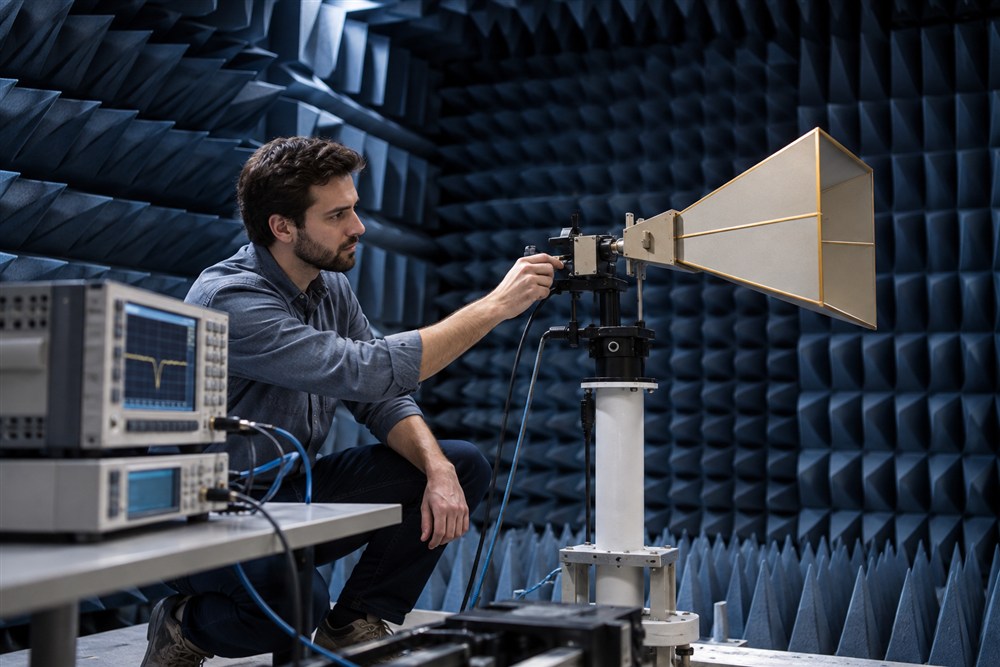
Antenna design revolves around a handful of fundamental parameters. Gain describes how effectively an antenna directs energy in a preferred direction compared to an ideal reference. Directivity focuses on how concentrated the radiation pattern is, while efficiency reflects how much input power actually becomes radiated energy instead of being lost as heat. Impedance, typically targeted at 50 ohms, must be matched between the antenna and its electronics to minimize reflections and signal loss. Designers visualize these factors with radiation patterns that show where an antenna sends and receives most strongly, revealing trade-offs between coverage and focus.
In real products, form factor and environment complicate the theory. A simple dipole antenna may work well in free space, but smartphones demand compact, multi-band antennas squeezed around batteries, screens, and metal housings. Designers use techniques like meandered traces, slots, and patch antennas printed on circuit boards to save space while still covering multiple frequency bands for 4G, 5G, Wi-Fi, Bluetooth, and GPS. Nearby components and the user’s hand can detune antennas, so simulations and over-the-air testing help refine shapes, positions, and tuning elements such as matching networks.
More advanced systems rely on arrays and smart control. Phased array antennas combine many small elements whose signals are carefully shifted in phase, allowing the overall beam to be steered electronically without moving parts. This enables technologies like 5G beamforming, satellite internet constellations, and automotive radar that tracks objects around a vehicle. As demand grows for higher data rates and more reliable links, antenna design increasingly blends electromagnetics, materials science, and signal processing. The result is that antennas are no longer just passive metal shapes, but tightly integrated parts of intelligent, adaptive wireless systems.
Antenna design is the field of engineering focused on shaping and tuning physical structures so they can efficiently transmit and receive electromagnetic waves. From early telegraph towers and radio masts to today’s compact smartphone antennas, the core idea has remained the same: convert electrical signals in a circuit into signals that can travel through space.
Because antennas interact with specific radio frequencies, their size and geometry are closely tied to wavelength—often fractions like quarter-wave or half-wave lengths. As wireless technologies evolved, designers moved from simple metal rods to printed circuit antennas, patch antennas, and complex arrays, enabling everything from Wi-Fi and GPS to satellite links and 5G networks.
In practice, antenna design balances physics with product constraints. Engineers choose shapes—such as dipoles, loops, patches, or arrays—based on the required frequency bands, coverage patterns, and device size. Key parameters include gain, efficiency, bandwidth, and radiation pattern, all of which determine how well an antenna sends and receives signals in real environments.
Modern devices complicate this picture. Smartphone antennas must fit into tight spaces, coexist with batteries and metal frames, and support multiple standards like 4G, 5G, Wi-Fi, Bluetooth, and GPS. Designers rely on simulation tools, prototyping, and over-the-air testing to fine-tune geometry, materials, and matching circuits so that performance remains stable even when users hold or move the device.
Antenna design is constrained by trade-offs. Smaller antennas tend to be less efficient, closely packed antennas can interfere with each other, and real-world surroundings—walls, vehicles, even human bodies—distort ideal radiation patterns. As systems push toward higher frequencies and faster data rates, these limits become more visible to users as dropped calls, weak Wi-Fi, or inconsistent coverage.
To overcome these challenges, engineers are exploring adaptive and phased-array antennas that can steer beams electronically, reconfigurable designs that shift frequency bands on demand, and new materials that shape radio waves more precisely. These advances aim to deliver more reliable connectivity for dense urban networks, satellite constellations, and emerging applications like autonomous vehicles and massive Internet-of-Things deployments.
Explore more "Explainers"
Discover additional explainers across politics, science, business, technology, and other fields. Each explainer breaks down a complex idea into clear, everyday language—helping you better understand how major concepts, systems, and debates shape the world around us.