

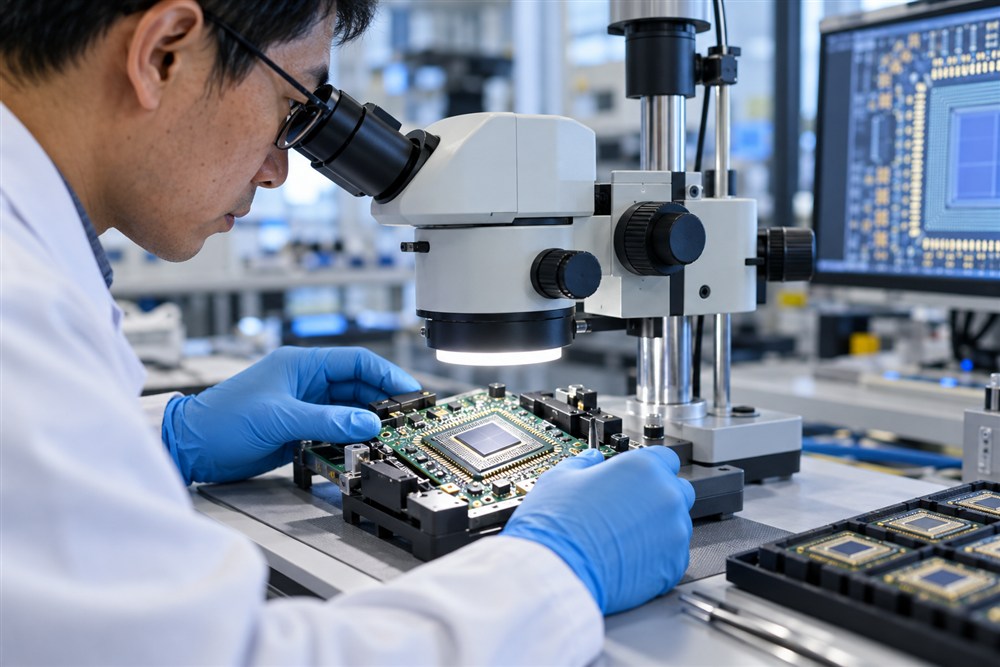
ASIC Chips Explainer
Application-specific integrated circuits, better known as ASIC chips, sit at the extreme end of hardware specialization. Unlike general-purpose processors such as CPUs, which can handle many different types of tasks, ASICs are designed and manufactured to do one job exceptionally well. That job might be processing wireless signals in a 5G base station, verifying blockchain transactions in a crypto mining rig, or accelerating AI inference in a data center. Because every transistor, pathway, and logic block is tailored to a narrow function, ASICs can deliver dramatic gains in performance, power efficiency, and size compared with off-the-shelf chips.
The trade-off is flexibility. Once an ASIC is manufactured, its behavior is essentially locked in silicon. If standards change, algorithms evolve, or regulations shift, a general-purpose processor or reprogrammable chip like an FPGA can be updated in software or reconfiguration. An ASIC, by contrast, usually requires a new design cycle and costly fabrication run. This makes ASIC development a high-stakes decision: companies invest heavily in design tools, simulation, and verification to ensure that what they send to the foundry is both correct and future-proof enough to justify the expense. For large-scale products such as smartphones, networking gear, or game consoles, the savings in per-unit cost and energy use often outweigh the upfront risk.
The economics of ASICs are closely tied to scale. Designing a custom chip can cost millions of dollars, but if that chip ships in tens of millions of devices, the non-recurring engineering cost is spread thinly over each unit. That is why ASICs appear in mass-market products and infrastructure: they help extend battery life in mobile devices, reduce power consumption in data centers, and fit complex processing into small, thermally constrained spaces. In industries such as finance, specialized ASICs accelerate trading algorithms by shaving microseconds off calculations, while in the cryptocurrency world, mining ASICs rapidly displaced GPU-based mining by offering far higher hash rates per watt for specific algorithms.
Technically, ASIC design sits at the intersection of hardware engineering and software-like logic development. Engineers describe the chip’s behavior in hardware description languages, simulate thousands of scenarios to catch flaws, and work with fabrication partners to map that abstract design onto physical transistors. Once produced, an ASIC becomes part of a broader system, interacting with memory, sensors, and other chips. As computing needs continue to grow, many technology roadmaps envision a mix of general-purpose processors for flexibility and ASIC accelerators for the most performance-critical workloads. In that balance between adaptability and optimization, ASIC chips are the dedicated specialists of the silicon world.
Application-specific integrated circuits (ASICs) are custom-designed chips built to perform a narrow set of tasks with exceptional speed and efficiency. Unlike general-purpose CPUs, which can run many types of software, an ASIC is optimized around a specific function—such as processing wireless signals, hashing in cryptocurrency mining, or accelerating AI inference.
ASICs emerged as computing needs outgrew what off-the-shelf processors alone could handle, especially in telecommunications, consumer electronics, and high-performance computing. As transistor sizes shrank and chip complexity grew, companies began investing in ASIC design to reduce power consumption, shrink device size, and gain a competitive edge in performance-critical workloads.
In practice, ASIC chips are the “specialists” inside hardware systems. Engineers describe the chip’s logic in hardware description languages, simulate it extensively, and then fabricate silicon where every transistor layout is tuned to a specific workload. Because the design is so focused, ASICs can deliver higher performance per watt and per dollar than more flexible processors.
You can find ASICs in smartphones handling tasks like signal processing and power management, in data centers running custom accelerators, and in networking gear routing traffic at high speeds. Their efficiency helps extend battery life, reduce heat, and cut operating costs. Once deployed, they typically run the same types of operations billions of times, taking advantage of the hardware-level optimizations baked into their design.
The main limitation of ASICs is rigidity. Once a chip is manufactured, its behavior is essentially fixed. If a standard changes, a bug appears in the design, or a new algorithm proves better, an ASIC cannot simply be reprogrammed like a CPU or updated like software on a GPU or FPGA. Adapting usually requires a costly redesign and new fabrication run.
This trade-off fuels ongoing debate about how much specialization is worth the risk. Supporters argue that for high-volume products and stable workloads, ASICs provide unmatched efficiency and long-term cost savings. Critics point to long development cycles, high upfront costs, and the risk of lock-in to specific algorithms or vendors. As computing demands grow, many systems are evolving toward hybrid architectures that mix general-purpose processors with ASIC accelerators, trying to balance flexibility with the raw speed that dedicated chips can deliver.
Explore more "Explainers"
Discover additional explainers across politics, science, business, technology, and other fields. Each explainer breaks down a complex idea into clear, everyday language—helping you better understand how major concepts, systems, and debates shape the world around us.