

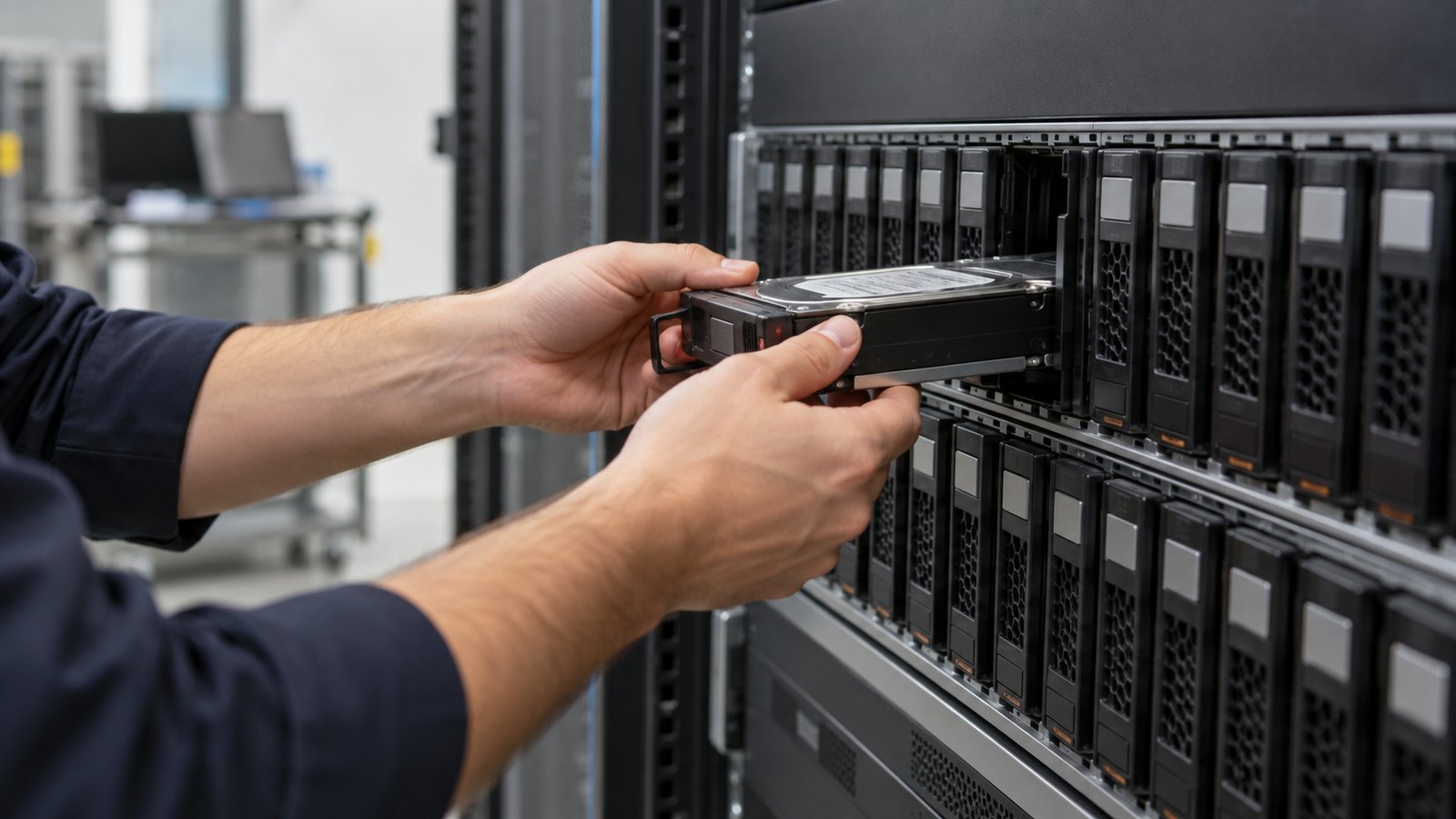
RAID combines multiple storage drives into a logical set to improve performance, provide redundancy, or balance both goals according to the chosen level. The technology addresses a practical coordination problem that appears whenever many devices or programs must agree about identity, location, state, or resources. Its name can sound more mysterious than its purpose. The useful starting point is to separate the job it performs from the products that implement it. Different vendors may expose different settings, but compatible systems follow the same basic ideas so information can move between independently built components. Understanding that boundary also prevents the feature from being credited with protections it was never designed to provide.
The main mechanism is straightforward once its parts are identified. Striping spreads blocks across drives, mirroring keeps duplicate copies, and parity records calculated recovery information. Controllers or operating systems manage the layout. Those parts operate under rules that define the format of messages or stored information and the conditions under which a result is accepted. Implementations also keep local state, because a later step often depends on what happened earlier. Good designs make that state visible through logs, counters, or diagnostic tools. That evidence helps an operator distinguish a normal negotiation from a configuration mistake, an overloaded component, or an active attack. It also makes failures easier to reproduce instead of treating the system as a black box.
A typical operation unfolds in a sequence rather than in one indivisible action. A write is divided or duplicated according to the array level. Reads may use several drives, and after a supported failure the system reconstructs missing data onto a replacement. Each stage can validate what it received before committing to the next stage. This ordering matters because partial information may be stale, ambiguous, or supplied by an untrusted party. Timeouts and retries handle ordinary loss, while explicit error results stop a bad state from silently spreading. The exact messages differ among implementations and versions, yet the sequence preserves the central contract: participants exchange enough evidence to reach the same conclusion, and they fail in a defined way when that evidence is missing or inconsistent.
The most visible advantage is operational rather than merely theoretical. An array can keep a service available after certain drive failures and can increase sequential throughput by working across devices in parallel. At scale, that improvement can reduce delay, manual work, downtime, or exposure across thousands of requests and devices. The benefit is strongest when every surrounding component respects the same assumptions. Monitoring still matters, because averages can hide a failed region, an unusual client, or a small group of requests taking a much slower path. Engineers therefore compare success rates, latency, capacity, and error causes before deciding that the feature is working as intended. A standard creates the opportunity for reliable behavior; measurement confirms whether a particular deployment delivers it.
The limits are equally important. RAID is not a backup: deletion, malware, file corruption, theft, and disasters can affect the entire array. Rebuilds take time and add stress, and some levels tolerate only limited failures. Security claims should be read narrowly: protecting one step does not automatically secure the endpoint, the user, every stored copy, or the recovery process. Compatibility can also require gradual deployment, so old and new behavior may coexist for years. That mixed environment creates downgrade, fallback, and configuration risks if teams do not know which path a request actually used. Updates remain necessary because specifications evolve, implementation defects are discovered, and assumptions that were reasonable for an earlier scale can stop being safe. Defense in depth treats this mechanism as one layer rather than the entire system.
In practice, successful use depends on careful operation. Administrators match the level to workload, monitor drive health, keep tested backups, maintain spare capacity, and verify controller and replacement compatibility. Documentation should record ownership, expected behavior, failure modes, and a tested recovery route. Changes are safest when introduced gradually with metrics and a way to reverse them. For an everyday user, the feature often works quietly in the background; the visible signs appear only during setup, a warning, or a failure. For a technical team, the right question is not simply whether the technology is enabled. It is whether the surrounding keys, policies, versions, capacity, and human procedures make its promise true. That distinction turns a checkbox into a dependable part of the system.
No. RAID can preserve availability after some hardware failures, but it does not keep independent historical copies.
The array reads surviving data and parity or mirrors to recreate the missing contents on a replacement drive.
They use different combinations of striping, mirroring, and parity, producing distinct capacity, speed, and fault-tolerance tradeoffs.
Explore more "Explainers"
Discover additional explainers across politics, science, business, technology, and other fields. Each explainer breaks down a complex idea into clear, everyday language—helping you better understand how major concepts, systems, and debates shape the world around us.