

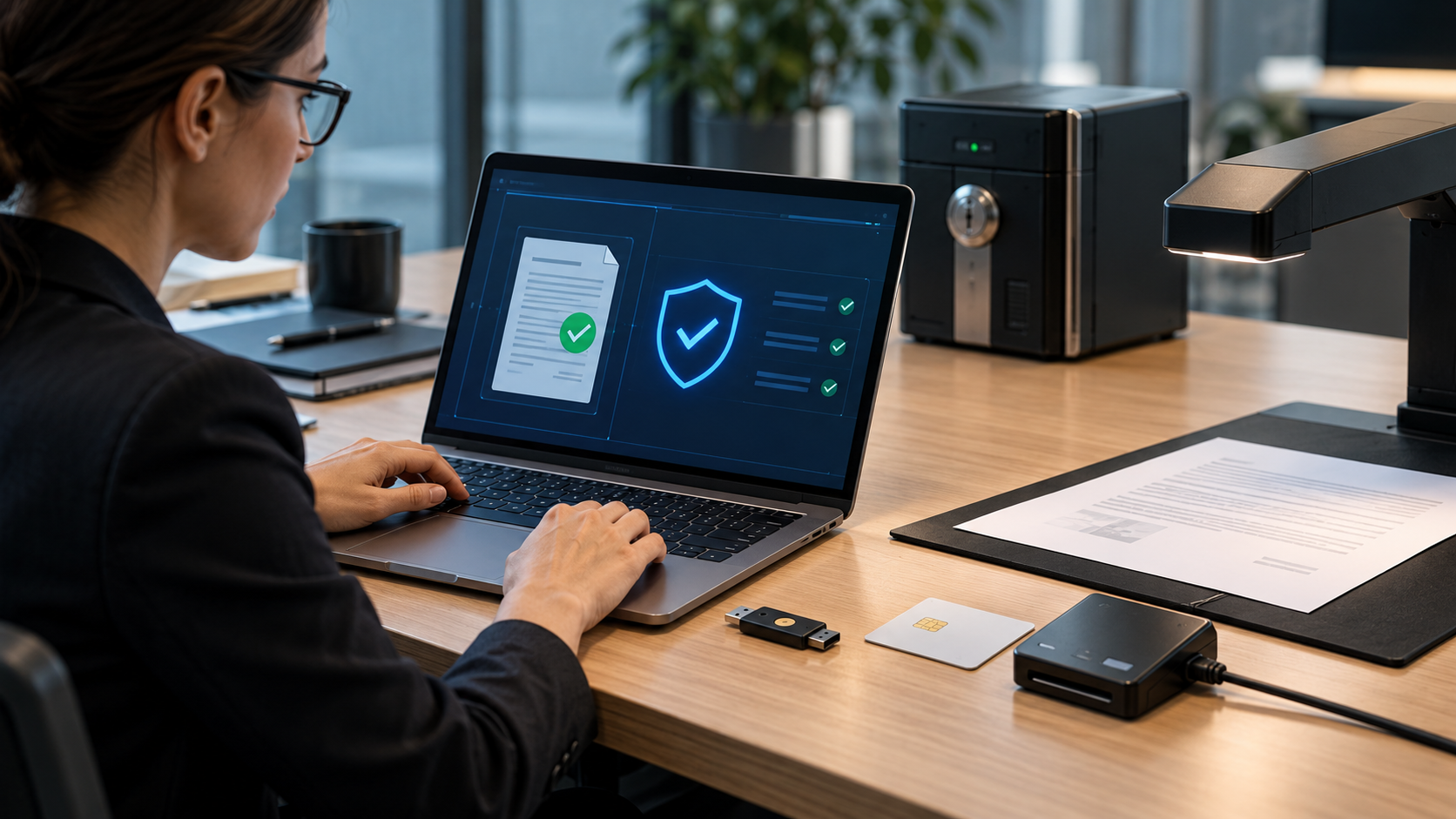
Digital Signature Explainer
A digital signature is cryptographic evidence attached to data so recipients can verify who controlled a signing key and whether the signed content changed. The signer uses a private key; verifiers use the related public key. The signature does not hide the document. It protects authenticity and integrity. If even one bit changes, verification against the original signature should fail. The strength of that statement depends on the signing algorithm, key protection, identity binding, and the exact bytes included in the signature process.
Software first hashes the message with a cryptographic hash function. The digest is a fixed-length representation designed so a changed message produces an unpredictable different value and finding two messages with the same digest is infeasible. The signature algorithm combines the digest or a standardized encoding of it with the private key. Because the operation covers a compact digest, large documents and software packages can be signed efficiently. The verifier hashes the received content in the same way and checks the signature with the public key.
Algorithms implement the check differently. RSA signatures use modular arithmetic with an approved encoding. Elliptic-curve signatures produce a pair of values derived from the digest, private key, and a unique per-signature value. Some modern schemes define deterministic nonce generation to reduce dependence on external randomness. Reusing or biasing a secret nonce can reveal a signing key, which is why implementation details matter. Verifiers must reject malformed encodings and unsupported parameters rather than guessing.
The public key needs an identity context. A certificate can bind it to a person, organization, server, or code-signing role through a certificate authority’s signature. A document workflow may rely on an enterprise directory or pre-enrolled key. Verification then checks both the document signature and the certificate path, validity, permitted usage, and revocation status. A mathematically valid signature proves control of a key, not that every claim in the document is true or that the named person personally reviewed it.
Private signing keys are high-value assets. Hardware tokens and security modules can perform signing without releasing the key to ordinary software. Access may require a PIN, biometric, approval quorum, or policy check. Time-stamp services can add evidence that a signature existed at a particular time, helping validate it after a certificate expires. Key rotation, revocation, audit logs, and archived validation information preserve trust across long document lifecycles.
Signatures appear in software updates, certificates, email, financial messages, electronic records, and secure boot. Each application defines what is signed and how surrounding metadata is interpreted. Canonicalization is important for formats where harmless visual changes can alter bytes. Signing only part of a file can leave unsigned fields open to manipulation. A safe interface shows the signer exactly what will be covered and shows the verifier which portions were authenticated.
The verification result answers a precise question: does this signature match this data under this public key and algorithm? Identity systems and policy turn that result into a useful decision. When the private key is controlled, the public key is trusted, and the full intended content is included, a digital signature makes later modification detectable and attributes the signing action to a cryptographic credential. It is a stronger, machine-verifiable mechanism than an image of a handwritten signature, but it remains dependent on key custody and workflow.
Multi-factor authentication, or MFA, requires more than one kind of proof before access is granted. Common factors include something you know, something you have, and something you are.
Passwords can be guessed, reused, stolen, or phished. A second factor such as an authenticator code, security key, or prompt can stop many account takeovers even when a password is exposed.
Phishing-resistant methods such as hardware security keys or passkeys can bind approval to the real site. Text-message codes offer added protection but can be more vulnerable to interception or social engineering.
Explore more "Explainers"
Discover additional explainers across politics, science, business, technology, and other fields. Each explainer breaks down a complex idea into clear, everyday language—helping you better understand how major concepts, systems, and debates shape the world around us.