

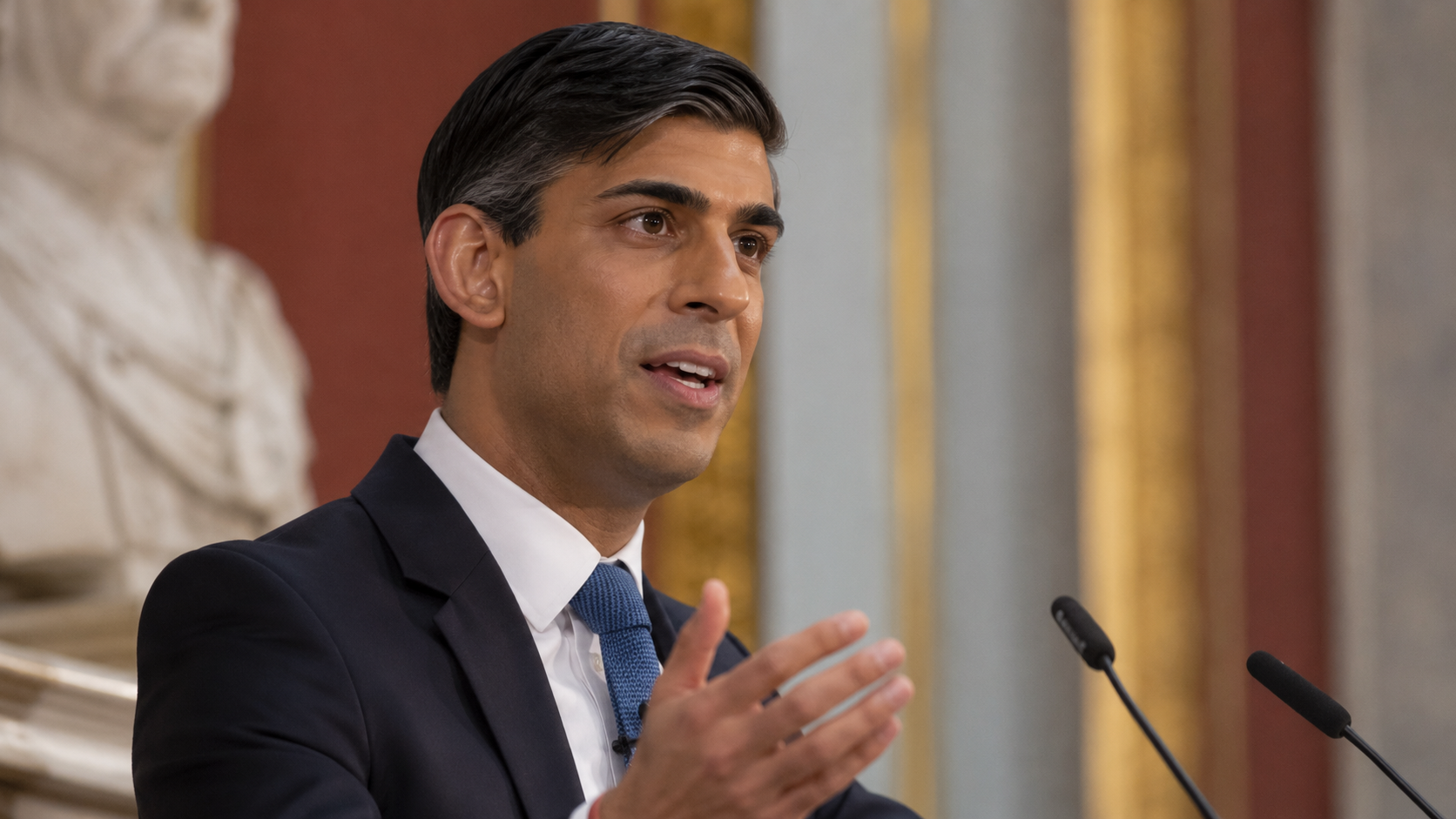
“AI will bring new knowledge, new opportunities for economic growth, new advances in human capability.”
Rishi Sunak delivered this line at the Royal Society in October 2023 while setting out the United Kingdom’s approach to advanced artificial intelligence. His speech was openly optimistic: he compared AI’s possible reach with the industrial revolution, electricity, and the internet. Yet the address was not a product launch. It prepared the ground for the Bletchley Park AI Safety Summit and argued that governments had to discuss severe risks without surrendering the benefits. The quotation belongs to that balanced frame, where capability and caution are presented as parallel responsibilities rather than competing slogans.
The three promises in the sentence are distinct. New knowledge points to scientific discovery, from interpreting medical images to modeling complex systems. Economic growth concerns productivity, new firms, and tools that let workers complete valuable tasks more efficiently. Advances in human capability describe augmentation: translation, accessibility, tutoring, analysis, and creative support that may help people do things previously beyond their time or expertise. Keeping these categories separate matters because a system can perform impressively in one area while creating little broad benefit in another. Social value must be demonstrated, not inferred from technical novelty.
Sunak’s surrounding remarks also supplied the limitation. Transformative technologies create dangers as well as opportunities, and public confidence cannot rest on reassurance alone. Developers need evaluations that reveal dangerous capabilities, organizations need controls suited to real use, and governments need enough technical capacity to challenge private claims. A safety process should not become theater that treats every speculative scenario as equally likely. It should identify plausible harms, measure them where possible, and connect each risk to a person or institution with authority to act before deployment and after failures occur.
The quote remains useful because it resists two easy stories: that AI progress will automatically improve life, or that fear requires stopping every experiment. Knowledge becomes valuable when it is reliable and shared. Growth matters when gains reach workers and communities instead of accumulating only around scarce infrastructure. Capability expands when people retain agency, skills, and meaningful choices. The speech’s durable standard is therefore practical optimism. Ambition earns trust when it is accompanied by evidence, honest disclosure, independent scrutiny, and rules strong enough to keep opportunity from becoming an excuse for preventable harm. For citizens and institutions, the useful question is not whether AI is simply good or bad. It is which applications create demonstrable public value, which safeguards match their stakes, and who remains answerable when a confident prediction becomes a consequential mistake.
Sunak delivered the speech on October 26, 2023, days before the Bletchley Park AI Safety Summit.
The address framed Britain’s policy as an effort to pursue benefits while examining frontier risks directly.
Knowledge, economic growth, and human capability describe different outcomes that should be measured separately.
A powerful demonstration does not by itself prove scientific reliability, broad prosperity, or meaningful human empowerment.
Safe adoption requires evaluation, public expertise, clear accountability, and the ability to intervene when evidence changes.
The quote is strongest when opportunity is treated as a responsibility to build benefits that can be verified and shared.
Explore more "Quotes of The Day"
Continue exploring how writers, thinkers, artists, and advocates have described the choices that shape an everyday life.