

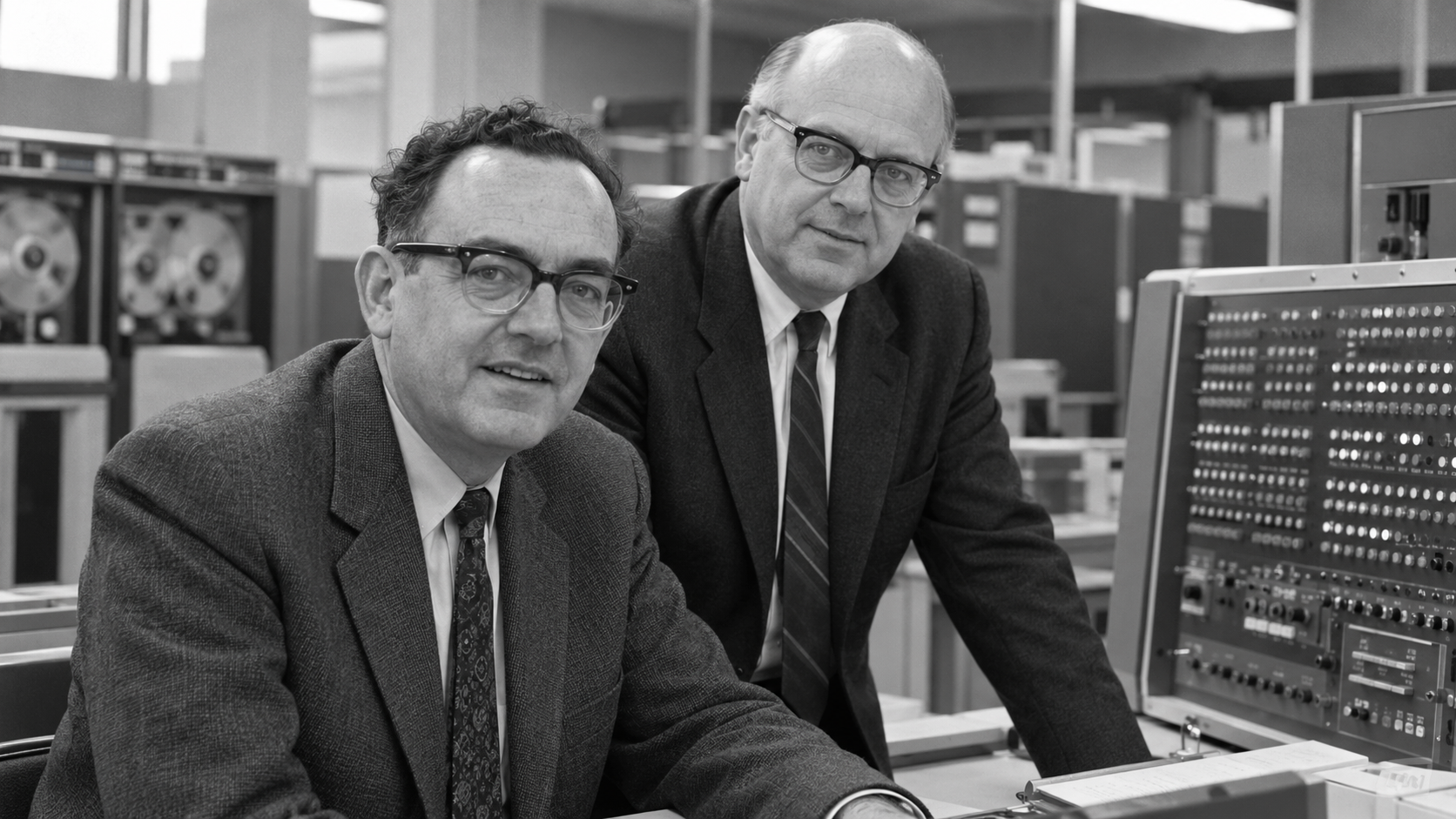
“There are now in the world machines that think, that learn and that create.”
Herbert Simon and Allen Newell used this declaration in 1958, during the formative years of artificial intelligence. Their programs had shown that computers could search through symbolic possibilities and produce proofs or solutions that looked like aspects of reasoning. The Logic Theorist, developed with J. C. Shaw, proved mathematical theorems; the General Problem Solver pursued a broader account of goal-directed problem solving. At a time when computers were commonly understood as numerical calculators, describing them as thinking, learning, and creating was a bold attempt to redraw the boundary of computation.
The claim reflected a particular model of intelligence. Newell and Simon emphasized symbols, rules, goals, and search through a space of possible actions. If reasoning could be described as manipulating structured representations, a machine might reproduce important parts of it. This approach produced foundational ideas in computer science and cognitive psychology. It also exposed the difficulty of the project. Problems that look manageable in a small demonstration can generate enormous search spaces, and the background knowledge people use effortlessly is hard to encode as a complete set of rules.
Later AI research added statistical learning, neural networks, probabilistic inference, large datasets, and new hardware. Modern systems may create fluent text or images without following the symbolic methods early researchers expected. Yet the original questions remain. What counts as learning: improved performance, an internal representation, or understanding? What counts as creation: a novel arrangement, an intentional act, or work that has meaning for a community? The answers influence how much credit, authority, and legal responsibility people are willing to assign to machines.
Historical confidence should be read in context. Early AI produced genuine achievements, but forecasts about rapid general intelligence underestimated the complexity of everyday perception, knowledge, and social interaction. That pattern still matters when a striking demonstration is treated as proof of a fully autonomous mind. Simon and Newell’s quote is valuable precisely because it invites argument. It asks readers to define the verbs rather than accept them as metaphors. Careful definitions allow society to celebrate technical progress without confusing performance with personhood. Their sentence survives as a reminder that every era names machine intelligence through its newest accomplishments. The productive response is neither ridicule nor awe, but precise examination of what the system represents, how it learns, and where human responsibility remains. Historical perspective keeps bold claims open to testing without denying the achievements that inspired them. Definitions still matter.
Simon, Newell, and J. C. Shaw built programs that proved theorems and searched symbolically for solutions.
Their work challenged the assumption that computers could only perform straightforward numerical calculation.
Early systems represented goals, rules, and possible actions, then searched for a path to a solution.
The approach was foundational but struggled with huge search spaces and the background knowledge of ordinary life.
Learning, thinking, and creating can refer to observable performance or to stronger claims about understanding and intent.
Clear definitions keep technical achievement from being confused with personhood, agency, or moral responsibility.
Explore more "Quotes of The Day"
Continue exploring how writers, thinkers, artists, and advocates have described the choices that shape an everyday life.