

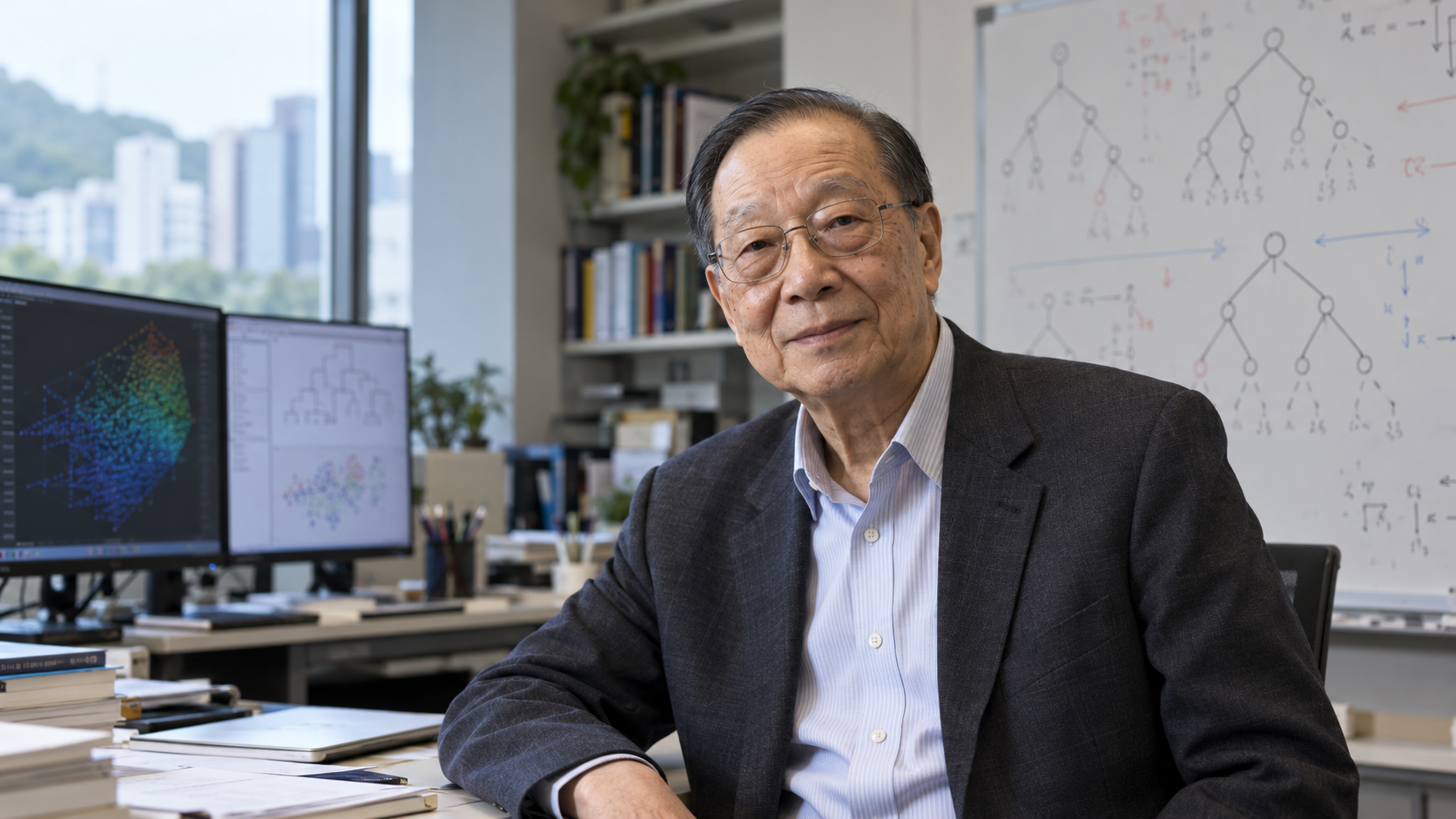
“The essence of the method is to build multiple trees in randomly selected subspaces of the feature space.”
Tin Kam Ho proposed random decision forests by training multiple trees on different randomly selected feature subspaces. A single decision tree can fit quirks in its data and change sharply after a small perturbation. A collection of trees becomes useful when their errors are not identical. By injecting diversity into the views each tree receives and combining their votes, the method can produce more stable classification. Read carefully, the quote records an engineering choice and an invitation to reproduce the result, rather than a universal claim about intelligence.
The insight is collective rather than individual. Each tree is intentionally limited, but the ensemble can integrate many partial perspectives. Random subspaces reduce correlation among the component models, allowing majority decisions to cancel some mistakes. This principle—combine diverse learners whose errors differ—became a foundation of ensemble methods. Performance depends not only on the strength of each member, but also on the relationships among their failures. The distinction is useful today: a mechanism may be powerful without being appropriate for every task, institution, or group of people affected by it.
Tree ensembles remain strong for structured tables used in finance, operations, science, and public administration. They can model nonlinear interactions with less preprocessing than many alternatives and provide useful baselines. Practitioners should evaluate calibration, subgroup behavior, and stability across time, not just headline accuracy. Tools that summarize feature importance can help investigation, though they should not be mistaken for a complete causal explanation of any individual decision. Modern practitioners can carry the idea forward through staged testing, independent evaluation, representative data, and direct feedback from people who experience the system’s consequences.
An ensemble can be robust statistically while remaining opaque institutionally. Hundreds of trees may make it difficult to explain why a person received a consequential outcome. Randomization also does not repair biased labels or missing groups. Organizations need reason codes grounded in the actual process, human review, appeals, and checks that the forest’s aggregate strength does not conceal concentrated harm. The best response is disciplined adoption: verify the benefit, disclose the limitation, protect the people carrying the risk, and preserve a path for correction. Ho’s formulation showed that deliberately varied models can succeed together. The same idea suggests a governance lesson: look for correlated failures before trusting a collective verdict. Returning to the source helps keep the achievement precise—and precision is the beginning of trustworthy engineering, communication, and governance. Keeping method, evidence, and consequence together gives the quote lasting value while protecting it from claims that exceed what the original work was designed to establish.
Individual decision trees are flexible but can be unstable and sensitive to details of the training sample.
Combining multiple trees can average away some of that variance and improve generalization.
Each tree receives a different subset of available features, encouraging diversity among its decisions.
The ensemble benefits when those varied perspectives make errors that are not perfectly correlated.
A statistically stable forest can still learn biased targets or produce uneven errors across groups.
Consequential use needs subgroup testing, defensible explanations, human review, and a meaningful appeal path.
Explore more "Quotes of The Day"
Continue exploring how writers, thinkers, artists, and advocates have described the choices that shape an everyday life.