

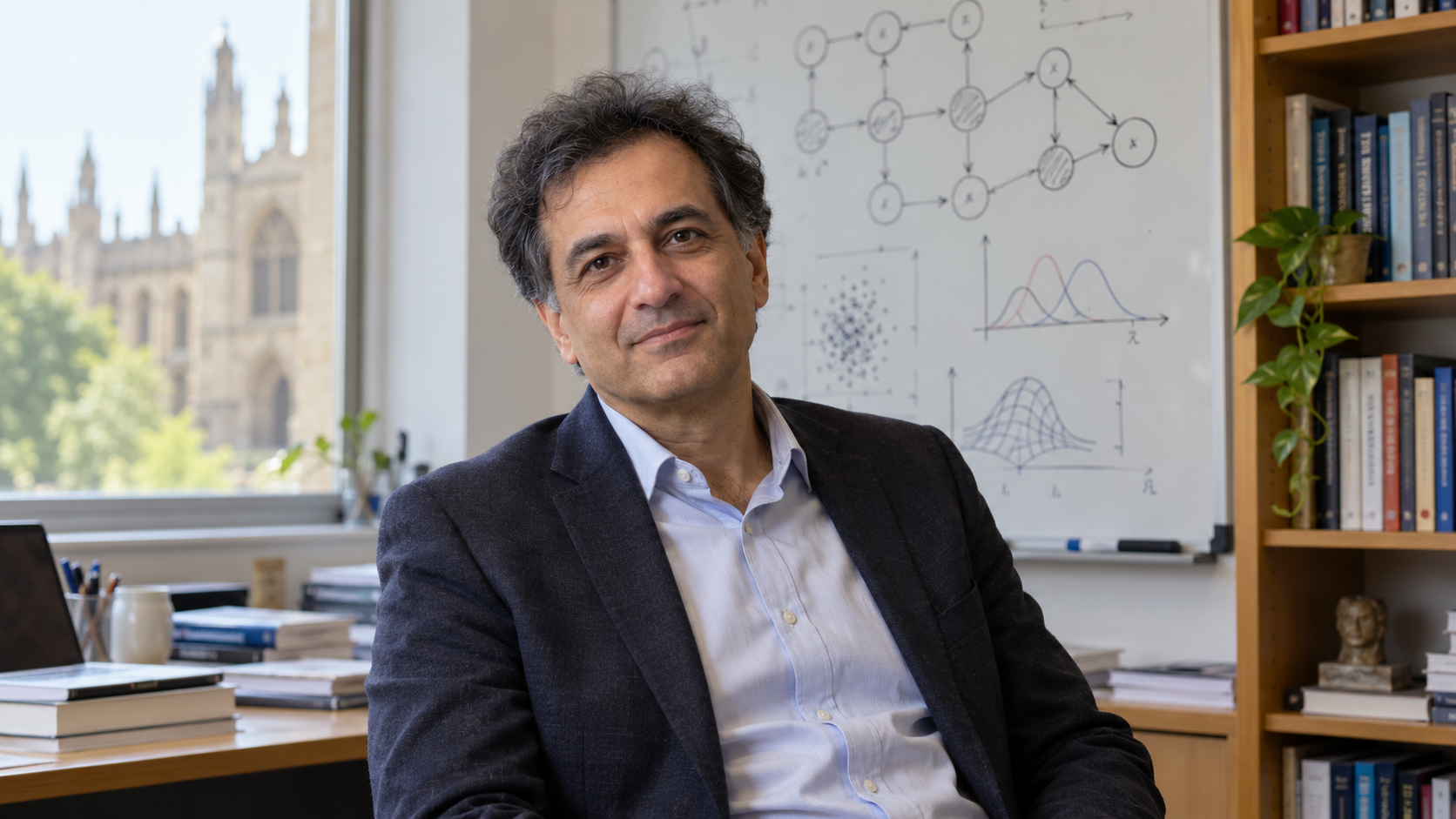
“How can a machine learn from experience?”
Zoubin Ghahramani used this question to introduce a broad account of probabilistic machine learning. Learning from experience means drawing conclusions from limited, noisy observations while acknowledging that several explanations may fit. Probability provides a language for representing those alternatives, updating beliefs as evidence arrives, and making predictions that carry uncertainty rather than presenting every answer as equally certain. Placed back in its source, the sentence reads as a testable research claim, not a prediction that every related problem has been solved.
The probabilistic perspective treats unknown quantities explicitly. A model combines assumptions with observations to produce a distribution over possible explanations or outcomes. That distribution can guide decisions, identify where more data would help, and reveal when evidence is weak. The approach does not eliminate assumptions; it makes many of them visible through priors, likelihoods, and model structure so they can be examined. This also shows why benchmark performance and real-world value are different questions. Each depends on assumptions that must be made visible before trust is earned.
Uncertainty is essential in scientific discovery, medicine, forecasting, robotics, and active learning. Modern neural systems can incorporate Bayesian approximations, ensembles, conformal methods, or calibrated probabilities, although no technique guarantees reliable uncertainty everywhere. Teams should test whether confidence tracks error under the actual conditions of use and should distinguish uncertainty caused by limited data from ambiguity that the model structure cannot capture. Organizations should pair technical measures with outcome measures: who benefits, who absorbs errors, how quickly failures are detected, and whether a workable appeal process exists.
A numerical probability can look more authoritative than it is. Poorly specified models, shifted data, and unobserved factors may produce precise but misleading estimates. Decision-makers also bring values to questions such as which risks matter and how uncertainty should affect action. Responsible use communicates assumptions, validates calibration, and creates conservative procedures for cases where the model recognizes—or fails to recognize—that it does not know. Teams should be ready to learn from failure. Clear incident reporting, redress, and periodic reassessment turn responsible use from a promise into an operating practice. Ghahramani’s question keeps AI grounded in evidence. Learning is not merely producing an answer; it is updating a view of the world while remaining honest about uncertainty. That balance allows the field to honor a real breakthrough without turning it into a shortcut around evidence, oversight, or human judgment. The research becomes more valuable when later users preserve its conditions, test competing explanations, and connect technical performance to the outcomes people actually experience.
Probabilistic models represent multiple possible explanations and update their relative support when evidence changes.
This makes uncertainty part of the model output rather than an afterthought.
Some uncertainty comes from limited observations, while other uncertainty reflects ambiguity or a model that omits important structure.
Useful systems try to distinguish these sources and test how confidence behaves in practice.
A probability is valuable only when it corresponds reasonably to observed error under relevant conditions.
Shift testing, conservative escalation, transparent assumptions, and human judgment are vital in high-stakes decisions.
Explore more "Quotes of The Day"
Continue exploring how writers, thinkers, artists, and advocates have described the choices that shape an everyday life.