

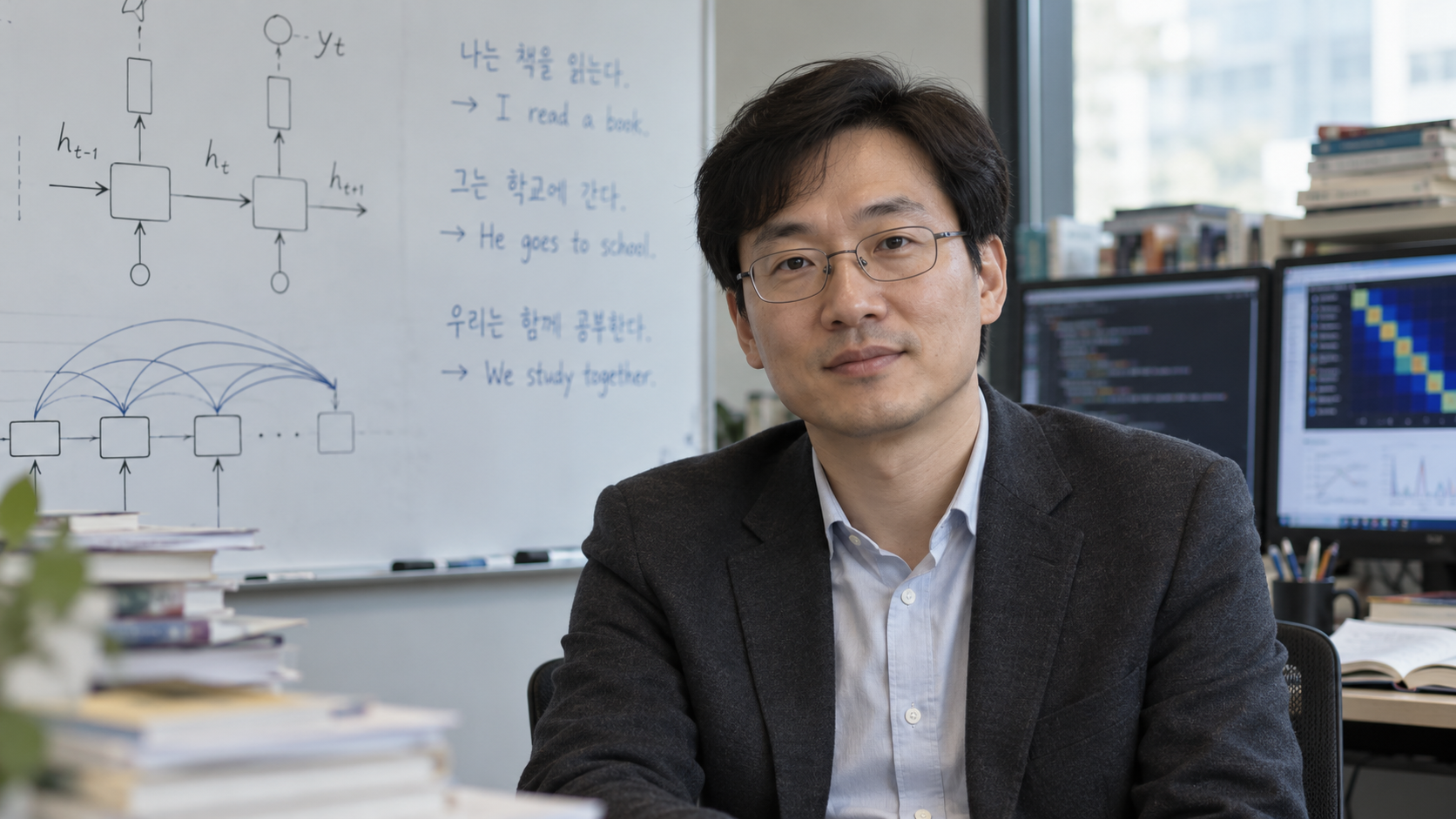
“In this paper, we propose a novel neural network model called RNN Encoder-Decoder that consists of two recurrent neural networks.”
Kyunghyun Cho and colleagues proposed an RNN Encoder-Decoder to learn mappings between variable-length symbol sequences. One recurrent network encoded a source phrase into a continuous representation, and another decoded it into a target phrase. The paper also introduced a gated hidden unit later known as the gated recurrent unit, or GRU, which controlled how information was updated and retained over time. The original wording matters because it fixes the claim to a particular experiment, method, and moment instead of the larger mythology that later formed around it.
The design learns a continuous space in which phrases with similar meanings can occupy nearby regions, helping the model score translation candidates beyond surface counts. GRU gates balance new evidence against stored state with fewer components than LSTM. Together, these ideas demonstrated that learned sequence representations could complement established statistical translation systems and provided building blocks for end-to-end neural approaches. Separating the method from the marketing makes the insight stronger, because readers can see exactly which capability improved and which judgments remain human responsibilities.
GRUs remain useful for time series, speech, embedded systems, and datasets where a compact recurrent model is appropriate. Encoder-decoder representations also laid groundwork for modern generative systems. Choosing among recurrence, convolution, and attention should depend on latency, sequence length, data, and hardware rather than fashion. Teams should benchmark the simplest architecture that satisfies accuracy and operational requirements. The practical test is not whether a demonstration looks impressive, but whether the approach remains reliable under ordinary constraints, unusual cases, and changing environments.
A continuous representation can smooth over rare words, minority language forms, and distinctions that matter culturally or legally. Translation data reflect whose language was digitized and whose usage was treated as standard. Developers should work with native speakers, preserve source visibility, evaluate names and terminology, and create escalation paths. Compression is useful only when essential meaning survives it. Technical success is incomplete when costs are hidden or errors fall disproportionately on people with the least power to contest them. Governance belongs in the design. The RNN Encoder-Decoder showed that phrases and sequences could be learned as adaptable representations. Its enduring challenge is to preserve meaning while simplifying structure enough for computation. Its legacy is most useful as a standard for careful inquiry: build boldly, measure honestly, and keep the people affected by the system in view. Readers can apply that standard by asking which evidence supports the claim, which conditions bound it, and who remains accountable when a system behaves differently in practice.
The encoder turns a source sequence into a learned representation, and the decoder produces a target sequence from it.
Both components are trained together to improve the probability of appropriate sequence pairs.
Gated recurrent units learn how much prior state to retain and how much new information to incorporate.
Their compact design can model temporal dependencies with fewer gates than an LSTM.
Learned representations may underperform on rare forms, names, dialects, and low-resource languages.
Native-speaker evaluation, terminology checks, source access, and correction channels protect meaning in deployment.
Explore more "Quotes of The Day"
Continue exploring how writers, thinkers, artists, and advocates have described the choices that shape an everyday life.