

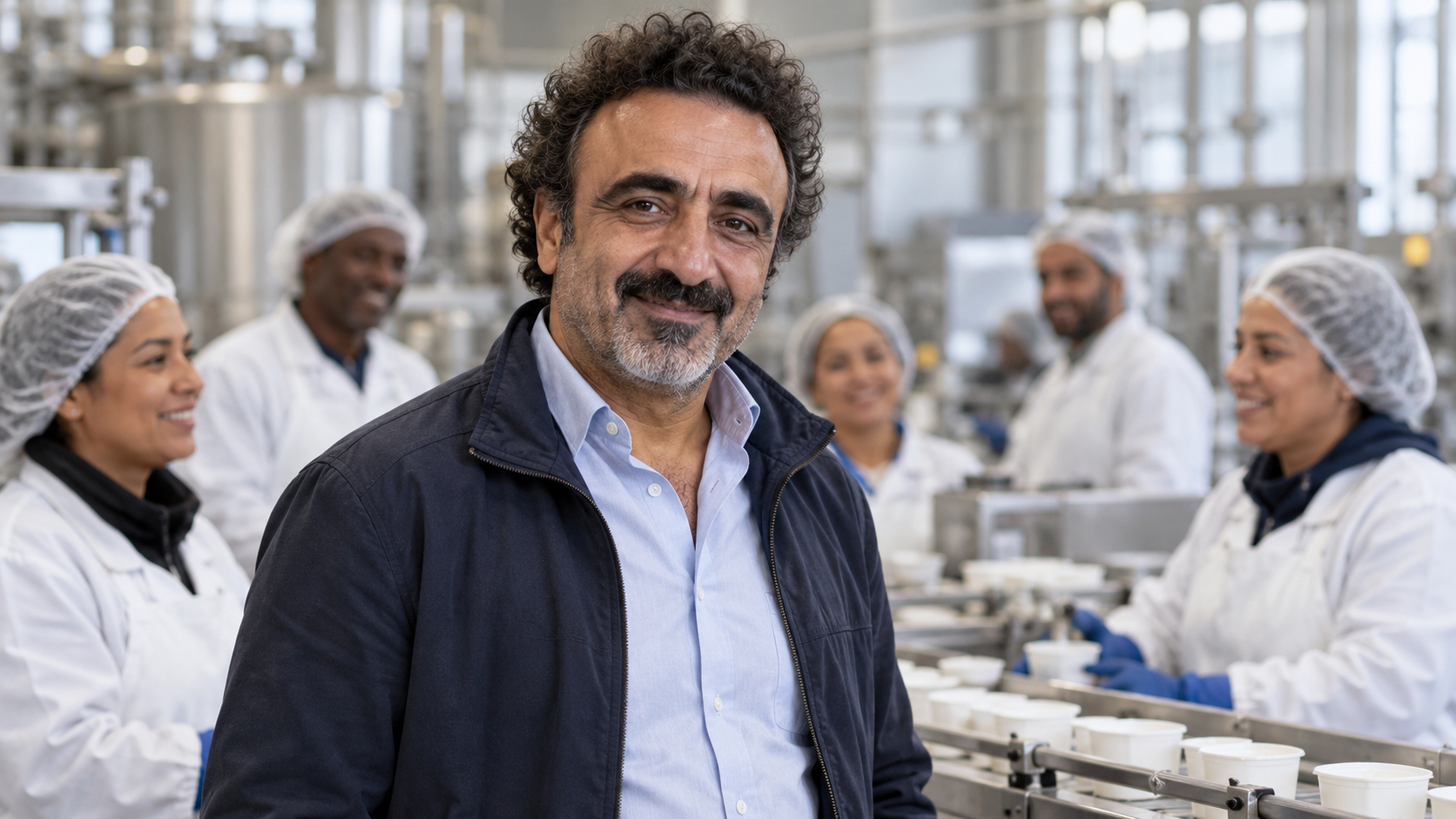
“The truth is: business should take care of employees first.”
Hamdi Ulukaya presented this principle in his 2019 TED talk, “The anti-CEO playbook.” After buying a closed yogurt plant in upstate New York, he rehired former workers and built Chobani with an emphasis on employees, local communities, customers, and social responsibility. Ulukaya rejected the idea that a company exists only to maximize shareholder wealth. His first rule was gratitude expressed through how the business treats the people whose daily work makes the product possible.
Taking care of employees becomes concrete in pay, benefits, safety, predictable schedules, parental leave, participation, and the chance to share in success. It also includes seeing capability where conventional hiring systems see risk. Chobani became known for employing refugees and immigrants alongside local workers, addressing transportation and language barriers rather than treating them as disqualifying. People-first practice changes the operating system; it is not a perk layered over an unchanged model.
The phrase should not suggest that every preference can be satisfied or that good intentions remove difficult decisions. A viable company still needs quality, productivity, accountability, and adaptation. Employee care can become paternalistic if leaders decide what people need without listening or worker voice. The strongest version combines fair conditions with agency, transparent constraints, and mechanisms through which employees influence decisions that affect their work.
The lesson matters as companies compete for talent while automating and restructuring. A workforce that is treated as a disposable expense may comply for a time but withhold the knowledge and commitment required for improvement. Leaders can test whether investments in people are classified only as costs, whether frontline workers share in gains, and whether community commitments survive expansion. Ulukaya’s anti-CEO framing is intentionally disruptive: begin the business equation with the people doing the work, then build customer and financial performance from that foundation. A people-first dashboard can combine pay and safety with mobility, schedule stability, retention, participation, and the share of improvement ideas adopted from frontline teams. Qualitative evidence matters too: do employees believe they can raise a problem, understand how decisions are made, and see a future inside or beyond the company? These measures expose whether gratitude is structural or ceremonial. Ulukaya’s principle becomes economically serious when leaders connect employee conditions with quality, innovation, customer trust, and community health, then treat improvement in those conditions as core operating work rather than discretionary generosity. Care becomes strategic when it improves both human capability and durable long-term operating resilience together.
Ulukaya stated the principle in his TED2019 talk “The anti-CEO playbook.”
He connected Chobani’s growth with employee care, community partnership, customer accountability, and corporate responsibility.
People-first business becomes real through pay, safety, benefits, participation, opportunity, and a share in success.
Care should include worker voice and transparent accountability rather than paternalism or avoidance of difficult choices.
Automation and restructuring can turn employees into short-term cost categories while increasing dependence on their judgment.
Investing in agency and fair conditions builds the knowledge, trust, and commitment that operational improvement requires.
Explore more "Quotes of The Day"
Discover more notable quotes from influential voices across politics, science, business, technology, sports, and culture. Each quote offers insight into how ideas, beliefs, and decisions shape the world around us.