

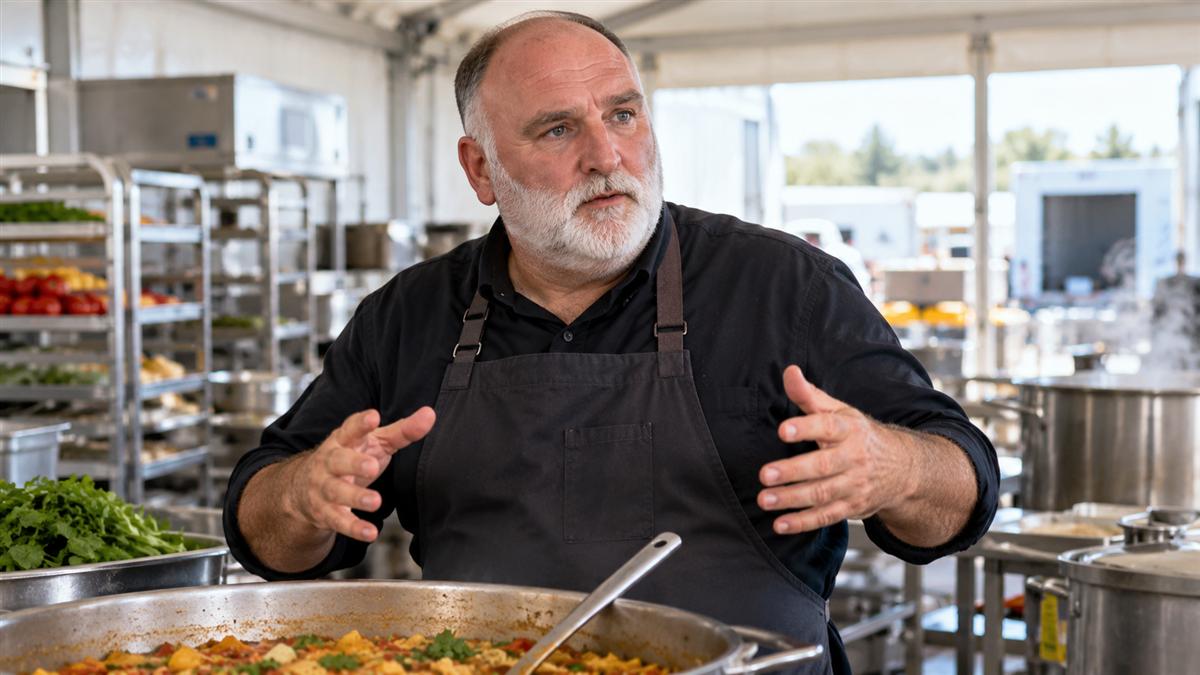
“A world where food is the solution, not the problem.”
José Andrés used this vision in his 2021 Princess of Asturias Award address with World Central Kitchen. His disaster-response work treats food as immediate relief and as a way to activate local cooks, suppliers, knowledge, and dignity during a crisis. Food sits at the intersection of health, jobs, agriculture, climate, culture, and community. Seeing it as a solution changes the operating question from how to move a standard commodity into a disaster to how existing local capacity can begin serving people quickly. Behind the concise wording is a claim about how organizations create results. It encourages leaders to look beyond individual effort and examine design, incentives, information, relationships, and the customer context that determine whether a good intention becomes reliable performance.
Response organizations can prepare relationships before emergencies, purchase locally when conditions permit, simplify authorization, and give frontline teams clear decision rights. Real-time information about need, supply, safety, and delivery should guide adaptation rather than a distant fixed plan. Managers can translate the claim into a small experiment with a baseline, an owner, a defined customer or employee outcome, and a review date. Specificity protects the work from drifting into broad language that nobody can challenge or verify.
Speed does not remove obligations for food safety, worker protection, financial controls, or coordination with public agencies. Heroic stories can obscure the local organizations that sustain recovery. Effective relief should strengthen rather than displace community capability. Responsible use also requires naming the tradeoff. Speed, cost, autonomy, safety, equity, and learning may not all improve at once. People closest to the consequences should have a meaningful voice, and uncertainty should be reported instead of hidden behind confidence.
Climate shocks and conflict are increasing demands on food systems while digital tools improve mapping, payments, and logistics. Technology is valuable when it helps trusted local networks act faster and keeps affected people visible as participants rather than anonymous recipients. A resilience plan can identify the kitchens, suppliers, community groups, and decision rules that could turn local food capacity into dignified service during the first days of disruption. Evidence from the experiment can guide scaling, revision, or stopping. The durable lesson is to join purpose with measurement and human judgment, so the organization becomes better at seeing reality and responding before a local success or failure hardens into mythology. Recording the decision and its limits gives colleagues a foundation they can inspect, challenge, and improve instead of asking them to rely on memory, authority, or an unexplained result.
José Andrés used this vision in his 2021 Princess of Asturias Award address with World Central Kitchen. His disaster-response work treats food as immediate relief and as a way to activate local cooks, suppliers, knowledge, and dignity during a crisis.
Food sits at the intersection of health, jobs, agriculture, climate, culture, and community. Seeing it as a solution changes the operating question from how to move a standard commodity into a disaster to how existing local capacity can begin serving people quickly.
Response organizations can prepare relationships before emergencies, purchase locally when conditions permit, simplify authorization, and give frontline teams clear decision rights. Real-time information about need, supply, safety, and delivery should guide adaptation rather than a distant fixed plan.
Speed does not remove obligations for food safety, worker protection, financial controls, or coordination with public agencies. Heroic stories can obscure the local organizations that sustain recovery. Effective relief should strengthen rather than displace community capability.
Climate shocks and conflict are increasing demands on food systems while digital tools improve mapping, payments, and logistics. Technology is valuable when it helps trusted local networks act faster and keeps affected people visible as participants rather than anonymous recipients.
A resilience plan can identify the kitchens, suppliers, community groups, and decision rules that could turn local food capacity into dignified service during the first days of disruption.
Explore more "Quotes of The Day"
Discover more notable quotes from influential voices across politics, science, business, technology, sports, and culture. Each quote offers insight into how ideas, beliefs, and decisions shape the world around us.