

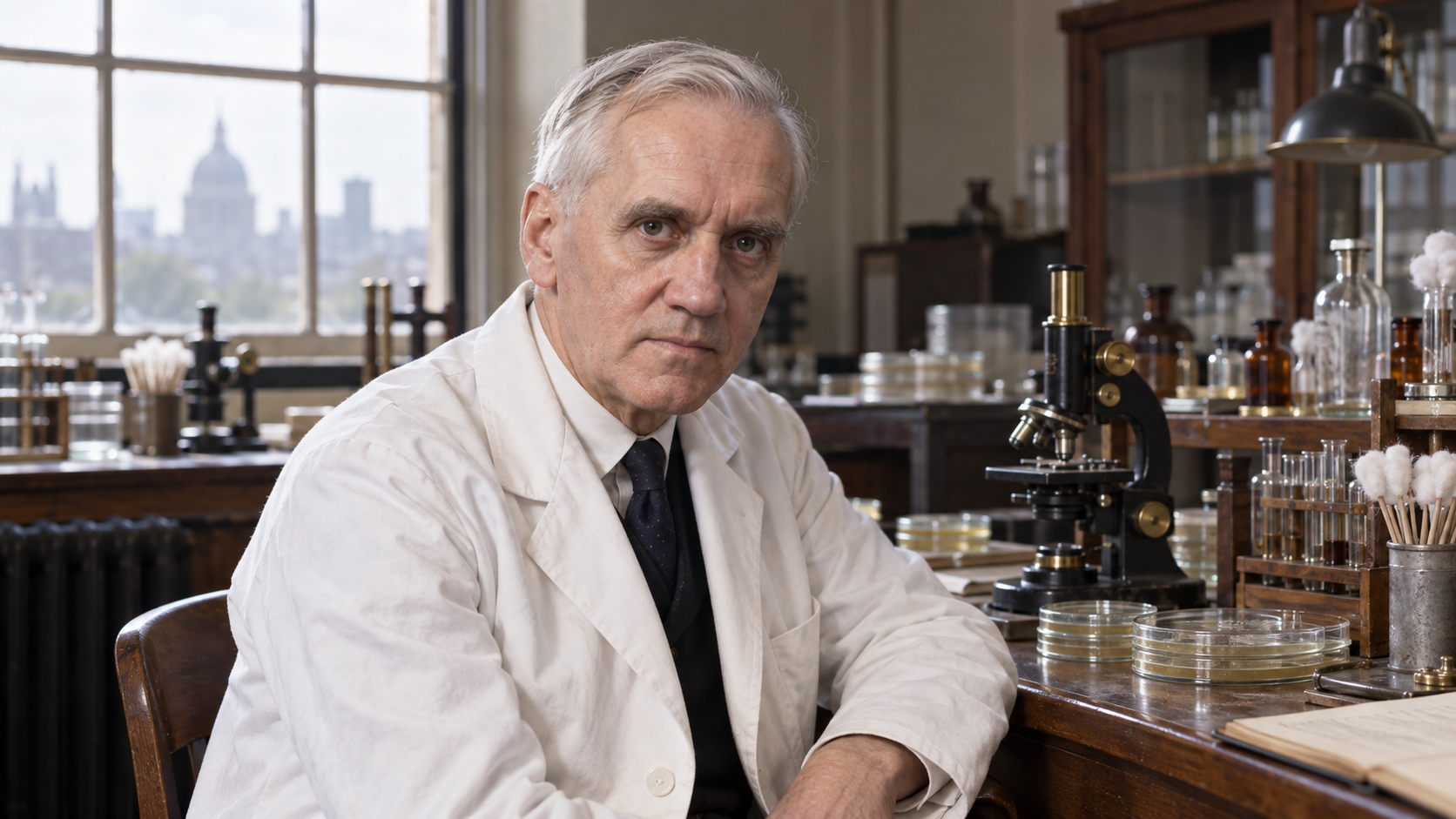
“The time may come when penicillin can be bought by anyone in the shops.”
Alexander Fleming included this prediction near the end of his Nobel lecture on December 11, 1945. Having described the observations that led him to study penicillin, he turned to what might happen once a powerful antibacterial medicine became widely obtainable. The sentence sounds like a forecast of convenience until the surrounding passage is restored. Fleming immediately warns that careless self-treatment could expose microbes to amounts that fail to kill them and allow resistant organisms to emerge. He then constructs a hypothetical household in which an inadequately treated infection passes to another person, for whom penicillin no longer succeeds. His example is a warning, rather than a report of an actual patient. The quotation therefore belongs to a discussion of responsibility at the moment of a celebrated scientific advance, not to an endorsement of purchasing antibiotics without clinical guidance.
The lecture also puts discovery within a longer chain of work. Fleming observed the effect of a contaminating mould on a bacterial culture in 1928, investigated its properties, and described difficulties concentrating and stabilizing the substance. At the close of his lecture, he handed the story to Howard Florey, whose work with Ernst Chain and other colleagues helped develop penicillin as a usable medicine. Fleming, Florey, and Chain shared the 1945 Nobel Prize in Physiology or Medicine. That collective history complicates a familiar picture of a solitary discovery instantly transforming care. Production, testing, and delivery were necessary before the observation could benefit patients at scale. Chemical & Engineering News later recounted both that development and Fleming’s warning. Read against that history, the sentence joins two questions that cannot be answered by a laboratory breakthrough alone: who can obtain an effective medicine, and what arrangements help keep it effective?
Its present relevance lies in the relationship between access and appropriate use. The World Health Organization describes antimicrobial resistance as a problem involving drug-resistant pathogens, misuse and overuse of medicines, and gaps in access to suitable diagnostics, prevention, and treatment. That account is wider than Fleming’s single imagined household. It includes institutions and infrastructure, rather than placing the entire burden on an individual patient. His historical wording can still prompt reflection on how a successful treatment becomes a shared resource whose usefulness needs protection. It should not be converted into a modern dosing rule: suitable medicines and treatment durations depend on the infection and clinical assessment. The March entry commemorates the quotation as an idea, rather than implying a March anniversary for the lecture. What remains striking is that Fleming used a moment of recognition to discuss the conditions under which his celebrated discovery might fail.
Fleming spoke these words in his Nobel lecture on December 11, 1945. The next sentences warn about resistance following inappropriate exposure of microbes to penicillin.
The household story that follows is explicitly hypothetical. The sentence about shops is part of a caution about self-treatment, rather than a recommendation for unrestricted purchase.
Fleming’s original observation did not by itself produce a medicine ready for widespread clinical use. Florey, Chain, and their collaborators helped carry the development forward.
The three scientists shared the 1945 medicine Nobel Prize. The lecture recognizes the distinction between finding an antibacterial effect and making that finding useful to patients.
Modern discussions consider access to appropriate medicines alongside their careful use, infection prevention, and diagnostic capacity. Resistant pathogens can affect people beyond the person who first received a drug.
The 1945 lecture is historical evidence of an early warning. Decisions about a present infection require current clinical evidence and individual assessment, rather than a dosing slogan taken from that speech.
Explore more "Quotes of The Day"
Discover more notable quotes from influential voices across politics, science, business, technology, sports, and culture. Each quote offers insight into how ideas, beliefs, and decisions shape the world around us.